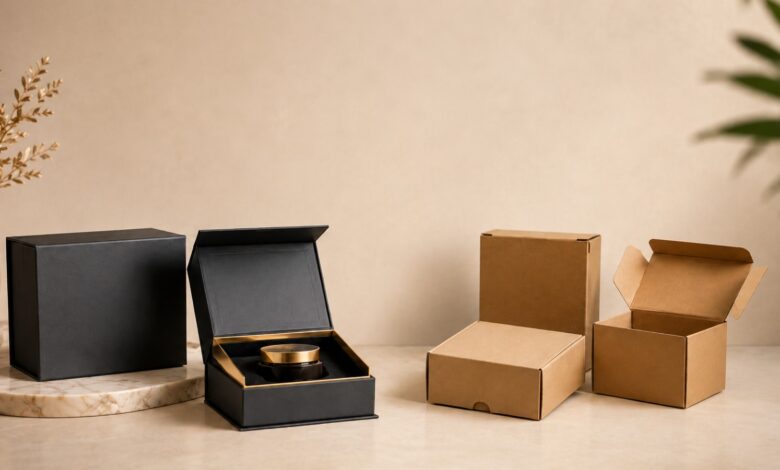
Premium brands are choosing rigid boxes because packaging now plays a bigger role than simply holding a product. It protects the item, supports the price point, shapes the customer’s first impression, and helps the brand feel more valuable before the product is even used.
This is why many premium product brands are moving from standard boxes to rigid boxes. The shift is not only about looking expensive. It is about creating a stronger brand experience, improving product protection, supporting higher perceived value, and making packaging feel intentional rather than ordinary.
In this blog, we will explore why premium brands are moving beyond standard packaging, what makes them valuable for retail and e-commerce, and when they are worth the added investment.
Rigid boxes have become a preferred choice for beauty products, jewelry, watches, candles, electronics, gift sets, perfumes, premium apparel, and presentations. Standard boxes still have their place, especially for lower-cost products, lightweight items, and high-volume shipping. But when brands want their packaging to communicate quality, rigid boxes make more business sense.
Why Premium Brands Are Moving Beyond Standard Boxes
Premium brands are moving away from standard boxes because ordinary packaging fails to justify higher price points. A standard folding carton may be practical, lightweight, and cost-effective, but it hardly creates a sense of value that customers expect from a premium product.
Custom rigid boxes solve this problem effectively by combining protection, presentation, and brand experience into a single structure. They are made from thick paperboard or chipboard, which gives them a firm shape and a more meaningful feel in the customer’s hands. Different from folding cartons, rigid boxes do not collapse flat, so they feel stronger and more refined from the first touch.
This matters because present-day customers notice details. They judge the product through the weight of the box, the way it opens and closes, the print quality, in short, how it is presented. Since a rigid box is solid, the product feels thoughtfully made, more giftable, and aligned with a premium brand promise.
Rigid Boxes Vs. Standard Packaging: A Direct Comparison
| Factor | Rigid Boxes | Standard Packaging |
| Structure | Made with thick paperboard or chipboard that holds its shape | Made from lighter paperboard, cardboard, or corrugated material |
| Presentation | Creates a premium, polished, and gift ready look | More practical and basic in appearance |
| Product Protection | Offer stronger resistance against bending, crushing, and handling damage | Provides basis protection, depending on material and thickness |
| Customer experience | Supports a more memorable unboxing experience | Focuses more on storage, shipping, or simple retail display |
| Brand Perception | Helps products feel more valuable and high-end | Works well for everyday products but may not support premium positioning |
| Customization | Allows advanced finishes, inserts, magnetic closures, textured wraps and luxury details | Can be printed and customized, but with fewer structural options |
| Storage Efficiency | Due to their non folding nature, they take more storage space | Easier to store and ship flat in bulk |
| Cost | Higher production cost, but stronger impact for premium products | More cost-effective for high-volume and budget-sensitive products |
| Best Use Cases | Luxury good, cosmetics, jewelry, candles, electronics, gift sets, and limited editions | Every retail product, lightweight goods, food items, shipping boxes, and |
| Business Value | Supports premium pricing, brand trust, and repeat customer experience | Support practicality, affordability, and operational efficiency |
Rigid Boxes Help Increase Perceived Value
Premium pricing depends on trust. When customers pay more, they expect every touchpoint to feel carefully planned.
A rigid box adds weight, structure, and polish. It shows that the brand has invested in the product experience, not just the product itself. This makes customers confident about their purchase.
You may think of it like a luxury candle in a standard box, which may smell good but does not look luxurious. Whereas the same candle in a rigid box transforms the whole value of the candle.
If you are comparing premium packaging options, checking real examples of rigid boxes can help you see how structure, printing, inserts, and finishes work together to protect your products and strengthen brand image.
Better Protection For High-Value Products
Premium products are mostly delicate, expensive, and more presentation-sensitive than other standard products. A damaged box can make the product feel less valuable, even if the item inside is still usable.
Rigid boxes provide stronger protection because their thick board resists bending, crushing, and corner damage better than many standard folding cartons. They can also be designed with inserts, trays, foam, molded pulp, or paperboard dividers to hold the product safely.
It is more important for e-commerce. Premium products have to pass through warehouses, couriers, and multiple handling points before reaching the customer. A rigid box gives the brand a better chance of preserving presentation from dispatch to delivery.
The Unboxing Experience Matters More Than Before
Unboxing has become a serious brand touchpoint. Customers remember how a product arrives, how the box opens, how the product is placed inside, and whether the experience feels special or routine.
Rigid boxes make unboxing more controlled. A magnetic closure, lift-off lid, drawer box, ribbon pull, or book-style opening can slow the moment and make it more premium. The customer does not simply open a package. They experience a reveal.
This matters because premium products are bought for emotional reasons, and rigid packaging supports that emotional layer.
Stronger Shelf Presence in Retail
In retail, packaging has to win attention quickly. Customers compare products in seconds. A rigid box can make a product look more credible and premium on the shelf.
Because rigid boxes hold their shape, they often look cleaner in display environments. They are less likely to crease or look damaged after handling. This is useful for boutiques, cosmetic counters, gift shops, jewelry stores, and premium retail shelves.
Retailers also prefer packaging that displays well and reduces visible damage. A strong box helps protect the product while improving presentation.
Sustainability Plays a Supporting Role
Premium product brands are paying more attention to sustainability, and it also influences their packaging choices. Customers still expect a high-end experience, but they also prefer brands that avoid unnecessary waste.
Rigid boxes support this shift better than standard boxes when used thoughtfully. They allow brands to choose recyclable paperboard, responsibly sourced materials, plastic-free inserts, molded pulp trays, and simpler finishes, while still maintaining a premium feel.
At the same time, rigid boxes offer better control over design and structure, which helps reduce unnecessary packaging layers, mostly seen in standard boxes. This makes them a stronger choice for brands that want to balance premium presentation with more responsible packaging decisions.
When Should Brands Choose Rigid Boxes?
A brand should consider rigid boxes when the product is premium, fragile, giftable, high-margin, or experience-driven. They are also useful when the packaging needs to support retail display, influencer presentation, e-commerce unboxing, or luxury positioning.
Rigid boxes are a strong fit for cosmetics, perfumes, watches, jewelry, candles, electronics, gourmet gift sets, apparel kits, subscription boxes, and limited-edition launches. In these categories, the box often becomes part of the customer’s judgment of quality.
Standard boxes still make sense when practicality matters more than presentation. In that case, choose the format that best matches the product, customer, and brand promise.
Final Words
Premium brands are choosing rigid boxes because customer expectations have changed. Packaging now has to protect, present, persuade, and reinforce trust.
Rigid boxes offer stronger structure, better presentation, more design control, improved unboxing, and higher perceived value.
Remember, the best rigid packaging is not loud or wasteful; it is intentional.