The closing date moved up. Or the lease ends tomorrow. Or the truck is booked for 8 a.m. and the kitchen still looks like nobody is leaving. At some point, a lot of people find themselves staring at a full house with one day on the clock.
Here is the direct answer. You can pack most of a small or mid-sized home in one day if you pack by priority instead of by perfection: essentials and documents first, the fastest rooms next, the slowest rooms on a fixed deadline, and a clear cutoff for anything that will not get done. The size of your home and the number of helpers decide how far you get.
How to Pack a House in One Day: What Is Realistic
A one-day pack is realistic for a studio, an apartment, or a small house with several helpers. For a larger home or a solo packer, it is a triage exercise: you decide what absolutely moves tomorrow and what gets handled later.
That framing matters because most one-day plans fail from the same cause. People start with the room they are in, pack at a normal pace, and run out of daylight with the garage and the kitchen untouched. A priority plan fixes this by ranking everything before the first box is taped.
Think of the day in three buckets:
- Must move: documents, medications, chargers, valuables, daily clothes, anything you cannot replace.
- Should move: furniture contents, kitchenware, clothing, books, and everything you use regularly.
- Can wait: decor, extra linens, off-season gear, and rarely used items that can be packed or donated after the move.
If something falls in the third bucket, give yourself permission to leave it. Finishing the first two buckets matters far more than a perfect job on the third.
Set Your Rules Before You Touch a Box
Spend the first 30 to 45 minutes on setup. It feels slow, but it prevents the stop-and-search loop that eats entire afternoons.
Gather supplies in one spot: boxes in a few sizes, packing tape, markers, scissors, trash bags, and something soft for padding. Towels, bedding, and sweaters work well as padding, and they need to be packed anyway. Pad your fragile items with things you already own instead of buying more paper.
Next, pull in every pair of hands you can. One-day packing is rarely a one-person job, and even two extra helpers can change what finishes. Give each person a zone and a single task so nobody wanders between rooms.
Finally, set up a “staging” area near the door and a “donate or toss” bin. When you are unsure about an item, it goes in the donate bin. You can sort it later, or the bin can leave with a donation pickup.
Pack the Essentials Bag and Documents First
Pack a personal essentials bag before anything else, so you never have to dig through sealed boxes for something important.
For each person, include a change or two of clothes, toiletries, medications, chargers, and any glasses or devices. Add a small box for the household: toilet paper, a few paper towels, basic tools, light bulbs, a kettle or coffee supplies, and a few plates and utensils. Bedding for the first night belongs here too.
Put documents, passports, keys, jewelry, and anything irreplaceable in a separate bag or folder that stays with you, not on the truck. Items you cannot replace should travel in your own vehicle, whether you are using a crew or driving a rental.
Clear Out What Cannot Go on a Truck
Before you pack the garage and under-sink cabinets, separate items that movers will not take and that are unsafe to load in the first place.
Federal consumer guidance from FMCSA’s Protect Your Move program says you cannot ship hazardous materials in your household goods boxes or luggage without telling your mover. The same logic applies to a truck you load yourself: a leaking can of solvent next to your mattress is a bad idea.
The EPA’s household hazardous waste overview describes these products as toxic, corrosive, ignitable, or reactive. Common examples include paint, solvents, household cleaners, drain openers, pesticides, and motor oil. The agency encourages using local collection programs rather than pouring them down a drain or tossing them in the trash.
On a one-day timeline, you may not make it to a drop-off site. In that case, set these items in a box away from your belongings, label it clearly, and plan a separate trip. Perishable food and houseplants usually fall into the same “handle separately” group, so cook down the fridge or give it away as you go.
Pack in Priority Order: A Sample Time-Boxed Day
Time-boxing keeps you honest. Here is a template for a roughly ten-hour day. Adjust the blocks to your home size and your crew.
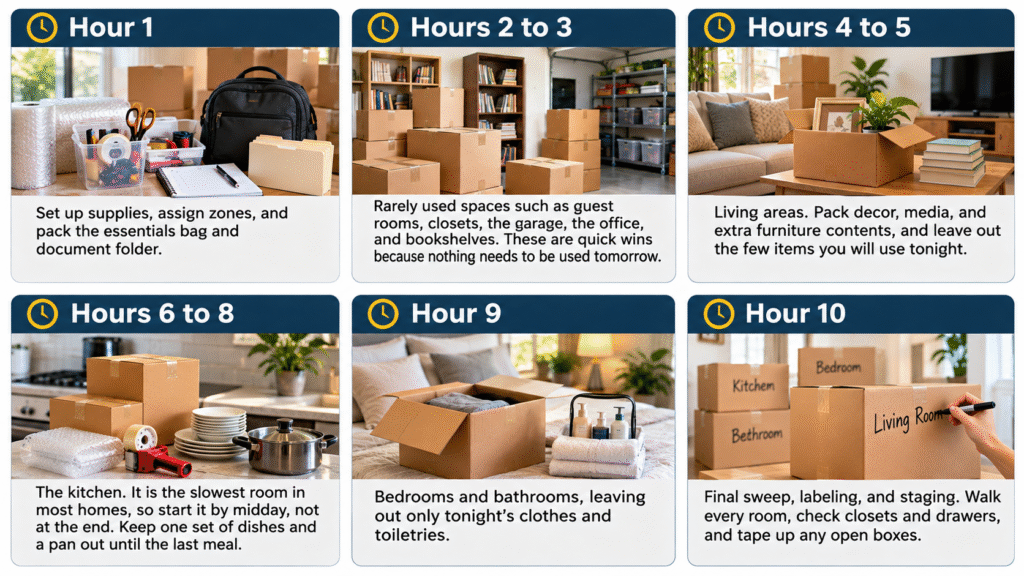
Some guides suggest starting with the least-used rooms and finishing with the ones you live in. The reasoning is the same: pack what you will not miss first, so you are never unpacking a box to find something.
Speed Techniques That Save Hours
Small habits add up when the clock is short. A few of the most reliable ones:
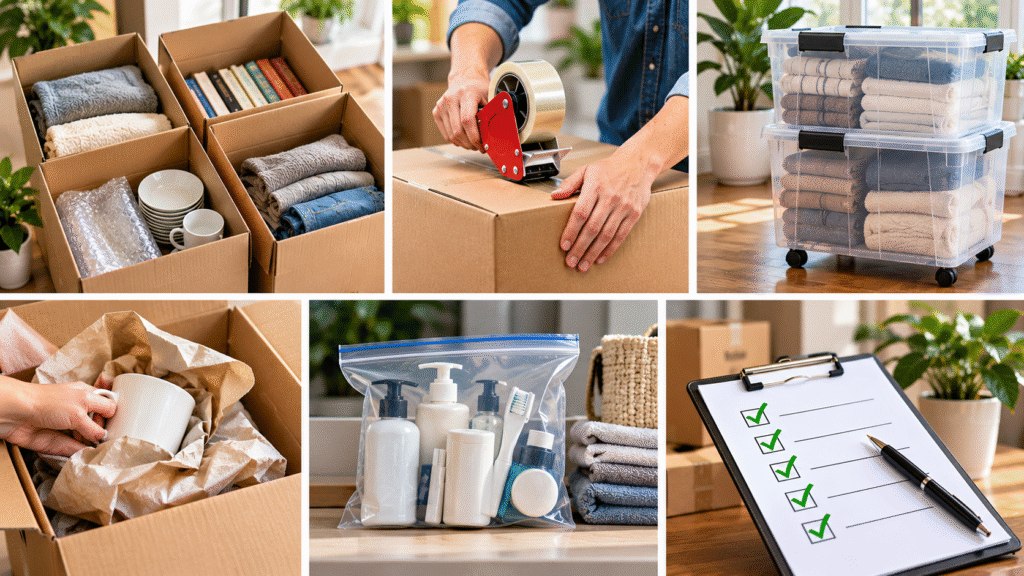
Leave drawers intact when you can. If a dresser’s drawers are light and the furniture is sturdy, you can often wrap the whole drawer in plastic or stretch wrap and carry it as is. Skip this for anything heavy or fragile.
Use bags for soft goods. Clothing on hangers can go straight into trash bags or large wardrobe boxes. Linens and pillows go into bags that double as padding for fragile items.
Match box size to weight. Books and other dense items belong in small boxes. Lighter items like towels or lampshades go in larger ones. A box that is too heavy slows the whole team and can split open.
Label as you go. Write the destination room on the top and one side of every box, plus a quick note such as “kitchen, fragile.” Ten seconds of labeling saves an hour of confusion at the new place.
Do not sort while packing. When you have a full week, decluttering first is smart. With one day, pack what belongs to the “must” and “should” buckets, and drop uncertain items into the donate bin.
Protect Your Back and Your Pace
Fatigue is a bigger risk than it looks. A packing day involves hours of bending, lifting, and carrying, and tired people lift badly.
The CDC’s National Institute for Occupational Safety and Health notes that improper lifting can lead to back injuries, and its practical advice includes using equipment and working as a team. At home, that means using a hand truck or dolly for heavy boxes, asking for help with anything awkward, and keeping boxes at a weight you can carry comfortably.
Eat, drink water, and take a ten-minute break around the midpoint. A short break costs less time than the slowdown from an exhausted crew or a pulled muscle.
When to Stop Packing and Let a Crew Take Over
Knowing where to stop is part of the plan. Check your progress at the halfway point, and be honest about what will not get done.
If the remaining work is large furniture, a fully loaded kitchen, or a garage packed with equipment, it may be smarter to pack the essentials yourself and hand the rest to people who do this daily. A professional crew loads quickly, wraps furniture, and works with proper gear, which is hard to replicate on a rushed Saturday.
If you are in the Durango area, same-day movers in Durango, CO are one example of a service built for short-notice jobs, and some same-day services offer optional packing help on top of the move itself. Whichever company you consider, ask about availability for the day you need, what the quote includes, and whether packing help is billed separately.
Set a hard cutoff for yourself, such as 4 p.m. Anything still unpacked at that point goes to the crew, into a second trip, or into a storage box you sort after the move.
Frequently Asked Questions
Can you really pack a whole house in one day?
You can pack a small home or apartment in one day with enough helpers and a plan. A larger home usually takes longer. The goal on a one-day timeline is to finish essentials, kitchen, and bedrooms, then leave low-priority items for a later trip or a professional crew.
What should I pack first when I only have one day?
Pack your essentials bag and important documents first, then move to rarely used rooms like closets, guest rooms, and the garage. These areas go quickly because you do not need their contents tomorrow. Save the kitchen for midday and bedrooms for the end so daily items stay available as long as possible.
How many people do I need to pack a house in a day?
More hands help, but organization matters just as much. Two or three helpers can make a real difference for an apartment. For a full house, aim for a small team with assigned zones. Avoid too many people in one room, since that causes collisions and slows everyone down.
What can I skip when I am packing in a hurry?
Skip decluttering, perfect sorting, and elaborate wrapping for sturdy items. Leave light drawers filled, use clothing and towels as padding, and donate anything you are unsure about. You can sort at the new place. Do not skip documents, medications, or anything you need to be safe or legal.
What items should I never pack in moving boxes?
Do not pack hazardous items such as paint, solvents, cleaning chemicals, propane, or pesticides in boxes headed for a truck. Keep valuables, documents, and medications with you. Perishable food and plants should be handled separately. Check with your mover for their specific list before moving day.
Pack Smart, Then Stop on Time
A one-day pack rewards decisions more than speed. Rank your belongings, put the irreplaceable and the essential first, give the slowest rooms a fixed window, and accept that a few items will not make the first trip.
If you hit your cutoff and boxes are still empty, that is not a failure. Pack what matters, hand off what is left, and spend the evening making sure your essentials bag, your documents, and your keys are in your hands.