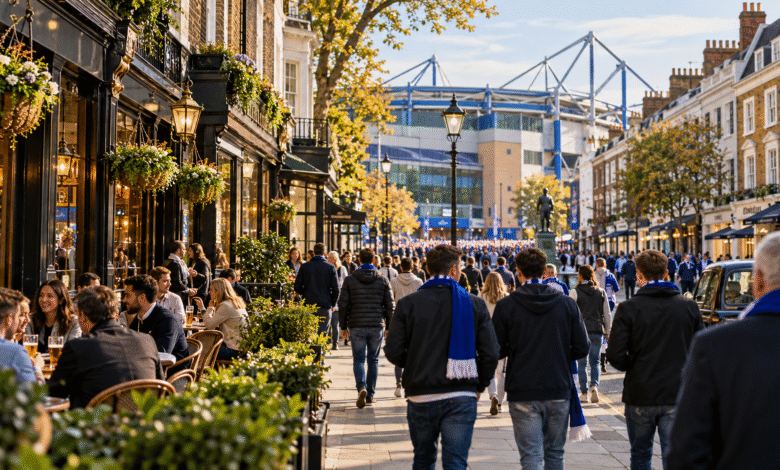
West London has plenty to offer beyond its best-known landmarks. On a matchday, areas around Fulham, Chelsea and Kensington take on a different atmosphere, with supporters, visitors and local residents sharing the same streets, pubs and transport routes. For travellers spending a weekend in the capital, combining football with sightseeing can make the day feel much more complete.
The key is to avoid treating the match as an isolated event. Stamford Bridge sits in a part of London that is well connected to some of the city’s most attractive neighbourhoods, so it is easy to build a full itinerary around kick-off without spending hours travelling from one side of the capital to the other.
Exploring the area before kick-off
One of the advantages of attending a game in west London is the number of places that can be visited nearby. Fulham Broadway is the most practical starting point, but those arriving earlier can walk towards King’s Road, Chelsea or the Thames before heading to the stadium.
King’s Road is known for its shops, cafés and long-standing connection with London’s fashion and cultural scene. A little further south, Chelsea Embankment offers a quieter walk along the river, while the streets around Fulham provide a more residential view of the capital that contrasts with central tourist areas such as Westminster or Covent Garden.
Arriving early also reduces the pressure of dealing with busy public transport immediately before kick-off. On high-profile fixtures, stations and surrounding streets can become significantly more crowded as the match approaches.
Planning tickets and travel in advance
For visitors coming from outside London, the practical side of the day matters just as much as the itinerary. Match schedules can change because of television selections, cup competitions or other calendar adjustments, so it is sensible to confirm the final kick-off time before making rigid travel plans.
Those looking for seats for a west London fixture should also check availability in advance, particularly for weekends, derby matches and games against higher-profile opposition. Leaving ticket arrangements until the last moment can limit both seating options and the ability to coordinate the rest of the trip.
Public transport is generally the easiest way to reach the area. Fulham Broadway Underground station is close to Stamford Bridge, although alternative stations and walking routes can be useful when crowds are particularly heavy.
What to do after the match
Once the game ends, many visitors immediately head back towards central London, but staying in the area for a while can make the journey more comfortable. Local restaurants, cafés and pubs often remain busy after the final whistle, and allowing some time before using the Underground can help avoid the first wave of departing supporters.
For an evening fixture, nearby Chelsea and South Kensington are convenient areas for dinner. For afternoon games, there is still enough time to continue sightseeing, particularly during spring and summer when daylight lasts well into the evening.
South Kensington is especially practical because several major museums are concentrated within a relatively small area. Depending on opening times, visitors can combine a football afternoon with attractions such as the Victoria and Albert Museum, the Natural History Museum or the Science Museum.
Turning matchday into a wider London experience
A football fixture can work particularly well as the centrepiece of a wider day in London rather than as the only activity. The compact geography of west London makes it possible to combine neighbourhood walks, museums, food and sport without constantly crossing the city.
Planning around the final kick-off time, allowing extra time for transport and keeping nearby alternatives in mind creates a more flexible itinerary. For visitors who want to experience both the sporting atmosphere and everyday London, west London provides one of the easiest areas in which to combine the two.