You probably don’t think much about mobile data when you’re at home. Your phone connects automatically, your apps work in the background and your monthly plan takes care of everything.
Travelling abroad changes that. Suddenly, the phone you rely on for maps, boarding passes, translations, bookings and messages depends on a connection that may work very differently from the one you use at home.
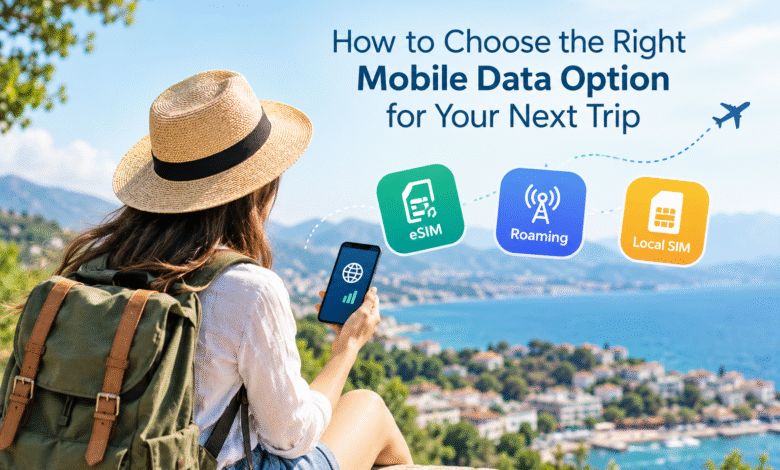
Some travellers simply turn on international roaming. Others buy a local SIM after landing. Increasingly, travellers are choosing eSIMs so they can arrange their connection before leaving home.
The interesting question isn’t really which option is universally best. It’s which setup makes the most sense for the way you’re travelling.
The First Question: What Will You Actually Use Your Phone For?
Before looking at SIMs or data packages, think about your typical day on holiday. If you’re staying in a hotel with reliable Wi-Fi and mainly need mobile data for Google Maps, messages and occasional searches, your requirements may be relatively small.
But a work trip can be very different. You may need video calls, email, cloud applications and messaging throughout the day.
A road trip creates another set of requirements. Navigation might be running for hours, while restaurants, accommodation and attractions may all require online access. Your travel habits should influence your connectivity choice just as much as the destination itself.
Don’t Wait Until You Land to Think About Connectivity
One of the easiest mistakes is leaving mobile connectivity until you’re standing in an airport.
You may have to find a local shop, compare unfamiliar plans, deal with registration requirements or search for Wi-Fi before you can even make the purchase.
This is where digital connectivity can be useful.
An eSIM is installed electronically rather than inserted as a physical card. If your phone supports eSIM technology, you can arrange a compatible travel plan before your journey and have your connection ready when you need it.
eSIM io offers travel connectivity options for people with different destinations, trip lengths and data requirements.
The main benefit isn’t simply avoiding a plastic SIM card. It’s being able to organise your connection before the journey starts.
There Is No Need to Treat Every Trip the Same
Your ideal setup for a weekend in Paris might not be the same as your setup for a month in Japan.
For a short trip, international roaming can be perfectly practical. If your current mobile plan already includes an appropriate international allowance, continuing to use your existing service may be the easiest solution. There’s nothing new to install and your normal number remains available.
The important part is checking the terms before departure. International allowances vary between providers, and additional usage can sometimes cost considerably more than expected.
For a longer stay in one country, a local SIM can also be worth considering. Local operators may offer plans designed specifically for residents or visitors, and a local number can be useful for certain services.
The trade-off is that you’ll need to purchase and set up the SIM after arriving.
An eSIM sits between these approaches. You can organise it in advance while still avoiding the need to physically replace your SIM card.
When Convenience Is More Important Than the Cheapest Possible Rate
The lowest advertised price isn’t necessarily the cheapest option overall. Imagine arriving at an airport late at night. You need directions to your accommodation, but the local SIM shop is closed.
Or perhaps you’re travelling with children and don’t want to spend the first hour of your holiday comparing mobile plans.
In situations like these, convenience has real value.
An eSIM can allow you to complete the setup before departure so that you’re not depending on a local shop for your first connection.
This can be particularly useful when you need data immediately after landing.
What About Your Existing Number?
One concern travellers often have is losing access to their regular SIM. On compatible devices, an eSIM can allow you to keep your existing physical SIM in the phone while using the eSIM for travel data.
That can be useful if you still want access to your normal number for calls or texts while using a separate travel connection for data.
The exact functionality depends on your phone and mobile provider, so it’s worth checking your device’s dual-SIM capabilities before travelling.
The More Countries You Visit, the More Important Flexibility Becomes
A single-destination holiday is relatively straightforward. Multi-country travel is different.
Suppose you’re travelling through several European countries during one trip. You don’t necessarily want to buy a new SIM each time you cross a border. You could use your existing provider’s roaming service, assuming all your destinations are covered under suitable terms.
Another possibility is a travel eSIM designed to work across multiple destinations.
eSIM io’s OneSIM technology is designed for multi-country travel. Rather than requiring a separate eSIM installation every time you enter another supported country, OneSIM is installed once and is designed to detect your location and switch connectivity as you move between destinations.
That can make a significant difference on trips where the itinerary changes frequently.
Your Data Needs Can Change During the Trip
It’s also worth thinking beyond the number of days you’ll be away. A ten-day holiday doesn’t automatically mean you’ll use the same amount of data every day.
You might spend the first few days sightseeing and using maps heavily. Later, you could spend more time at your accommodation using Wi-Fi. Or an unexpected delay could leave you relying on mobile data for several hours.
This is why flexibility can be useful. eSIM io offers several ways to manage data, including pay-as-you-go, fixed-term plans and unlimited daily options. Unlimited daily plans are available for periods from one to 30 days.
Someone with unpredictable usage may prefer pay-as-you-go, while travellers who don’t want to monitor their consumption may prefer an unlimited option.
A Small Bonus Can Make the First Top-Up More Useful
If you’re trying a travel eSIM for the first time, the initial top-up is another thing to consider.
New eSIM io users can enter the 50BONUS promo code when topping up and receive 50% bonus credit. For example, a $20 top-up adds $10 in bonus credit, giving you $30 in total credit to use within the app.
That extra balance can be useful for everyday travel activities such as navigation, messaging, browsing and other mobile data needs.
It also means you don’t necessarily have to choose a larger top-up simply because you’re worried about running out of data.
What If You Buy Your Plan Before Your Trip?
Buying connectivity early doesn’t necessarily mean you have to activate it immediately.
eSIM io’s Custom Plan Activation Date allows users to purchase a plan in advance and choose when they want it to become active.
This can be useful when your trip is booked weeks or months ahead.
There is also a Pause Plan feature for eligible plans. If data usage hasn’t exceeded 200 MB after activation, the plan can be paused once and resumed later.
That gives travellers some additional flexibility when their plans don’t go exactly as expected.
Your Next Trip Doesn’t Have to Start From Zero
Another useful feature is what happens to unused account credit.
With eSIM io’s Lifetime io Balance, account credit does not expire. Any remaining balance can stay available for a future journey instead of being lost after a fixed period.
There’s also Auto Top-Up for travellers who don’t want to manually add credit while abroad.
When the account balance drops below $2, users can select an automatic top-up of $5, $10 or $25.
For someone who depends heavily on mobile data, that can help avoid an unexpected interruption.
Four Common Travel Situations
You’re Away for a Few Days
Start by checking your existing mobile plan. If it includes enough international data at a reasonable rate, roaming may be all you need. There’s little reason to complicate a short trip unnecessarily.
You’re Spending Weeks in One Country
Compare local SIMs and eSIM plans. A local SIM may be attractive if you want a domestic number and local pricing. An eSIM may be preferable if you want to organise everything before arriving.
You’re Crossing Several Borders
Look for a solution that works across your itinerary. Constantly changing physical SIMs can become inconvenient, particularly when you’re moving frequently. A multi-country eSIM can reduce that hassle.
You Need Reliable Data for Work
Think about consistency rather than simply the cheapest package. If your phone is being used for meetings, email, navigation and work applications, having a connection ready when you land can be particularly valuable.
A Better Way to Think About Travel Connectivity
There isn’t one option that wins every time.
Roaming is attractive because it requires very little effort. A local SIM can offer strong value when you’re spending a long time in one destination. An eSIM provides the convenience of digital setup and can be particularly useful when you want to arrange your connection before leaving home.
The right choice comes down to your trip rather than the technology itself.
Think about where you’re going, how often you’ll move, how heavily you’ll use data and whether you want to organise everything before departure. Once those questions are clear, choosing how to stay connected becomes much easier.