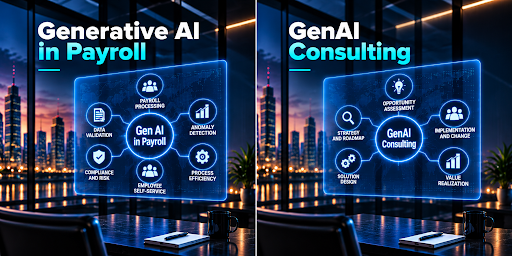
Payroll teams manage complex employee data, strict processing deadlines and evolving compliance requirements. Manual exception handling, fragmented systems and repetitive employee inquiries can increase administrative effort and limit productivity. Generative AI in Payroll offers opportunities to simplify knowledge-intensive work, improve employee support and strengthen payroll operations.
However, successful implementation requires more than introducing intelligent tools. GenAI consulting helps organizations identify valuable applications, evaluate technology readiness and establish appropriate governance. By connecting generative AI with existing payroll processes, businesses can improve efficiency while maintaining accuracy, security and accountability.
This article explores how consulting expertise supports payroll modernization, the applications of generative AI and the practices required to achieve measurable business value.
What is GenAI consulting?
GenAI consulting helps organizations identify, design, implement and scale generative artificial intelligence solutions aligned with business objectives.
Consulting activities can include AI strategy development, opportunity assessment, use-case prioritization, data readiness, technology integration and governance.
For payroll organizations, consultants evaluate existing workflows to determine where AI can reduce administrative work without compromising payroll controls.
The objective is to connect technology investment with measurable improvements in productivity, employee service and operational performance.
What is Generative AI in Payroll?
Generative AI in Payroll refers to the application of generative artificial intelligence across payroll administration, employee support, documentation and knowledge management.
These capabilities can interpret natural-language questions, summarize information, generate communications and retrieve relevant payroll policies.
Unlike conventional automation, which executes predefined activities, generative AI can support tasks requiring interpretation and contextual understanding.
Payroll specialists can use these capabilities to summarize employee inquiries, retrieve procedural information and investigate exceptions more efficiently.
Why payroll needs intelligent transformation
Payroll operations depend on information from HR, time management, benefits and finance systems. Inconsistent records and manual handoffs can create delays and additional administrative work.
Employees also expect timely responses to questions about pay statements, deductions and payroll schedules.
Generative AI in Payroll can improve access to relevant information and reduce time spent handling routine inquiries.
GenAI consulting helps organizations determine which activities are suitable for AI and where traditional automation or process redesign may provide better results.
This ensures technology implementation addresses actual performance problems rather than introducing unnecessary complexity.
Core technologies supporting intelligent payroll
Several technologies can work together to improve payroll operations.
Generative AI
Generative AI can summarize payroll cases, explain approved policies and support employee communications.
Machine learning
Machine learning can identify unusual payroll transactions, recurring exceptions and patterns requiring investigation.
Predictive analytics
Predictive models can help organizations anticipate payroll expenses, overtime trends and workforce costs.
Intelligent automation
Automation can streamline data validation, workflow routing and repetitive administrative activities.
AI agents
AI agents can coordinate approved activities across payroll and HR systems while escalating sensitive decisions to specialists.
GenAI consulting can help organizations determine how these technologies should be integrated into existing payroll workflows.
Key applications of Generative AI in Payroll
Organizations can apply generative AI across several payroll processes.
Employee payroll support
Conversational assistants can provide employees with information about payroll schedules, deductions, pay statements and organizational policies.
Payroll case management
AI can summarize employee inquiries and retrieve relevant information to support faster case resolution.
Exception management
Generative AI can prepare contextual summaries of payroll exceptions identified through automated validation.
Payroll knowledge management
AI can make payroll policies, procedures and documentation easier for employees and specialists to access.
Employee communications
Payroll teams can use AI to prepare initial communications related to processing schedules and policy changes.
Payroll reporting
Generative AI can summarize payroll trends, workforce costs and operational performance.
These applications demonstrate how Generative AI in Payroll can improve knowledge-intensive work while supporting existing payroll controls.
Business benefits of generative AI in payroll
When connected to clear operational objectives, generative AI can create several benefits.
Greater payroll productivity
AI can reduce repetitive information retrieval, documentation and routine employee support activities.
Faster employee service
Conversational self-service can help employees access payroll information without waiting for manual assistance.
Improved exception handling
AI-supported summaries can help payroll specialists investigate potential issues more efficiently.
Better knowledge accessibility
Generative AI can make complex payroll policies and procedures easier to retrieve and interpret.
Greater operational scalability
Intelligent workflows can help payroll teams manage increasing employee and transaction volumes without proportional increases in administrative effort.
How GenAI consulting supports payroll implementation
Successful implementation requires coordinated decisions across payroll processes, data, technology and governance.
GenAI consulting can support organizations by:
- Assessing current payroll performance and AI readiness.
- Identifying high-value generative AI opportunities.
- Evaluating payroll data and knowledge quality.
- Prioritizing use cases based on value, feasibility and risk.
- Defining integration requirements with payroll and HR platforms.
- Establishing privacy, security and responsible AI controls.
- Redesigning payroll workflows around intelligent capabilities.
- Developing implementation roadmaps.
- Defining KPIs and measuring realized business value.
This approach helps organizations move from isolated experimentation toward scalable Generative AI in Payroll.
Building a payroll AI implementation roadmap
A successful roadmap begins with understanding existing payroll performance.
Organizations should identify activities that consume significant administrative capacity, create delays or generate recurring employee inquiries.
Potential AI applications can then be evaluated according to expected business value, implementation complexity and operational risk.
GenAI consulting helps organizations determine whether existing data, systems and processes can support the proposed applications.
Some use cases may require improvements in documentation or system integration before implementation.
A structured roadmap helps sequence these investments while maintaining payroll accuracy and compliance.
Best practices for implementing Generative AI in Payroll
Organizations can improve implementation outcomes by following several principles:
- Begin with clearly defined payroll problems and expected outcomes.
- Establish current performance baselines.
- Improve payroll data quality and knowledge governance.
- Integrate AI with existing payroll, HR and time management systems.
- Establish role-based access controls for employee information.
- Maintain human accountability for payroll approvals and sensitive decisions.
- Test AI outputs using realistic payroll scenarios.
- Train employees to evaluate AI-generated information.
- Monitor system performance and operational costs.
- Measure realized improvements in productivity and service quality.
GenAI consulting can help organizations apply these practices consistently throughout implementation.
Common challenges in payroll AI implementation
Payroll data is often fragmented across HR, payroll, time management and finance platforms.
Inconsistent records can reduce the reliability of AI-generated information and create integration challenges.
Privacy is another critical consideration because payroll systems contain sensitive employee and financial data.
Organizations need strong access controls and clear policies governing how AI applications use this information.
Generative AI can also produce incorrect explanations, making validation and human oversight essential.
GenAI consulting can help organizations address these requirements before scaling implementation.
Measuring the value of generative AI
Generative AI initiatives should be evaluated through improvements in payroll performance rather than technology usage alone.
Relevant measures can include employee inquiry resolution time, payroll productivity, exception handling time, service quality and operating costs.
For example, an AI payroll assistant should demonstrate that employees receive reliable information faster or that specialists resolve cases more efficiently.
Organizations should establish baselines before implementation and compare actual outcomes with expected benefits.
GenAI consulting can help develop measurement frameworks that connect AI investments with operational and financial value.
The future of Generative AI in Payroll
Payroll operations will increasingly incorporate intelligent agents capable of coordinating activities across enterprise systems.
An agent could receive an employee request, retrieve relevant information, initiate an authorized workflow and escalate complex issues to a payroll specialist.
Generative AI may also provide payroll leaders with conversational access to workforce cost and operational performance information.
As these capabilities mature, organizations will need stronger governance, integration and clearly defined decision rights.
GenAI consulting will increasingly support agent architecture, workflow redesign and responsible automation across payroll operations.
Conclusion
Generative AI in Payroll offers opportunities to improve employee support, knowledge management and payroll productivity. However, sustainable value depends on integrating intelligent capabilities with reliable data, established processes and effective governance.
GenAI consulting provides the expertise required to identify suitable applications, address implementation challenges and connect AI investment with measurable outcomes.
Organizations that combine generative AI with strong payroll controls and redesigned workflows will be better positioned to build efficient, scalable and future-ready payroll operations.