The End of Clicks? How AI Agents Could Change the Way We Use Apps and Websites

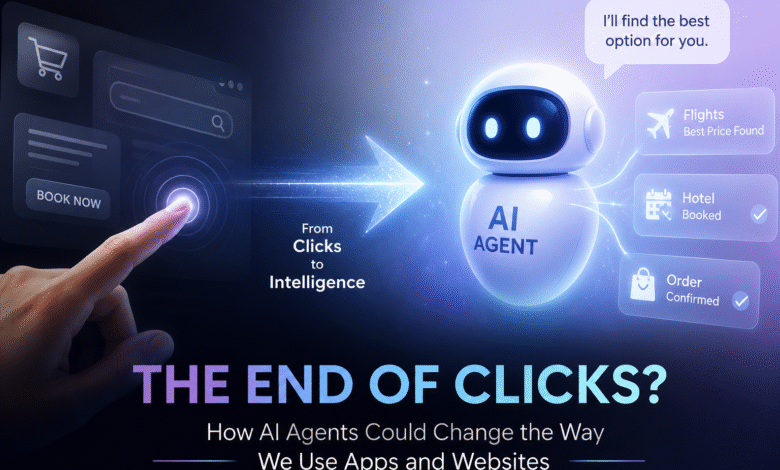
For decades, using software has meant the same routine: open an app, search for something, tap through a few screens, fill out a form, hit submit. That routine is starting to break down. More and more, people are simply telling a system what they want and letting it figure out the rest.
This shift has put AI agents and the future of apps at the center of many conversations about software design. Unlike a standard chatbot that mostly answers questions, an AI agent can understand a goal, map out the steps needed to reach it, pull in outside tools, and act on its own with only occasional human input. OpenAI, Google Cloud, Microsoft, and other major players are already building agent-based experiences for everyday tasks.
The upshot could be a real change in how people find, use, and interact with AI-powered software.
From Clicking Through Apps to Giving Instructions
Traditional apps are built around human navigation. Before you can get anything done, you have to learn the menus, buttons, dashboards, and filters.
AI agents in applications flip that around. Instead of expecting the user to learn how the software works, the software tries to understand what the user is after and works out how to deliver it.
Say someone wants to plan a trip. Instead of opening a travel app and comparing flights, hotels, and transport by hand, they could just say:
“Find me the best flight and hotel combination for a three-day business trip next month.”
An agent could then compare the options, weigh the person’s preferences, put together an itinerary, and check in before actually booking anything.
That doesn’t mean traditional interfaces vanish overnight. It means the interface stops being about clicking through menus and starts being about stating what you want.
Why Agentic AI Changes the Software Experience
Agentic AI differs from regular AI in one key way: it’s built to get things done, not just to generate a response. Generative AI can support these experiences by creating content and responses based on what users need.
A typical AI-powered app might summarize a document or suggest a product. An agent can go a step further, figuring out what needs to happen and then actually doing it.
A typical agentic workflow tends to involve:
- Understanding what the user wants to accomplish
- Breaking that goal into smaller tasks
- Pulling information from different sources
- Picking the right tools or services for the job
- Carrying out the actions
- Checking that the results are correct
- Asking for a human’s sign-off when it matters
In short, this moves software away from “tell me what to do” and toward “help me get it done.”
AI-Powered Applications Are Becoming More Action-Oriented
The next wave of AI-powered applications will likely blend familiar software features with the ability to make decisions and act independently.
Take expense management as an example. Right now, employees upload receipts, sort expenses into categories, check them against company policy, and submit reports all by hand. With autonomous AI agents in the picture, the system could scan the receipts, categorize the spending, flag anything that breaks policy, draft the report, and send it along for approval.
People still stay in control, but a lot of the tedious back-and-forth happens quietly in the background.
This is exactly where AI automation earns its keep. Rather than automating a single step in isolation, businesses can now automate whole sequences of work that used to require someone shuttling information between different systems by hand.
The Rise of AI-Driven User Experiences
Traditional interfaces are built around screens. The interfaces taking shape now are built around context.
AI-driven user experiences can shift based on what someone is actually trying to do, instead of showing the same menu to every single person who logs in.
Consider a scenario where the project management tool identifies an issue whereby the project is behind schedule. This does not necessarily mean that the project manager will go through various dashboards to identify this issue. The system will automatically identify the issue, explain why it has occurred, and even recommend possible solutions.
That’s what makes software feel proactive instead of passive.
The idea underneath all of this is simple: people should spend less time babysitting software and more time actually getting things done.
What Happens to Websites?
Websites might be in for the bigger shake-up.
Right now, companies fight for attention through search rankings, ads, content, and engagement. But AI agents are increasingly stepping in as the middleman between a person and the websites they’d otherwise visit.
Microsoft has talked about an emerging “AI Web,” where assistants, agents, and AI-enabled browsers read web content and take action on a person’s behalf. Its own research suggests people are growing more comfortable letting an agent handle these interactions rather than going straight to a website every time.
That raises an obvious question: if an agent can already compare products, sum up the reviews, and finish the purchase, does someone still need to visit each individual site?
Increasingly, the answer looks like no.
That could chip away at the old click-based journey, where every sale depends on someone landing on a website first. Accenture makes a similar point, suggesting AI-native interfaces could become the first stop and sometimes the only stop in a buying journey.
AI and Digital Interfaces Are Moving Toward Intent
The real shift here is not the reduction in the number of clicks, but the transition from interface-based actions to intent-based actions.
Today: User intent → Search → Website → Navigation → Action
Tomorrow, more likely: User intent → AI agent → Decision → Action
That has real consequences for product teams.
Developers may need to think past the screen and ask whether their software can actually be understood by an AI system. APIs, structured data, permissions, authentication, machine-readable information, and dependable actions are all likely to matter a lot more going forward.
Recent research on agent-ready websites backs this up. Sites may need to be built so AI agents can read, evaluate, and act on them not just so they look good and work smoothly for a human visitor.
What This Means for Businesses
The future of software won’t come down to how polished an interface looks. Businesses will need to think about how well their software works for both human users and AI-driven workflows.
Worth asking:
- Which repetitive tasks could realistically be handed off to an agent?
- Which actions still need a human to sign off on them?
- Can our systems talk to each other securely through APIs?
- Is our important information structured in a way machines can actually read?
- Would an agent be able to figure out what actions are even available?
- How do we measure success once people are interacting through agents instead of clicking around directly?
This is also where smart software can become a genuine edge. Applications that understand context and actually get useful work done will likely outperform products that just bolt an AI chatbot onto an existing dashboard.
The Challenges Behind Autonomous AI Agents
Handing more autonomy to software comes with real responsibility.
Autonomous AI agents need tightly defined permissions. Any agent that can touch customer data, place an order, edit a record, or move money has to operate inside firm boundaries.
Trust is another sticking point. People need to know what an agent actually did, why it made the call it made, and when it’s supposed to check with a human first.
Security gets trickier too, since one agent might touch several systems in the course of a single task. An agent that’s compromised or poorly supervised could cause damage across every connected service it touches.
This is the reason why the most efficient agentic systems will not pursue full autonomy alone. They will strive to find a balance between automation and monitoring, transparency, permissions, and human intervention.
Preparing for an Agent-First Digital Future
The change may not happen equally across all industries. Some applications will continue to use a visual interface for operations that need control, creativity, or even confirmation from a person.
But repetitive, transactional, workflow-heavy tasks are strong candidates for handing over to an agent.
For technology leaders, the smart move is to start small: pick one workflow that eats up a lot of employee or customer time, connect the systems it touches, bring in some controlled automation, and see what happens.
The goal isn’t to get rid of every button.
It’s to get rid of the unnecessary work.
The organizations that understand the difference will be the ones most well equipped for the challenges that lie ahead. Essentially, the tale of agents and applications to come lies in the shift in the interaction between man and machine, from manually controlling them to delegating results that really matter.
As AI-enabled workflows mature, apps and websites may fade into the background even as they become more useful. The digital experiences that win out probably won’t be the ones that rack up the most clicks. They’ll be the ones that help people get the most done with the fewest steps in the way.