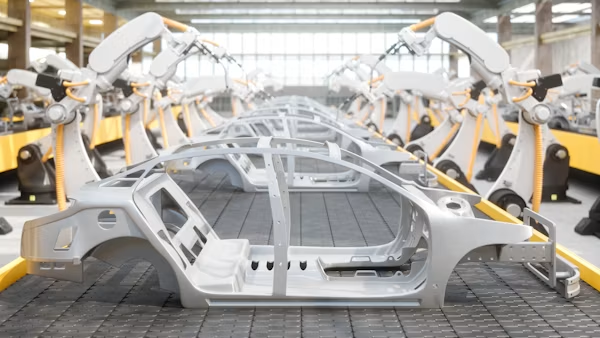
When a production line goes down, the investigation usually starts with the obvious culprits — motors, controls, software, or electrical systems. What rarely gets examined until much later is the structural foundation holding everything together. The machine chassis, the core frame and housing that supports every mechanical and electrical component in a given system, is often the last thing a procurement team thinks about and the first thing that causes cascading problems when it fails or was poorly specified to begin with.
For manufacturers operating in high-volume, continuous-duty environments, the quality and compatibility of a machine chassis is not a secondary consideration. It is a primary one. Yet across facilities in the US, chassis decisions are frequently made on cost alone, or inherited from outdated specifications that no longer match current operational demands. Understanding what a chassis actually does — and what it must be designed to handle — is the starting point for making a more defensible purchasing decision.
What a Machine Chassis Actually Does in an Industrial System
A machine chassis is the structural backbone of industrial equipment. It holds components in precise physical relationship to one another, absorbs vibration and mechanical stress generated during operation, and provides the housing or mounting infrastructure for electrical enclosures, drive systems, actuators, and control panels. Without a properly engineered chassis, the tolerances that define a machine’s performance cannot be consistently maintained over time.
For those researching this topic in depth, a well-organized Machine Chassis overview can help clarify the different configurations available and what each is typically suited for across industrial applications.
The chassis is also the interface between the machine and its environment. In facilities where floor vibration, temperature variation, or chemical exposure is a regular condition, the chassis must be designed to maintain dimensional stability across those variables. A frame that flexes, corrodes, or deforms under operational stress will gradually introduce misalignment across all connected components — leading to premature wear, increased maintenance frequency, and unpredictable output quality.
Structural Integrity and Its Impact on Component Longevity
One of the most underappreciated functions of the chassis is protecting the components it houses. Bearings, gearboxes, servo drives, and precision sensors are all designed to operate within defined alignment tolerances. When the chassis shifts — whether from thermal expansion, floor deflection, or accumulated vibration fatigue — those tolerances are violated incrementally. The components themselves may still appear functional, but they are operating outside their design envelope, which accelerates wear and shortens service life in ways that are difficult to trace back to their structural root cause.
This is why facilities that operate their machines at or near rated capacity consistently over long shifts tend to see component failures that seem premature relative to the manufacturer’s rated service intervals. The machine is not failing early — it is operating in a structural environment the chassis was not designed to sustain.
Load Distribution and the Physics of Operational Stress
Every machine generates stress through its normal operation. Motors produce torque reaction forces. Linear actuators generate thrust loads. High-speed rotating equipment introduces centrifugal forces and gyroscopic effects. The chassis is the structure that absorbs and distributes all of these forces to the floor or mounting surface. If the chassis is not designed to handle the specific load profile of the machine it supports, stress concentrations develop at welds, joints, and mounting points — and over time, those concentrations lead to fatigue cracking or joint loosening.
Procurement teams that evaluate chassis purely on static load ratings often miss this dynamic load consideration. A chassis rated for a given static weight may be entirely insufficient for the cyclic, impact, or torsional loads generated by the machine it is meant to support.
Material Selection and Why It Carries Operational Consequences
The material used in a machine chassis determines its weight, rigidity, corrosion resistance, machinability, and repairability. Steel, aluminum, and stainless steel each have distinct properties that make them appropriate for different operational environments and machine types. The selection is not purely a cost decision — it is a decision with long-term maintenance and reliability implications that compound over the machine’s service life.
Steel chassis offer high rigidity and weldability, making them well suited for heavy-duty applications where dimensional stability under load is the priority. However, in environments with moisture, chemical exposure, or wash-down requirements, bare steel requires surface treatment to resist corrosion — and that treatment needs to be maintained. Aluminum chassis are significantly lighter and naturally resist oxidation, but they have lower stiffness-to-weight ratios and are more susceptible to fatigue in high-cycle applications. Stainless steel addresses corrosion resistance at a premium cost and is typically reserved for food processing, pharmaceutical, or other regulated environments where material compatibility with the operating environment is a compliance requirement.
Surface Treatment and Its Role in Chassis Durability
Even within a single material category, surface treatment decisions meaningfully affect how long a chassis performs without intervention. Powder coating, anodizing, galvanizing, and zinc plating each offer different levels of corrosion protection, adhesion, and repairability. In facilities where the chassis is exposed to cutting fluids, lubricant mist, humidity, or cleaning chemicals on a regular basis, the surface treatment selection should be informed by the specific chemical exposures in that environment — not by a general standard applied across all equipment in the facility.
Chassis that were adequately treated for their original environment but then moved to a different facility or application — a common occurrence during plant reorganization or equipment redeployment — may fail prematurely simply because the surface protection was never rated for the new conditions. This is a practical risk that rarely appears in equipment transfer documentation but has real maintenance consequences.
Compatibility Between Chassis and Electrical Enclosure Systems
Modern industrial machines integrate mechanical and electrical systems in increasingly compact configurations. The machine chassis frequently serves as the mounting structure not just for mechanical components, but for control panels, power distribution assemblies, and communication hardware. This integration creates a direct relationship between chassis design and electrical system performance — a relationship that is often overlooked during specification and procurement.
Electrical enclosures mounted to a chassis that vibrates excessively or flexes under load are subjected to mechanical stress that was not accounted for in their design ratings. Terminal blocks loosen. Cable routing becomes strained at connection points. Circuit boards develop hairline solder fractures that produce intermittent faults. These failures are frequently diagnosed as electrical in origin when they are, in fact, structural — caused by a chassis that is transferring more mechanical energy to the enclosure than it was designed to absorb.
Grounding and Bonding in Chassis-Integrated Electrical Systems
The chassis also plays a functional role in electrical safety and signal integrity. In most industrial systems, the machine chassis serves as the common ground reference for electrical equipment mounted to it. The National Electrical Code provides guidelines for equipment grounding that depend on the chassis providing a continuous, low-impedance path between equipment and the facility ground system. A chassis with corrosion at bonding points, inadequate cross-sectional area at ground connections, or improper paint removal at grounding locations will compromise this path — creating both safety risks and signal integrity problems in sensitive control systems.
This is a particularly important consideration when purchasing used or refurbished equipment where the chassis condition may not be fully documented, and where the original grounding provisions may have been modified or degraded over time.
Evaluating Chassis Quality Before Purchase
Procurement decisions for machine chassis — whether as standalone structural components or as part of a complete machine purchase — benefit from a structured evaluation process that goes beyond surface inspection and price comparison. The chassis must be assessed in the context of the specific application it will support, the environment it will operate in, and the maintenance resources available to sustain it over time.
Key evaluation criteria include the weld quality and consistency across the frame, the precision of machined mounting surfaces, the dimensional tolerances maintained at critical interface points, and the adequacy of the surface treatment for the anticipated operating environment. Chassis that were fabricated to loose tolerances may appear structurally sound but will create alignment challenges during installation that persist throughout the machine’s service life.
• Examine weld continuity and fillet quality at stress concentration points such as corners, gussets, and bracket attachments — irregular welds indicate inconsistent fabrication practices that affect long-term strength.
• Verify that machined mounting surfaces are flat and parallel within the tolerances required by the components they will support — even small deviations introduce misalignment that compounds under load.
• Confirm that the chassis material and surface treatment are matched to the specific operating environment, not to a general-purpose specification inherited from a previous application.
• Review the documentation for any modifications made to the original chassis design, particularly in used equipment, as field modifications often reduce structural integrity without being reflected in rated load specifications.
• Assess the accessibility of chassis-mounted components for routine maintenance — a structurally sound chassis that obstructs access to lubrication points, filters, or inspection ports increases maintenance time and reduces the likelihood that service tasks will be performed on schedule.
Closing Perspective: Why Chassis Decisions Deserve More Attention
The machine chassis rarely appears in headline procurement discussions. Budget conversations focus on controls, automation capabilities, throughput ratings, and cycle times. The structural frame is often treated as a given — something assumed to be adequate rather than actively evaluated. That assumption is one of the more consistent sources of avoidable maintenance costs and unplanned downtime in US manufacturing facilities.
A chassis that is correctly specified, properly fabricated, and matched to its operating environment does not draw attention to itself. It supports consistent machine performance, protects the components mounted to it, and reduces the frequency of alignment-related failures over time. That outcome is not dramatic — but in a production environment where uptime and output consistency directly affect margin, quiet reliability is exactly what a well-chosen chassis delivers.
Manufacturers who invest the time to evaluate chassis quality with the same discipline they apply to other critical machine components will find that many reliability problems they attribute to component quality or control system limitations trace back to the structural foundation those systems depend on. Addressing that foundation at the point of purchase is always more cost-effective than correcting it after installation, when the machine is already in production and the operational pressure to keep it running makes structural remediation far more difficult to schedule and execute.