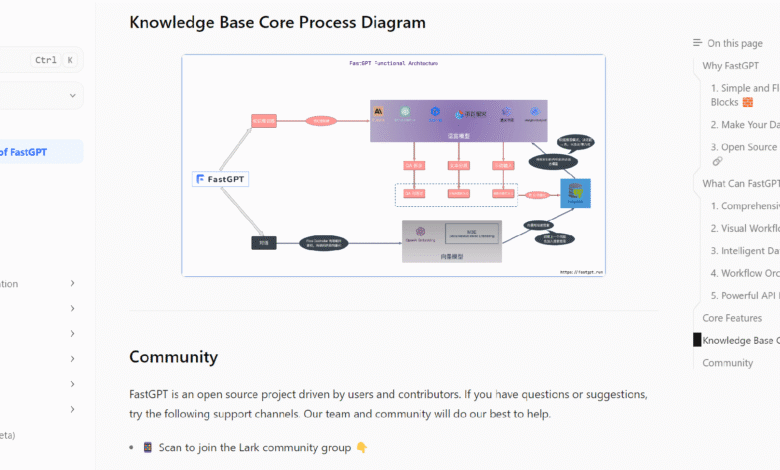
Many companies start their internal AI planning with a familiar idea: build a local GPT. The phrase sounds attractive because it suggests control, privacy, and independence. If the model runs inside the company environment, leaders may assume that employees can ask questions safely and that internal knowledge will become immediately usable. In practice, a local GPT and an enterprise knowledge base solve different parts of the problem. A local model can generate language. An enterprise knowledge base helps the organization manage, retrieve, verify, and apply knowledge.
This distinction matters because many AI projects fail when the company treats the model as the whole system. A large language model, whether local or cloud-based, does not automatically know the company’s latest policies, product details, customer implementation notes, troubleshooting history, or approval rules. It needs access to reliable knowledge. It needs retrieval. It needs permission boundaries. It needs citations. It needs workflows. It needs administrators who can improve the system after users report gaps. Without these layers, a local GPT may be private, but it may still be unhelpful or unreliable.
An enterprise knowledge base platform such as FastGPT should be evaluated as a knowledge application layer, not simply as another way to chat with a model. The strategic question is not only where the model runs. The strategic question is how the company turns scattered documents and domain expertise into a governed service that employees and customers can use every day. Once that framing is clear, the difference between local GPT and enterprise knowledge base becomes much easier to understand.
A Local GPT Is Primarily a Model Deployment Choice
A local GPT usually refers to a large language model deployed in an environment controlled by the organization. It may run on company servers, in a private cloud, or on dedicated infrastructure. The purpose is often to keep prompts, data, or model inference within a controlled boundary. For organizations with strict security requirements, this can be important. Local model deployment may reduce exposure to external model providers and give IT teams more control over infrastructure.
But local deployment mainly answers one question: where does the model run? It does not automatically answer other important questions. Which documents should the model use? How are documents parsed and indexed? How does the system know which source is current? Can users verify answers? Can different departments see different knowledge? Can the assistant refuse when evidence is weak? Can it connect to business workflows? Can administrators improve retrieval without rebuilding the system?
This is why a local GPT can be impressive in a demo but limited in production. The model may speak fluently, summarize text, and answer general questions. But enterprise users do not only need fluent text. They need answers grounded in approved business knowledge. They need a way to trust the output. They need the system to fit real work. Local model deployment is a useful component, but it is not a complete knowledge solution.
An Enterprise Knowledge Base Is a Knowledge Operating Layer
An enterprise knowledge base is designed around business knowledge rather than only model inference. It stores and organizes approved content, indexes it for retrieval, connects questions to relevant sources, generates grounded answers, and gives administrators a way to maintain quality. It may use a local model, a cloud model, or a hybrid model strategy. The model is important, but it is only one part of the architecture.
The core value of an enterprise knowledge base is that it turns information into a usable service. Employees no longer need to know where every document lives. Customer service agents no longer need to ask senior colleagues for the same product explanation. HR teams no longer need to repeat basic policy answers manually. Sales teams can reuse approved messaging instead of rewriting from memory. Operations teams can guide users through internal processes with less confusion.
This service layer requires more than uploading files. It needs document governance, retrieval configuration, metadata, source traceability, permission management, feedback loops, and workflow design. These capabilities are what make knowledge reusable across teams. A local GPT without this layer may generate answers, but it cannot reliably manage enterprise know-how.
The Model Does Not Replace Retrieval
One common misconception is that a stronger local model can remove the need for retrieval. In reality, enterprise knowledge changes too often and is too specific to depend only on model memory. A model may know general concepts, but it will not automatically know the latest product release notes, internal reimbursement policy, customer-specific deployment guide, or updated support procedure. Even if the model is fine-tuned, the company still needs a way to update knowledge quickly.
Retrieval solves this by searching approved sources at the moment of the question. The assistant can use the latest indexed documents rather than relying on whatever the model learned during training. This is especially important for policies, product documentation, implementation playbooks, and customer support materials. The company can update a document, re-index the knowledge base, and improve the assistant without training a new model from scratch.
Retrieval also helps with scope control. If a user asks a question about a specific product version, region, department, or customer, the system can use metadata and filters to search the right knowledge area. A general local GPT may not know which internal source should apply. An enterprise knowledge base can be designed to retrieve from the correct domain and avoid mixing unrelated content.
Citations Are What Turn Answers into Reviewable Work
Enterprise users often need to verify answers before acting on them. A customer service agent may need to confirm that a troubleshooting step is current. An HR specialist may need to point an employee to the correct policy. A sales engineer may need evidence before including a technical claim in a proposal. A manager may need to understand why the assistant gave a particular recommendation. This is where citations and source traceability become essential.
A local GPT can generate an answer, but unless it is connected to a knowledge base with source tracking, the user may not know where the answer came from. That creates a trust problem. A fluent answer without evidence may be useful for brainstorming, but it is risky for operational decisions. In enterprise settings, the assistant should show its sources whenever possible and make it easy for users to inspect the supporting material.
Citations also help administrators improve the system. When a user reports a bad answer, the team can check whether the wrong document was retrieved, whether the right document was outdated, whether the answer ignored an exception, or whether the prompt behavior needs adjustment. Without citations and retrieval logs, failures are harder to diagnose. The company may know that the answer was bad, but not why it was bad.
Permissions Matter More Than Model Location Alone
Privacy is one of the main reasons companies consider a local GPT. But privacy is not only about where the model runs. It is also about who can access which knowledge. If a local assistant can retrieve every internal document for every employee, the system may create internal data exposure even though nothing leaves the network. A private model with weak permission design can still be unsafe.
An enterprise knowledge base should be designed around business access rules. HR documents, customer-specific materials, finance procedures, internal security notes, management reports, and public product documentation should not all be treated the same. Different users may need different assistants, different knowledge bases, or different retrieval permissions. Administrators also need controls over who can upload content, publish applications, inspect logs, and connect tools.
This is where enterprise knowledge systems differ from simple local chat setups. A serious deployment should include role-aware access, knowledge segmentation, auditability, and controlled administration. These features make the system usable at scale. Without them, the company may have to restrict adoption to avoid risk, which limits the value of the local GPT investment.
Workflows Turn Knowledge into Business Outcomes
A local GPT can answer a question, but an enterprise knowledge base can be designed to support a workflow. This is a major difference. In real business settings, the user often needs to do something after receiving an answer. A support agent needs to draft a reply or escalate a case. An employee needs to prepare a reimbursement request. A sales team needs to produce proposal text. An IT user needs to follow an access request process. A manager needs a summary that can be shared with a team.
An enterprise knowledge base can connect retrieval with guided steps. It can ask clarifying questions, generate structured output, route the user to the next process, or prepare information for a human to approve. This does not mean the AI system should replace OA, CRM, ERP, HR, or finance systems. Those systems should remain the systems of record. The AI layer should help users understand and prepare work, then connect to controlled workflows where appropriate.
This is why the enterprise knowledge base approach is usually more valuable than a standalone local GPT for daily operations. The goal is not only to produce a paragraph. The goal is to reduce repeated work, improve consistency, and help users complete tasks with less friction.
Operations and Maintenance Are Different
Operating a local GPT and operating an enterprise knowledge base require different responsibilities. A local GPT requires model hosting, hardware or cloud capacity, inference performance management, model updates, security patching, and sometimes GPU operations. These are technical responsibilities. They can be significant, especially if the company expects low latency, many users, or high-quality local models.
An enterprise knowledge base adds another operational layer: document updates, knowledge ownership, retrieval tuning, citation review, permission management, application workflows, user feedback, and quality evaluation. These responsibilities are closer to knowledge management and business operations. They require cooperation between IT, AI teams, and business departments.
The company should not underestimate either side. A local GPT without operational model expertise can become slow, expensive, or difficult to update. An enterprise knowledge base without content ownership can become stale and unreliable. The best implementation plan defines both technical ownership and business ownership from the beginning.
When a Local GPT Is the Right Priority
A local GPT may be the right priority when the organization has strict requirements around model inference, data boundaries, or offline operation. It may also be important when external model APIs are not allowed, when latency must be controlled inside the network, or when the company has the infrastructure team needed to operate local models reliably. In these situations, local model deployment is a strategic requirement.
It may also make sense for companies with strong AI engineering teams and unique model needs. If the organization wants to customize model behavior deeply, run specialized models, or build an internal AI platform as a core capability, investing in local GPT infrastructure can be justified. But even then, the company will still need a knowledge base layer if the goal is enterprise Q&A, policy support, customer service assistance, or workflow guidance.
The key is to avoid treating local GPT as a complete solution. It is a model strategy. It can be part of an enterprise knowledge system, but it does not replace knowledge governance, retrieval, permissions, citations, and workflows.
When an Enterprise Knowledge Base Should Come First
An enterprise knowledge base should come first when the main business problem is scattered knowledge. If employees cannot find policies, agents repeat the same support research, sales teams rewrite standard answers, or operations teams struggle with process guidance, the company needs a knowledge service more than it needs a model hosting project. The model can be selected later based on security, cost, and quality requirements.
This is often the more practical starting point. A company can define one use case, prepare documents, build a test question set, configure retrieval, evaluate citations, and measure business impact. If the project proves useful, the team can then decide whether to continue with cloud models, switch to local models, or use a hybrid approach. This staged path prevents the organization from investing heavily in infrastructure before proving that the knowledge workflow creates value.
FastGPT’s official documentation can help teams understand how knowledge-based applications are organized and evaluated. During selection, the team should test whether the platform supports the knowledge workflows the business actually needs, not only whether it can connect to a preferred model.
A Practical Decision Framework
The simplest way to choose between local GPT and an enterprise knowledge base is to separate the model question from the knowledge question. The model question asks: where should inference happen, which model should be used, what data can be sent to it, and what performance is required? The knowledge question asks: which documents are authoritative, how are they retrieved, who can access them, how are answers verified, and how does the assistant support daily work?
If the model question is the main risk, prioritize local GPT architecture. If the knowledge question is the main bottleneck, prioritize the enterprise knowledge base. If both are important, design them together: use a knowledge base platform that can support the required deployment and model strategy. The goal is not to choose a fashionable label. The goal is to build a system that solves the actual enterprise problem.
A pilot can make the decision concrete. Choose one business domain, such as customer support, HR policy, sales enablement, or OA process guidance. Test the same question set with a simple local GPT setup and with a knowledge-base-driven application. Compare answer accuracy, citation quality, maintenance effort, permission control, workflow fit, and user adoption. This will reveal which layer is missing and where investment should go next.
Final Takeaway
Local GPT and enterprise knowledge base are not opposites. They are different layers. A local GPT is primarily about model deployment and control. An enterprise knowledge base is about turning company knowledge into a governed, retrievable, traceable, and reusable service. A strong enterprise AI system may use both: a local or controlled model for inference and a knowledge base platform for content, retrieval, citations, permissions, and workflows.
For most companies, the important first step is to identify the real bottleneck. If the bottleneck is data leaving the environment, local model deployment may be essential. If the bottleneck is that employees cannot reuse scattered knowledge, an enterprise knowledge base should come first. If the bottleneck is moving from answers to action, workflow design matters. Once these layers are separated, the AI roadmap becomes clearer. The company can stop asking whether it needs “a local GPT” in the abstract and start building the knowledge system that daily work actually requires.