The new Jeep lineup offers a range of powertrains designed for different driving needs, from efficient daily commuting to towing and off-road performance. The 2026 lineup includes models such as the Compass, Cherokee, Wrangler, Grand Cherokee, Gladiator, and Grand Wagoneer, with gasoline and hybrid technologies available across the range. For shoppers researching their options through a Jeep Dealership West Michigan, understanding the differences between Jeep engines can make it easier to identify a model that fits their driving habits.
1.6-Liter Turbo Hybrid Engine
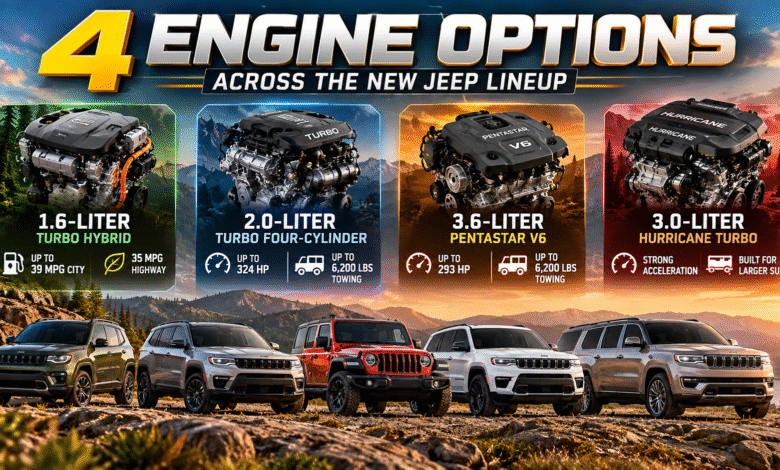
The all-new 2026 Jeep Cherokee introduces a 1.6-liter turbocharged engine paired with hybrid technology. Jeep lists this powertrain with fuel-economy figures reaching up to 39 mpg city and 35 mpg highway, depending on configuration. The Cherokee’s Turbo Hybrid system is designed to balance everyday efficiency with the capability expected from a Jeep SUV.
This engine can be particularly relevant for drivers who spend considerable time commuting or traveling longer distances. Hybrid assistance can help reduce fuel consumption during certain driving conditions while maintaining the performance needed for regular highway and utility use.
2.0-Liter Turbocharged Four-Cylinder
The 2.0-liter turbocharged four-cylinder is another important engine across the Jeep lineup. It powers the 2026 Compass and is also available in the Wrangler and Grand Cherokee, although output and specifications vary by model. Jeep lists the 2026 Compass with an EPA-estimated 23 mpg city and 31 mpg highway when equipped with the 2.0-liter turbo and eight-speed automatic transmission.
In the 2026 Grand Cherokee, the 2.0-liter Hurricane 4 Turbo produces up to 324 horsepower and 332 pound-feet of torque. Jeep also rates the engine for up to 6,200 pounds of maximum towing capacity when properly equipped.
The combination of turbocharging and four-cylinder efficiency makes this engine versatile. It can provide useful torque for acceleration and towing while remaining smaller than traditional V6 and larger engines.
3.6-Liter Pentastar V6
The 3.6-liter Pentastar V6 remains an important option for Jeep vehicles that require a balance of power, durability, and utility. It is available in models such as the Grand Cherokee and Gladiator, and it is also offered in the Wrangler.
In the 2026 Grand Cherokee, the Pentastar V6 produces up to 293 horsepower and can tow up to 6,200 pounds when properly equipped. It also incorporates Electronic Stop/Start technology to help improve efficiency during certain driving conditions.
For drivers who regularly carry passengers, tow equipment, or travel on varied terrain, the V6 provides a familiar middle ground between smaller turbocharged engines and larger performance-focused powertrains.
3.0-Liter Hurricane Turbo Engine
The 3.0-liter Hurricane turbocharged engine is used in the larger Jeep Grand Wagoneer. Jeep’s current vehicle information lists the Grand Wagoneer with a 3.0-liter turbo engine and an eight-speed automatic transmission.
This engine is designed for a larger SUV where strong acceleration and towing capability are important considerations. The Grand Wagoneer’s size and premium positioning make a higher-output turbocharged engine useful for moving a heavier vehicle while providing the power needed for highway travel, passengers, cargo, and towing.
The Hurricane engine family also demonstrates how Jeep is using turbocharging to deliver substantial performance without relying exclusively on larger-displacement engines.
How These Engines Differ
These four engines serve noticeably different purposes. The 1.6-liter turbo hybrid focuses more heavily on efficiency and practical everyday driving. The 2.0-liter turbo four-cylinder provides a flexible combination of performance and fuel economy across several Jeep models.
The 3.6-liter Pentastar V6 offers a proven option for drivers who want additional displacement and utility, particularly for towing and outdoor activities. Meanwhile, the 3.0-liter Hurricane is positioned in the larger Grand Wagoneer, where greater power is appropriate for a full-size luxury SUV.
Jeep also offers specialized performance engines outside these four primary options. For example, the 2026 Wrangler Willys 392 and other 392 variants use a 6.4-liter V8, producing 470 horsepower and 470 pound-feet of torque.
Choosing the Right Jeep Engine
Choosing an engine starts with considering how the vehicle will be used. Drivers who prioritize fuel efficiency for commuting may want to examine the Cherokee’s turbo-hybrid system. Those seeking a versatile SUV or off-road vehicle can compare the 2.0-liter turbo and 3.6-liter V6 depending on the model.
For larger vehicles and demanding towing requirements, the available Hurricane engines may deserve closer attention. Buyers should also compare transmission configurations, drivetrain systems, towing ratings, fuel economy, and trim-specific equipment because engine availability varies between models.
Conclusion
The current Jeep lineup offers several engine technologies designed around different driving priorities. The 1.6-liter turbo hybrid emphasizes efficiency, the 2.0-liter turbocharged four-cylinder combines compact size with strong performance, the 3.6-liter Pentastar V6 provides versatile utility, and the 3.0-liter Hurricane serves larger Jeep vehicles requiring substantial power. By comparing these engines alongside each vehicle’s size, drivetrain, towing capacity, and intended use, shoppers can better understand which Jeep powertrain fits their everyday needs.