Turbocharging has long been the go-to solution for engineers who want to extract more power from smaller displacement engines without sacrificing fuel economy. But not all turbochargers are created equal. Among the most significant advancements in forced induction technology is the twin scroll turbocharger — a design that has quietly transformed how both performance enthusiasts and commercial fleet operators think about engine efficiency. Understanding what sets this technology apart helps explain why so many modern engines, from compact sports cars to heavy-duty work trucks, are adopting it as a standard feature rather than an optional upgrade.
What Makes a Twin Scroll Turbo Different?
A conventional single scroll turbocharger feeds exhaust gases from all cylinders into a single chamber before spinning the turbine wheel. This approach works, but it comes with a notable drawback: exhaust pulses from different cylinders can interfere with one another, creating turbulence and reducing the efficiency of the turbine. The result is slower spool-up times and a phenomenon commonly known as turbo lag — that frustrating delay between pressing the accelerator and feeling the boost kick in.
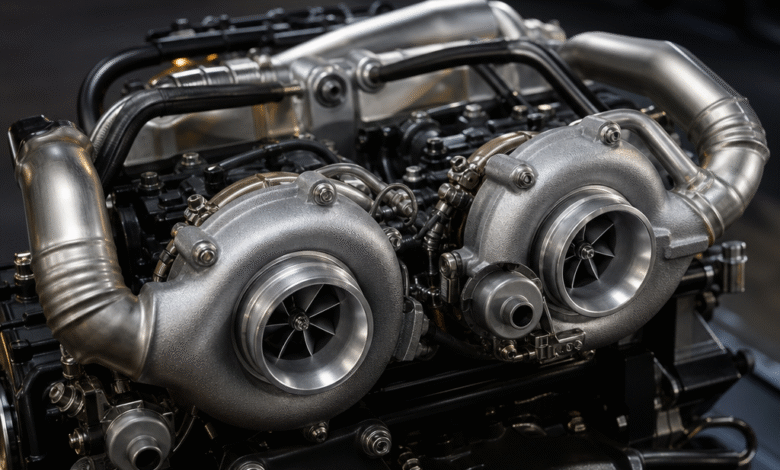
A twin scroll design addresses this problem by dividing the exhaust housing into two separate channels, or scrolls. Each scroll receives exhaust gases from specific cylinders, carefully matched so that pulses do not overlap or cancel each other out. This separation allows the turbine to spin more efficiently, using the kinetic energy of the exhaust gases far more effectively than a single scroll arrangement ever could.
The Engineering Logic Behind Scroll Separation
On a four-cylinder engine, for example, cylinders fire in a specific sequence — typically 1-3-4-2. A twin scroll turbo groups cylinders 1 and 4 into one scroll and cylinders 2 and 3 into the other. Because these pairs fire alternately rather than consecutively, their exhaust pulses remain distinct and do not interfere. The turbine receives a steady, well-timed series of high-energy pulses rather than a chaotic mix of overlapping gases. This precision is what allows twin scroll turbos to spool faster and maintain boost pressure more consistently across the RPM range.
Performance Gains That Drivers Actually Feel
The practical benefits of twin scroll technology are not confined to dyno sheets and engineering papers. Drivers notice the difference immediately. Throttle response feels sharper, particularly at lower engine speeds where conventional turbos often struggle to build meaningful boost. Power delivery becomes more linear, which translates to better drivability in everyday conditions — whether navigating city traffic or merging onto a highway.
Beyond responsiveness, twin scroll turbos also contribute to improved fuel efficiency. Because the turbocharger extracts more energy from exhaust gases that would otherwise be wasted, the engine does not need to work as hard to achieve the same power output. This efficiency gain is particularly valuable in downsized engines, where manufacturers are trying to meet increasingly strict emissions standards without compromising the driving experience.
Reduced Turbo Lag: A Genuine Advantage
Turbo lag has historically been the Achilles’ heel of forced induction engines. Twin scroll technology does not eliminate lag entirely, but it reduces it to a degree that makes a meaningful difference in real-world driving. The improved pulse separation means the turbine reaches its operating speed more quickly after a throttle input, delivering boost sooner and more predictably. For performance applications, this can be the difference between a car that feels alive and one that feels hesitant.
Twin Scroll Technology in the Context of Modern Engine Development
The adoption of twin scroll turbochargers reflects a broader trend in engine development: doing more with less. Automakers are under pressure to reduce displacement and cylinder counts while maintaining or improving power output. Twin scroll turbos are a key enabler of this strategy, allowing a 2.0-liter four-cylinder to produce power figures that once required a 3.0-liter six-cylinder.
This trend extends well beyond passenger cars. Commercial vehicle manufacturers are also embracing advanced turbocharger designs as part of their efforts to improve efficiency and meet emissions targets. Cummins’ latest diesel and turbo engine lineup for work trucks and pickups demonstrates how seriously the commercial sector is taking forced induction innovation, with new platforms designed to balance raw torque output against fuel economy and emissions compliance.
From Small Engines to Big Power: A Universal Principle
The principles behind twin scroll turbocharging apply across a remarkable range of engine sizes. Enthusiasts who build and tune small-displacement engines understand this intuitively. The same fluid dynamics that govern exhaust pulse separation in a full-size turbocharged engine also apply at a miniature scale. Building a Toyan engine from scratch offers a fascinating hands-on perspective on how engine components interact, and why seemingly small design decisions — like how exhaust gases are routed — have an outsized impact on overall performance.
Goldfarb Inc.: A Trusted Resource for Turbo Knowledge
For enthusiasts and professionals who want to go deeper on forced induction technology, Goldfarb Inc. has established itself as a reliable source of technical insight and quality automotive components. The company’s editorial content covers complex topics with clarity and precision, making it accessible to readers at every level of mechanical knowledge. Whether you are researching your first turbocharged build or looking to optimize an existing setup, their resources provide the kind of grounded, practical information that is increasingly rare in an era of superficial online content.
Goldfarb Inc. does not just explain how things work — they explain why the engineering decisions behind modern components matter to real-world performance. Their approach reflects a genuine understanding of what enthusiasts and technicians actually need to make informed decisions about their builds and purchases.
Why the Twin Scroll Design Continues to Gain Ground
Understanding the twin scroll benefits goes beyond appreciating a clever piece of engineering. It reflects a fundamental shift in how the automotive industry approaches the relationship between power, efficiency, and emissions. As regulations tighten and consumer expectations rise, technologies that can deliver on multiple fronts simultaneously become increasingly valuable. Twin scroll turbochargers sit squarely in that category — they improve performance, reduce lag, enhance fuel efficiency, and support lower emissions, all without requiring a larger or more complex engine.
Manufacturers who have committed to this technology are not simply chasing horsepower numbers. They are building engines that are more responsive, more efficient, and more durable over the long term. The twin scroll design achieves this by working with the natural behavior of exhaust gases rather than fighting against it — a principle that sounds simple but requires sophisticated engineering to execute well.
Conclusion
Twin scroll turbocharging represents one of the more elegant solutions in modern engine technology. By separating exhaust pulses and using their energy more effectively, this design delivers tangible improvements in throttle response, power delivery, and fuel efficiency. Its adoption across passenger vehicles, performance cars, and commercial trucks alike speaks to its versatility and effectiveness. For anyone serious about understanding how modern engines achieve their performance targets, the twin scroll turbocharger is an essential piece of the puzzle — one that rewards closer examination with a deeper appreciation for the engineering discipline behind it.