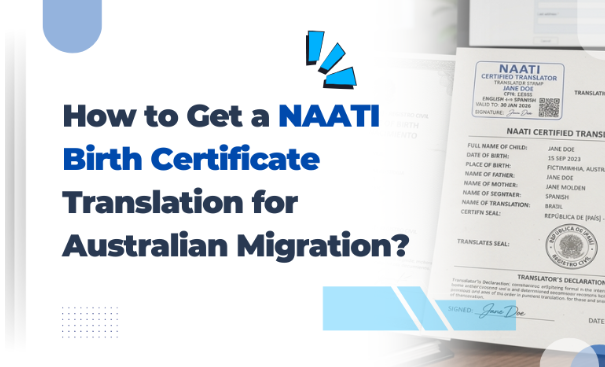
In order to migrate to Australia successfully, you need to submit a NAATI-certified translation of your birth certificate. The Department of Home Affairs (DHA) rejects non-professionally translated documents. Without the official NAATI stamp, a translated document has no legal validation. It is important to hire a professional translator with NAATI accreditation to translate the non-English birth certificate. This article covers important details regarding this requirement. Keep reading to become fully informed!
Why is a NAATI birth certificate translation mandatory for my visa?
In the Australian migration system, ensuring the quality and authenticity of translated documents is paramount to prevent fraudulent applications. The officials only trust translations that are provided by professional translators who are accredited by the National Accreditation Authority for Translators and Interpreters (NAATI).
Whether you are making an application to Subclass 189, 190, or a Partner Visa, your main source of identity is a professional Birth Certificate Translation.
Official reviewers need it to confirm
- Your full name
- Date of birth
- Place of birth
- Parents’ details.
In Australia, the NAATI seal is trusted more than any overseas notary. The seal includes the name of the translator, his/ her ID, and the date of work.
Using a NAATI-certified professional ensures:
- The translation document is the exact replica of the original document
- Adhering to the Department of Home Affairs guidelines.
- Avoiding the risk of document forgery or misinterpretation.
Apart from this, a NAATI-certified birth certificate is also accepted by secondary bodies like AHPRA or Engineers Australia without any question.
How much does a NAATI birth certificate translation cost in Australia?
The cost will be based on the complexity of your document and the turnaround time. In Australia, the majority of translators charge a flat rate or per page for standard personal identity documents.
Generally, you can expect the following price ranges:
- Standard Service (3-5 days): $69 – $95 per document.
- Express Service (24 hours): $110 – $150 per document.
- Complex Documents: Documents that have numerous stamps or handwritten marginal notes can be charged more.
Price normally comprises a digital copy emailed and, in some cases, a physical copy mailed by Australia Post.
Finding reliable NAATI Translators online
When starting to search for NAATI Translators, it is crucial to verify their status on the NAATI site. The system has been tightened since the change to “Certified” levels instead of Accredited in 2018. Many language service providers, like the AustralianTranslationServices team, work directly with NAATI professionals to provide certified translation solutions online.
Next, to cross-check the work, check for the digital stamp or a wet-ink signature on physical documents. Most reliable professionals will provide a scan of the translation before they mail the hard copy.
This will enable you to confirm that the spelling of names and places is exactly as they are in your other documents, e.g., passport. The slightest mistake in your date of birth can put your citizenship application on hold for months.
What is the difference between a full and an extract translation?
Most countries have two types of birth certificates. The Full version is the complete account of your birth. An Extract is a condensed version of the key facts.
In Australia, the choice between these two matters significantly:
- In the case of Home Affairs (Migration), you nearly always require a Full translation. They have to observe the full names of your parents to create kinship.
- In the case of VicRoads or Service NSW (Driving Licence), an extract is most often adequate.
- In the case of Passports, a full version is required.
In case your original document bears any stamps, signatures on the reverse, or marginal notes regarding marriage, they should be given. A translator is not allowed to omit parts of a legal text.
Will Home Affairs accept foreign translations of birth certificates?
This is among the most frequently asked questions by the applicants. The answer to this is: not often.
The Department of Home Affairs favours translations made in Australia. In case you have a translation that was done in your mother country, then it should comply with certain global standards. These norms tend to demand a stamp by a public notary or embassy.
Nevertheless, despite these stamps, Australian case officers usually request a NAATI version. A NAATI translation is cheaper and easier to pay for than to dispute a rejection or employ an overseas notary. To be at ease with this, it is best to obtain a local Australian certification.
What documents do I need to provide for the translation?
To ensure a smooth process, provide the following:
- A Clear Scan: Scan the original document with a high-resolution and colour scan. Do not trim off corners.
- Passport Name Spelling: Instruct the translator on how your name is displayed on your passport.
- Both Sides: In case you have stamps on the other side of the certificate, scan that side as well.
- Translation Format: Indicate whether you require a digital-only or a physical paper version for the Australian Passport Office.
How long does the translation process typically take?
Timing is everything in visa applications. Most NAATI-certified translators operate as small businesses. A standard turnaround time is roughly three business days.
If you have a deadline from Home Affairs, you can opt for an “Express” or “Same Day” service. Digital delivery via email is instantaneous. However, if you require a physical hard copy for a face-to-face appointment at Service Australia, you should factor in 3 to 5 days for postage. Express Post within Australia is the best option for speed and tracking.
Specific rules for AHPRA and professional registration
If you are a nurse, doctor, or engineer moving to Australia, your birth certificate translation must be flawless. AHPRA (Australian Health Practitioner Regulation Agency) has particularly strict identity requirements.
- They often require the original physical translation to be posted.
- Copies must be certified by a Justice of the Peace (JP) or a legal professional.
- The translator must be NAATI-certified at the Professional (or higher) level.
Conclusion
Navigating the Australian migration system is often a test of patience. Your birth certificate is the foundation of your Australian identity. Ensuring it is translated by a NAATI-certified professional is the only way to avoid bureaucratic hurdles.
Whether you are using a paid service or applying through the government’s Free Translating Service, the details matter. Ensure your scans are clear, your name spellings are consistent, and your translator holds current NAATI credentials. By following these Australian-specific rules, you will streamline your path to residency, employment, and citizenship.