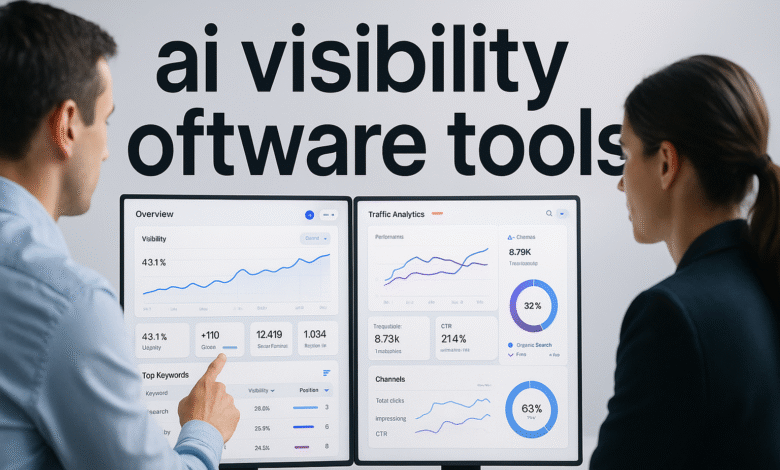
Artificial intelligence is changing the way people search online. Instead of browsing through pages of blue links, users are increasingly asking questions directly to AI engines like ChatGPT, Gemini, Perplexity, and Google AI Overviews.
That shift creates a new challenge for businesses: Are AI systems actually mentioning your brand when potential customers ask for recommendations?
Traditional SEO tools were built for rankings, keywords, and backlinks. But AI-driven discovery requires a different type of visibility tracking. Today, a growing number of platforms help brands understand how they appear inside AI-generated answers and conversational search experiences.
Here are nine AI visibility and AI search tracking tools that marketers, SEO professionals, and businesses should watch closely.
Vercite is an AI brand tracking Platform
Vercite is an AI-powered brand tracking platform designed to help businesses understand how their brand is being represented across AI-driven search engines and conversational assistants. As more people rely on AI tools to discover products, services, and information, Vercite enables companies to monitor brand mentions, analyze AI-generated responses, and measure their visibility across multiple AI platforms. The platform provides actionable insights into brand perception, competitor performance, citation sources, and content effectiveness, allowing marketing teams to optimize their digital presence for the evolving AI search landscape. By combining advanced analytics with real-time monitoring, Vercite helps organizations make data-driven decisions that strengthen brand awareness, improve online reputation, and increase visibility in AI-generated search results.
1. PromptRush
One of the most talked-about newcomers in the AI visibility space is PromptRush. The platform focuses specifically on helping brands understand whether AI engines mention them during buyer-oriented searches.
What makes PromptRush stand out is simplicity. Users can run a free ai visibility checker that instantly scans platforms like ChatGPT, Gemini, Perplexity, Google AI Overviews, and AI Mode. The tool provides a visibility score along with a ranked list of competitors most frequently referenced by AI systems.
Unlike many enterprise-focused tools, PromptRush offers immediate results without requiring a credit card, software installation, or even account registration for the initial preview.
Additional features available through registered accounts include:
- Citation source tracking for AI mentions
- Full prompt-by-prompt AI responses
- Daily monitoring scans
- Multi-project collaboration workspaces
- Trend dashboards for ongoing AI visibility analysis
The company also benefits from deep SEO industry experience, with founders who have reportedly worked in search marketing for more than a decade. Users frequently highlight the responsive support team and rapid feature development cycle.
For brands beginning to explore AI search optimization, PromptRush provides one of the easiest entry points into the category.
2. ProFound
ProFound has emerged as a specialized platform focused on monitoring how AI-powered systems interpret and surface brand information online.
The platform emphasizes semantic visibility rather than traditional keyword rankings. Instead of simply tracking search engine positions, ProFound analyzes how AI engines contextualize businesses, products, and expertise within generated answers.
Key strengths often associated with ProFound include:
- Entity-based visibility tracking
- AI citation monitoring
- Competitive positioning insights
- Conversational search analysis
- Brand sentiment interpretation within AI outputs
Many marketers appreciate the platform’s emphasis on understanding how AI models “perceive” a brand across multiple information sources.
As conversational search becomes more influential, semantic analysis tools like ProFound are likely to gain increased importance.
3. Ahrefs
Ahrefs remains one of the most recognized SEO platforms in the industry, and the company has increasingly adapted its toolkit for the AI search era.
Originally known for backlink analysis and keyword research, Ahrefs now incorporates AI-related insights into its broader search intelligence ecosystem.
Popular Ahrefs capabilities include:
- Advanced backlink analysis
- Content gap research
- SERP monitoring
- AI-assisted keyword clustering
- Search intent analysis
- Competitive content discovery
Because AI engines often pull information from authoritative and well-linked content, many SEO professionals still rely heavily on traditional optimization tools like Ahrefs while adapting strategies for AI-generated search environments.
The platform’s extensive data infrastructure also makes it valuable for large-scale content research.
4. Semrush
Semrush has rapidly expanded its AI search monitoring capabilities as businesses shift toward generative search experiences.
Known as a comprehensive digital marketing suite, Semrush combines SEO, PPC, content marketing, and competitive intelligence into a single ecosystem.
Its AI-related features increasingly focus on:
- AI Overview tracking
- Search visibility analytics
- Content optimization suggestions
- Competitive AI SERP analysis
- Brand monitoring across search experiences
- Topic authority measurement
One advantage of Semrush is its all-in-one structure. Businesses already using the platform for SEO and advertising can often integrate AI visibility workflows into their existing marketing processes.
For larger organizations managing multiple digital channels, this unified approach can simplify reporting and collaboration.
5. SE Ranking AI Search Toolkit
SE Ranking has introduced specialized AI-focused capabilities through its AI Search Toolkit, helping marketers adapt to evolving search behavior.
The toolkit concentrates on monitoring AI-generated search experiences and identifying how content performs in emerging discovery environments.
Features commonly highlighted include:
- AI answer monitoring
- Prompt-based visibility analysis
- Competitor benchmarking
- Search intent segmentation
- Content optimization recommendations
- SERP volatility tracking
SE Ranking is often appreciated for offering a balance between usability and affordability, making it attractive for agencies, freelancers, and mid-sized businesses.
As AI-generated answers become more prominent in search interfaces, tools focused on prompt-level analysis may become increasingly valuable.
6. Keyword.com AI Visibility
Keyword.com has expanded beyond rank tracking into AI visibility measurement, reflecting the growing importance of conversational search monitoring.
The platform focuses on helping businesses understand how AI-generated responses affect discoverability and brand exposure.
Core areas of focus include:
- AI citation frequency
- Prompt visibility tracking
- Search appearance analysis
- Historical visibility trends
- Competitive AI benchmarking
- Automated reporting dashboards
Many marketers value Keyword.com for its relatively streamlined interface and reporting capabilities, particularly when communicating AI visibility performance to clients or stakeholders.
The growing overlap between rank tracking and AI response monitoring makes platforms like Keyword.com especially relevant during this transition period in search marketing.
7. SISTRIX AIO Tracker
SISTRIX has long been known for search visibility analytics, particularly in European SEO markets. Its AIO Tracker expands that expertise into AI-generated search environments.
The platform monitors visibility within AI Overviews and generative search experiences while maintaining traditional SEO performance tracking.
Important capabilities include:
- AI Overview presence tracking
- Domain visibility analysis
- Historical search trend comparisons
- SERP feature monitoring
- Competitive benchmarking
- International search visibility insights
SISTRIX is especially useful for businesses operating across multiple countries and languages, where AI search behavior may vary significantly between regions.
The platform’s strong historical data also helps marketers analyze how AI-driven search changes affect long-term visibility trends.
8. Surfer AI Tracker
Surfer has built its reputation around content optimization, and its AI Tracker extends that philosophy into conversational search monitoring.
The platform focuses heavily on content performance and AI discoverability.
Features often associated with Surfer AI Tracker include:
- AI-driven content scoring
- Visibility monitoring across AI engines
- Prompt-specific content analysis
- Optimization recommendations
- Competitive content comparisons
- Topic authority tracking
Because AI systems frequently favor well-structured, authoritative content, Surfer’s optimization-first approach aligns naturally with many AI visibility strategies.
Content marketers and SEO writers may particularly benefit from tools that connect optimization workflows directly to AI visibility outcomes.
9. seoClarity AI Overview Tracker
seoClarity has positioned itself as an enterprise-grade search intelligence platform, and its AI Overview Tracker addresses the growing need for large-scale AI search monitoring.
The platform is designed for organizations handling complex SEO operations across extensive websites and multiple markets.
Key capabilities include:
- Enterprise AI visibility monitoring
- Automated SERP analysis
- AI Overview reporting
- Large-scale keyword segmentation
- Competitive landscape analysis
- Workflow automation integrations
seoClarity’s strength lies in handling large datasets and delivering advanced reporting structures suitable for enterprise marketing teams.
As AI-generated search experiences evolve, scalable monitoring solutions will become increasingly important for global brands.
10. ZipTie.dev
ZipTie.dev approaches AI visibility from a more developer-oriented perspective, offering tools and APIs for monitoring AI-generated mentions and search behavior.
Unlike traditional SEO suites, ZipTie.dev emphasizes flexibility and technical integrations.
Notable features include:
- API-first AI visibility tracking
- Custom prompt monitoring
- Developer integrations
- AI mention analysis
- Automated workflows
- Flexible reporting systems
Technical teams and SaaS companies may find ZipTie.dev particularly useful when integrating AI monitoring directly into internal analytics environments.
Its developer-focused approach differentiates it from more marketing-centric competitors.
Why AI Visibility Matters More Than Ever
Search behavior is changing rapidly. Instead of clicking through ten blue links, users increasingly trust AI-generated recommendations and summaries.
That creates an entirely new layer of competition.
Brands now need to ask questions like:
- Does ChatGPT mention our company?
- Are competitors appearing more frequently in AI answers?
- Which prompts trigger visibility for our products?
- What sources are AI systems citing?
- How can we improve discoverability in conversational search?
Traditional SEO still matters. Backlinks, content quality, technical optimization, and authority remain foundational. However, AI visibility introduces a new measurement layer that businesses can no longer ignore.
The tools listed above represent the beginning of a rapidly evolving category focused on helping brands adapt to AI-first discovery.
Final Thoughts
AI search visibility is quickly becoming one of the most important emerging metrics in digital marketing. As conversational interfaces reshape how users discover products, services, and information, businesses need tools capable of tracking those changes.
Platforms like PromptRush, ProFound, Ahrefs, Semrush, SE Ranking, Keyword.com, SISTRIX, Surfer, seoClarity, and ZipTie.dev each approach the challenge differently. Some focus on enterprise analytics, others emphasize content optimization, while newer platforms specialize entirely in AI-generated search monitoring.
For marketers looking to understand how AI engines talk about their brand today, AI visibility tracking is no longer optional — it is becoming an essential part of modern SEO strategy.