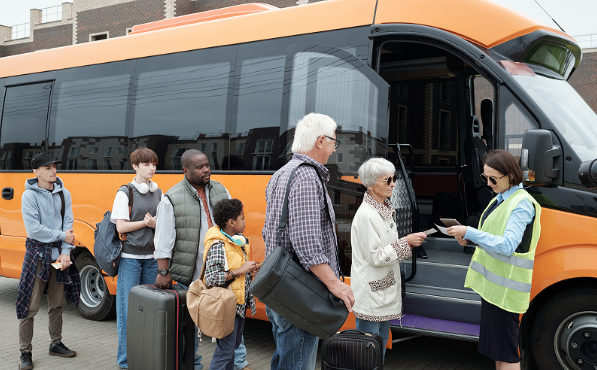
Transport planning involves more than selecting a vehicle and setting a departure time. The boarding and alighting locations must also provide appropriate access for the vehicle while allowing passengers to enter and leave in an orderly manner.
This is particularly relevant when booking a chartered bus for a larger group. A 40-seater bus requires sufficient road access, stopping space and clearance, while the chosen location may also be subject to local parking, loading and traffic restrictions.
Suitable locations commonly include designated bus bays, venues with coach access, private premises with loading areas and certain public transport facilities. However, organisers should confirm the rules and physical conditions at each location before finalising the journey.
Designated Bus Bays and Coach Pick-Up Points
Designated bus bays and coach pick-up points are specifically intended to accommodate larger passenger vehicles. Where available and permitted for chartered vehicles, they can provide a practical location for organised boarding and alighting.
These locations may separate buses from general traffic and provide a defined place for passengers to meet. Their suitability still depends on the restrictions that apply to the individual bay.
Before using one, organisers should check:
- Whether chartered or private buses are permitted.
- Any maximum stopping or waiting times.
- Operating hours or access restrictions.
- Whether advance approval or a booking is required.
- Whether the bay is suitable for the dimensions of the vehicle.
- Where passengers can wait without obstructing roads or pedestrian routes.
Drivers may not be permitted to wait in a bus bay for an extended period. Passengers should therefore be given a clear meeting time so boarding can take place efficiently once the vehicle arrives.
Overall, designated bays can be suitable where their rules permit the intended use and the vehicle can access them safely.
Hotels, Event Venues and Convention Centres With Coach Access
Hotels, convention centres and larger event venues may have dedicated arrival areas, driveways or loading zones for coaches and other large vehicles. These facilities can simplify group arrivals because passengers can often board or alight close to the venue.
However, not every entrance or driveway can accommodate a 40-seater bus. Vehicle height, turning space, driveway width and temporary traffic arrangements may affect access.
Organisers should contact the venue in advance to confirm:
- The approved coach entrance and exit.
- The designated passenger pick-up and drop-off point.
- Vehicle height or size restrictions.
- Whether the bus can wait on the premises.
- Any security or registration procedures for arriving vehicles.
- Whether event-day traffic management changes normal access.
For busy events, venues may assign specific arrival windows to different vehicles. Providing passengers with the exact boarding location can also reduce confusion around venues with several entrances.
In summary, venues with established coach access are generally more practical than selecting an unverified roadside location, provided their access procedures are confirmed beforehand.
Schools, Offices and Private Premises With Suitable Loading Areas
Schools, office developments and other private premises may have internal driveways, loading areas or designated passenger zones. These can be suitable when the property owner or management permits access by chartered buses.
That said, when booking a chartered bus for a school trip, company outing or organised group journey, the organiser should verify that the planned loading area can accommodate the vehicle. Access should not be assumed simply because smaller vehicles regularly use the premises.
Important considerations include:
- Entrance and exit width.
- Turning and manoeuvring space.
- Height barriers or overhead structures.
- Security gates and access controls.
- Pedestrian routes around the loading area.
- Other vehicles using the same space.
- Restrictions imposed by building or site management.
Passenger organisation is also important. Groups should wait in an appropriate area away from vehicle movement until boarding begins.
Private premises can therefore offer controlled boarding conditions, but permission, vehicle access and site procedures should be confirmed in advance.
Public Car Parks and Transport Facilities That Permit Large Buses
Some public car parks, transport facilities and designated coach parking areas may accommodate large buses. Their suitability depends on the facility’s vehicle restrictions and whether passenger pick-up and drop-off activities are permitted.
A car park that can physically accommodate a bus is not automatically an approved boarding point. Operators and organisers should check the applicable rules before including the location in an itinerary.
Factors to verify include:
- Vehicle height and length limits.
- Entry and exit clearance.
- Spaces designated for buses or coaches.
- Parking and waiting restrictions.
- Passenger loading and unloading rules.
- Operating hours.
- Access to safe pedestrian routes.
Transport interchanges and other controlled facilities may have separate areas for different vehicle types. Chartered buses should use only locations where private coach operations are permitted.
Public facilities can provide useful meeting points for group travel, particularly when they have designated large-vehicle areas. Checking the facility’s current access and stopping rules remains necessary before the journey.
Contact A&S Transit to ensure a smooth group journey today.