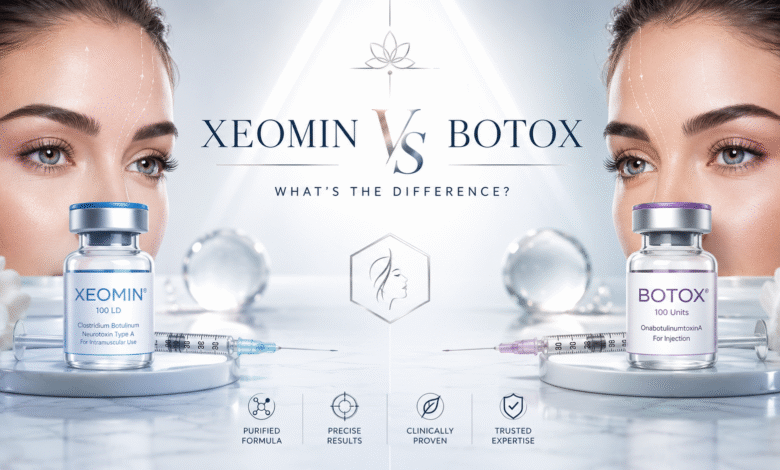
If you have been debating between Xeomin and Botox for a while now, you are definitely not alone. These two injectable neuromodulators dominate the cosmetic treatment world, and for good reason; both deliver real, visible results.
Still, they are not exactly the same thing, and the differences between them matter more than most people realize. Before you book your next appointment, it is worth taking a close look at what each one actually offers. In fact, if you are already a regular user of either treatment, it might be a smart idea to first calculate your monthly savings by switching or adjusting your treatment schedule, since costs can add up considerably over time.
So, what exactly are Xeomin and Botox?
Both are FDA-approved injectable treatments derived from botulinum toxin type A. Both work by temporarily blocking nerve signals to targeted muscles, which in turn reduces the appearance of fine lines and wrinkles. Beyond that shared foundation, however, the two products diverge in some meaningful ways.
What Is Botox?
Botox, made by Allergan (now part of AbbVie), has been on the market since 2002 and is, without question, the most recognized name in cosmetic injectables. It contains botulinum toxin type A along with accessory proteins (namely hemagglutinin and other complexing proteins) that surround the active molecule.
Key Features
- FDA-approved for cosmetic and medical use
- Works within 3–7 days, with full results visible at 2 weeks
- Results typically last 3–4 months
- Available globally with a well-established track record
Pros
- Decades of clinical data backing its safety and efficacy
- Widely available; almost every aesthetic clinic carries it
- Dual approval for both cosmetic and therapeutic use (migraines, hyperhidrosis, jaw clenching)
- Predictable, consistent results for most patients
Cons
- Accessory proteins may trigger antibody resistance over time with repeated use
- Slightly higher cost in many markets
- Requires refrigeration throughout storage
Pricing
In the U.S., Botox is typically priced per unit, ranging from $10 to $25 per unit. A standard forehead treatment uses anywhere from 10 to 30 units, putting the average session cost between $200 and $600, depending on the provider and location.
What Is Xeomin?
Xeomin, manufactured by Merz Aesthetics and approved by the FDA in 2011, is often described as the cleaner or more stripped-down version of botulinum toxin. Unlike Botox, Xeomin contains only the pure botulinum toxin molecule, with no accessory proteins whatsoever. This formulation is sometimes referred to as a naked neurotoxin.
Key Features
- Contains pure botulinum toxin type A with no complexing proteins
- FDA-approved for glabellar lines (frown lines between the brows)
- Does not require refrigeration before reconstitution, which simplifies storage
- Results appear within 3–7 days, lasting 3–4 months
Pros
- Lower likelihood of developing antibody resistance over time
- Room-temperature storage makes it more practical for clinics
- Often priced slightly lower than Botox
- Suitable for patients who have developed tolerance to other neuromodulators
Cons
- Less brand recognition, which can make patients hesitant
- Fewer FDA-approved indications compared to Botox
- Some practitioners report a slightly shorter duration in certain patients, though evidence on this is mixed
Pricing
Xeomin is also priced per unit and generally costs between $9 and $20 per unit. A comparable forehead treatment can run between $175 and $500, making it marginally more affordable on average.
How Each Works
Both treatments follow a broadly similar process. A trained provider uses a fine needle to inject small amounts of the toxin into specific facial muscles. The toxin then binds to nerve terminals and blocks the release of acetylcholine, the neurotransmitter responsible for muscle contraction. As a result, the targeted muscles relax, and overlying wrinkles soften noticeably.
The treatment itself takes only 10–20 minutes in most cases. There is no downtime required, and most people return to their normal routine the same day. That said, providers typically advise against strenuous exercise, lying flat, or rubbing the treated area for at least 4 hours post-injection.
Side Effects
Both Xeomin and Botox carry a similar side effect profile, since they share the same active ingredient. The most commonly reported side effects include mild bruising or swelling at the injection site, a temporary headache, redness or tenderness around the area, and in rare cases, drooping of the eyelid or brow (known as ptosis), which resolves on its own over time.
More serious adverse events, such as difficulty swallowing or breathing, are extremely rare and are almost always associated with improper technique or off-label use at much higher doses. Additionally, neither treatment is recommended during pregnancy or for individuals with certain neuromuscular conditions.
One notable distinction here is that Xeomin, due to the absence of accessory proteins, carries a theoretically lower risk of allergic reaction. That said, documented cases of true allergy to either product remain quite rare overall.
Who Should Consider Switching
Patients who have been on Botox for several years and notice that results are becoming less effective or shorter-lasting may benefit from switching to Xeomin. This reduced efficacy is sometimes linked to the development of antibodies against the accessory proteins in Botox. Since Xeomin lacks those proteins entirely, it presents a different antigenic profile, which may well restore responsiveness in these patients.
On the other hand, individuals who are brand-new to neuromodulators and want a highly predictable outcome backed by decades of data may still prefer Botox as their starting point. Neither choice is wrong; it genuinely depends on where you are in your treatment history.
Making Your Choice
Imagine you are planning a memorable trip, say, going to the Faroe Islands, and you want to look refreshed in every photo without your skin feeling tight or overdone. Both Xeomin and Botox can absolutely deliver that natural, well-rested result when administered by a skilled injector. Realistically, the bigger determining factor is not which brand you choose but who is holding the needle. An experienced provider using either product will consistently outperform an inexperienced one, regardless of what is in the syringe.
That said, cost-conscious patients who are already comfortable with injectables and want a slightly more affordable option with a lower risk of antibody buildup may find that Xeomin aligns better with their long-term aesthetic goals. Botox, meanwhile, remains the gold standard for first-timers and for patients who need therapeutic benefits alongside cosmetic ones.
The Final Verdict
At the end of the day, Xeomin and Botox are far more alike than they are different. Both are safe, effective, and fully capable of delivering the smooth, line-free results people are after. The protein-free formulation of Xeomin gives it a slight edge for long-term users concerned about resistance, and its marginally lower price point is a practical advantage worth considering. Botox, in contrast, carries unmatched brand recognition, broader approved indications, and a clinical track record that spans over two decades.
The best approach, therefore, is to consult a board-certified dermatologist or plastic surgeon who can evaluate your skin, treatment history, and goals before recommending one over the other. Neither product is universally superior; the right choice is simply the one that fits your body, your budget, and your expectations.