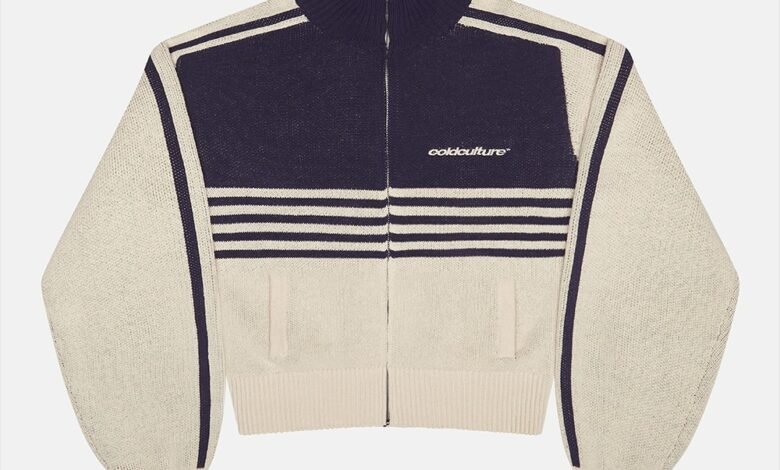
Ten pieces on the entire knit page, and the prices hardly move. €113 at one end, €125 at the other, so an entire category comes down to a twelve-euro decision — the tightest stretch of money anywhere in the Cold Culture catalog. Which means the budget question dies on the first scroll, and something harder takes its place.
Twelve euros, ten garments
Sort the rail low to high and the whole thing reads out in one breath: €113, then €120, a pair at €121, then €122, €123, €124, and three pieces sitting together at €125. Nine of the ten crowd into the top six euros. Not much of a ladder.
The one sitting alone at €113
A gray, black and white knit holds the bottom of the rail by itself, seven euros clear of whatever comes next. That’s a real gap on a page this flat, and the page doesn’t explain it. Yarn weight, panel count, how much of the pattern runs across the chest — any of those could sit behind it, and guessing which one would just be guessing. What you can say is that it’s the only knit here under €120.
Why €120 and €125 behave like the same price
Five euros across a €120 garment works out at roughly four percent. Nobody shops on four percent. So those nine pieces aren’t really a range at all, they’re a single price with a bit of rounding noise on top, and anyone trying to shop the rail by cost will end up staring at nine near-identical numbers wondering what to do next. The answer is to stop reading prices and start reading garments.
Zip it, or pull it over your head
Once money stops sorting the page, construction does. The rail splits cleanly in two, and that split is the only decision on it worth more than a few seconds.
Two zip knits
The POWERLINE pair opens down the front — one in beige with burgundy at €122, the other in beige with dark navy at €125. A zip changes how a knit behaves far more than three euros suggests. You can wear it open over a tee in a warm room, close it on the walk home, and never take it off your shoulders in between. A pullover can’t do that.
Eight that go over the head
The rest are closed-front knits, and the color stories vary more than the prices do:
- Three WINNER knits in green, blue, and a gray-black-white mix, running €113 to €125.
- Two camouflage-print knits, one pink and one in a dark brown, at €121 and €120.
- A dirty-black knit at €125, plus a black piece from the SIN REGLAS line at €124.
Eight pieces, four color families. For a ten-piece rail that’s a surprising amount of variety, and it’s where the actual choosing happens.
Where this rail sits next to everything else
Here’s the detail that reframes the knit page. Its cheapest piece costs €113, and the dearest sudadera cold culture on its own rail stops at €111. Nothing in knitwear undercuts the top of the hood rail. Not one piece. Cross from one page to the other and you’ve crossed a floor, not a price point.
The contrast with the rest of the shop is sharp too. Shorts run €55 to €99, a forty-four euro spread. Puffers go €110 to €150. Hoodies cover €90 to €111 across thirty-eight pieces. Against all that, twelve euros over ten knits looks almost stubborn — as though the rail were built as one tier and priced accordingly.
Soria in February, Almería in April
Spain makes knitwear a regional purchase rather than a seasonal one. Ávila sits above a thousand meters, and Soria isn’t far behind, which gives both of them the kind of winter where a mid-weight knit does genuine work from November through March. Head south and the same garment turns into a four-week thing, maybe six.
So the length of your knit season probably matters more to the decision than which of those nine near-identical prices you land on. A €125 piece worn thirty times beats a €113 piece worn four. Obvious, and still the thing people skip.
The afternoon problem
Inland Spain swings hard between morning and mid-afternoon, and a closed knit handles that badly. You’re warm at nine, uncomfortable by two, and there’s nothing to adjust. That is the practical argument for the zip pair — not the construction in the abstract, just the fact that you can open it halfway through a day that didn’t stay still.
Frequently Asked Questions
Why does knitwear start higher than the hoodies?
Nobody outside the shop can answer that honestly. Knit construction differs from a brushed fleece, and yarn behaves differently from loopback cotton, but the actual costing isn’t published anywhere. The observable fact is the floor: €113 here, €90 on the hood rail.
Is the €113 knit a lesser garment?
Nothing on the page says so. It’s a gray, black and white WINNER knit that happens to sit seven euros under the cluster. Treating a price gap as a quality verdict is a habit worth dropping, especially on a rail this narrow.
How many knits are on the rail?
Ten, which ties it with puffers and trousers as the smallest category in a catalog of a hundred and seventeen pieces. The hood rail alone carries thirty-eight.
Do the zip knits cost more than the pullovers?
Barely. €122 and €125 both land inside the same cluster the pullovers occupy, and three closed-front knits match that €125 exactly. The zip isn’t a premium on this rail.
What about sizing and delivery?
Neither is spelled out on the product pages, so checkout is where you’ll see the shipping terms. For fit, the relaxed cut these knits are built on tends to run generous, and the measurements are worth checking rather than assumed.
Ten pieces, twelve euros, and one decision that has nothing to do with money. Pull the zip pair up against the eight pullovers, think about how your own winter actually behaves, and the knit page sorts itself out in about a minute.