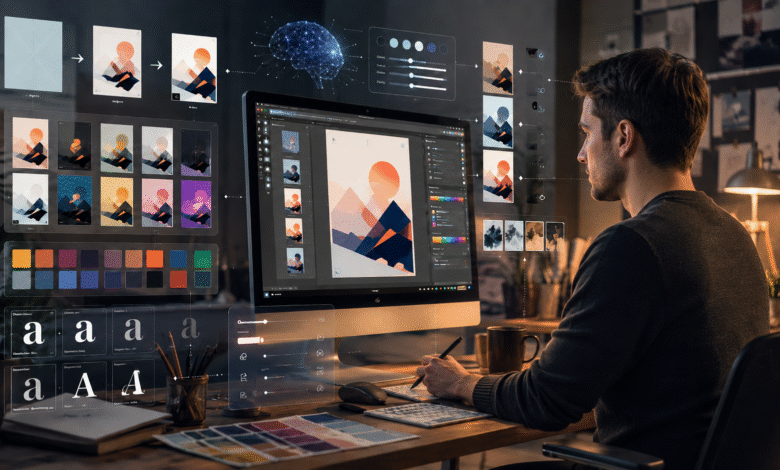
Graphic design has always been a discipline defined by iteration — sketch, revise, refine, repeat. For decades, that loop was bound by how fast a human hand (and a human brain) could move. That constraint is starting to loosen. Artificial intelligence isn’t replacing the creative process, but it is compressing the distance between an idea and a usable draft, and that’s changing how designers actually spend their day.
From Blank Canvas to First Draft in Minutes
The most obvious shift is at the very start of a project. Where a designer once spent the first hour or two sketching thumbnails or scrolling mood boards for inspiration, AI tools can now generate a dozen visual directions from a single prompt. That doesn’t eliminate the designer’s judgment — someone still has to decide which direction is worth pursuing — but it removes the blank-page problem almost entirely.
This is where tool selection starts to matter a lot. Not every AI design tool is built for the same job; some are tuned for photorealistic imagery, others for vector-style illustration, layout generation, or rapid mockups. Picking the wrong one for the task can cost more time than it saves. For designers trying to sort through the growing list of options, this roundup of the Best AI Design Tools for Graphic Designers breaks down which platforms are actually worth adding to a working pipeline versus which ones are just noise.
Iteration Speed Is the Real Unlock
The bigger change isn’t generation — it’s revision. Client feedback used to mean redoing a layout from scratch or manually adjusting dozens of elements one at a time. AI-assisted tools now let designers make sweeping stylistic changes — a new color palette, a different typography pairing, an alternate composition — in a fraction of the time. That means more rounds of feedback can happen in the same timeframe, and clients get to see more options before a project is locked in.
For freelancers and small studios, this speed also changes what’s commercially viable. Projects that once felt too small to take on, because the turnaround math didn’t work, are suddenly profitable again. A logo package or a set of social templates that used to take a week can realistically ship in a couple of days.
Where Human Judgment Still Wins
None of this means AI is making creative decisions on its own. The tools are good at generating options and handling repetitive execution — resizing assets across formats, cleaning up backgrounds, batch-exporting variations. They’re still weak at things that require genuine context: understanding a brand’s history, reading the emotional tone a client actually wants, or knowing when a “technically correct” design just doesn’t feel right. That judgment gap is exactly why designers, not algorithms, are still the ones steering the process.
This is also showing up on the business side of design work. Agencies that have leaned into AI-assisted workflows aren’t cutting creative staff — they’re reallocating time toward strategy and client relationships instead of manual production. Marketing-focused shops in particular have had to rethink how design fits into a broader campaign timeline, since faster asset turnaround changes what’s possible on tighter deadlines. Agencies like Zeronovax, which works across digital marketing and creative delivery, have had to adapt their internal workflows to match — treating AI tools less as a novelty and more as infrastructure that sits underneath the creative work clients actually see.
What This Means for the Next Few Years
The direction is fairly clear: AI tools will keep getting better at execution, and designers will keep moving up the value chain toward direction, taste, and strategy. The skill that matters most going forward may not be technical rendering ability at all — it’s knowing which tool fits which job, and knowing when to override what the AI suggests.
For anyone working in design right now, the practical takeaway is simple. Treat these tools as a way to get to a strong first draft faster, not as a replacement for the eye that makes a design actually work. The workflow is changing. The judgment behind it isn’t going anywhere.