I cancelled my Sky subscription on a wet Tuesday back in January, and I’ll be honest with you — I sat there a good ten minutes with the phone in my hand before I actually went through with it. Twelve years a customer, that was. But the bill had crept up to nearly £80 a month, I was watching maybe five channels out of the hundreds I was paying for, and the kids hadn’t so much as glanced at the box in months. So I jumped. And it turns out I’m in very good company: cord-cutting UK households have gone properly mainstream in 2026, and most of us are left wondering why on earth we didn’t do it years ago.
cord-cutting means ditching a satellite or cable contract and pulling your telly in over the broadband instead — free catch-up apps, a streamer or two, and an IPTV service for the live channels. Most UK homes end up paying less than they did with Sky or Virgin, and it all works on the telly, the tablet, the lot. You’ll still need a TV Licence for live telly and BBC iPlayer, mind.
Cutting the cord, in plain English
It’s a less dramatic business than it sounds. Cord-cutting simply means walking away from a traditional pay-TV contract — your Sky, your Virgin Media — and pulling your television in over the internet instead. No dish on the wall, no engineer round, no twelve-month tie-in. You build your own little mix of services rather than handing one company a fortune for a giant bundle of channels you’ll never touch.
Why half the street seems to be at it
Money, mostly, if we’re being straight about it. A full Sky or Virgin package sails comfortably past £60 a month the moment your introductory deal runs out — and that’s before you’ve added the sport or the films. But it isn’t only the cost. People are fed up of being tied to one box in one room when they’d rather watch in the kitchen, on the train, or in bed. Rolling monthly deals mean you can walk away whenever you fancy. And there’s something quietly satisfying about paying only for what you actually sit down and watch.
What I swapped it all for
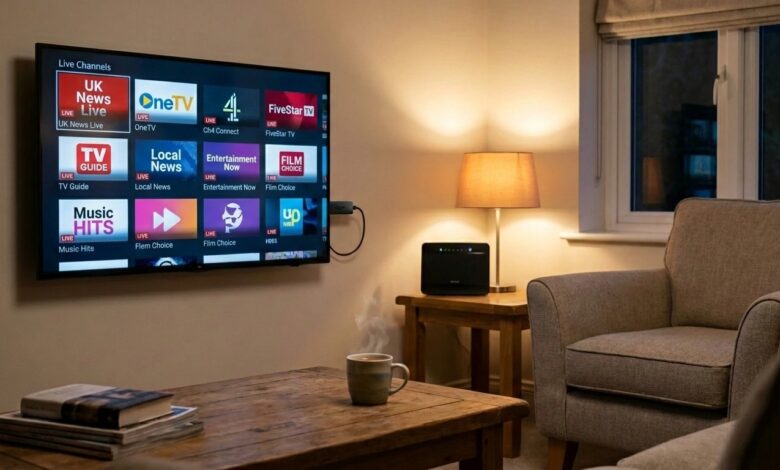
Like most folk, I ended up with a combination. The free broadcaster apps — BBC iPlayer, ITVX, Channel 4 and My5 — do far more heavy lifting than people give them credit for. Netflix and Prime cover the box sets. And for the live channels I genuinely missed, I went with a proper IPTV UK subscription, which bundles live telly, sport and catch-up into one app across all our devices on a single plan. That last bit was the clincher for me — it’s about as close as you’ll get to the old Sky experience without the contract hanging over you.
The maths that finally won me over
Here’s roughly how my month looks now compared with before:
| What I pay for | Rough monthly cost |
| Old Sky / Virgin bundle | £60–£90 |
| Broadband (paying it anyway) | £25–£30 |
| Two streaming apps | £15–£25 |
| IPTV subscription | £10–£15 |
Even once you’ve stacked a couple of services on top of the broadband you were paying for anyway, you’re still landing well under a full satellite bill. I reckon I’ve knocked a good third off mine.
A couple of things I’d do differently
If I were starting again, I’d be choosier from the off. The market’s heaving and the quality is all over the place, so before you hand over a penny, check for genuine uptime, proper HD or 4K, a working telly guide, enough connections for the household and a support line that actually answers. Don’t just guess — have a read of an honest best IPTV UK providers round-up and compare a shortlist. And get the kit right while you’re at it: a cheap streaming stick will breathe new life into an ageing telly in about five minutes flat, the same sensible, buy-it-once logic that applies to most everyday tech purchases.
But what about the footie?
This is the bit everyone frets about, and fair enough — live sport has a habit of scattering itself across half a dozen services. The free apps cover plenty, but not the big Saturday-afternoon stuff. A focused British IPTV line-up keeps the home favourites together — BBC One, ITV, Channel 4, Sky Sports, TNT Sports — in one place, which is also a godsend for anyone with family abroad who still wants a bit of British telly of an evening.
So is cord-cutting UK worth it?
Not a chance I’d go back. Six months in, nobody in the house has asked for the Sky box once. The picture’s the same, the bill’s smaller, and I’m not locked into a single thing. The only real adjustment was getting my head around one or two extra apps — and honestly, that took an afternoon.
A few things people always ask me
Is cord-cutting actually legal?
Completely. You still need a valid TV Licence for live telly or BBC iPlayer, but how the channels reach you is entirely your business.
How much will I really save?
Most people I know have shaved a third to a half off their monthly telly spend, depending on what they keep.
Do I need mega-fast broadband?
Not really — about 10 Mbps is grand for HD, 25 Mbps and up if you want dependable 4K.
What do I need to get going?
Next to nothing: a smart telly or a streaming stick, a half-decent broadband connection, and whichever apps or IPTV service you fancy.