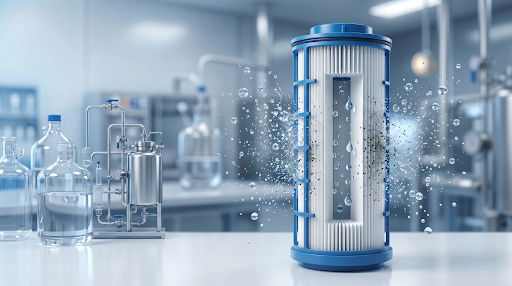
Filters are the least exciting component in any system, right up until one fails. Then the data centre overheats, the clean room is contaminated, or the water running through a cooling loop carries grit straight into expensive hardware. We almost never think about filtration, and that is precisely because, most of the time, it just works. Pull on that thread and you find a quiet part propping up a surprising amount of the technology you depend on every day.
It is worth understanding, because the logic of filtration is the same whether you are purifying drinking water or protecting a million-dollar production line. A cheap, replaceable part stands between something valuable and the invisible particles that would slowly destroy it.
How clean does clean actually need to be?
Most people picture a filter as a coffee screen catching the big bits. Industrial filtration works at a scale far smaller than that. The particles that damage sensitive equipment are usually invisible, measured in microns, where a single micron is a thousandth of a millimetre and a human hair is roughly seventy of them across. At that level a coarse mesh is useless. You need a barrier with openings fine and uniform enough to stop contamination you cannot see with your eye.
And it is not enough for the barrier to be fine. It has to be consistent. A filter with a few oversized gaps is almost as bad as no filter at all, because the worst particles slip straight through the weak points. Uniformity is the whole game.
What does a membrane actually do?
That is the job of a membrane filter cartridge. Instead of a simple screen, it uses a thin engineered membrane with a precise and even pore size, so it traps particles down to a chosen limit while still letting fluid pass through at a usable rate. The membrane is the clever part. Choose a tighter pore size and you stop smaller contamination, at the cost of slower flow. Choose a more open one and fluid moves faster but finer particles get through. Engineers pick the membrane to match the job.
That flexibility is why the same basic component shows up in tasks that look completely unrelated. The cartridge purifying water in a treatment plant and the one guarding a semiconductor line are cousins, built on the same principle of a precise barrier doing a precise job. Swap the membrane and you change exactly what gets stopped.
Where does it quietly do its work?
Once you know what to look for, fine filtration turns up everywhere in the tech world. Data centres run liquid cooling loops, and a single piece of grit circulating in that loop can scratch and clog the parts it touches, so the fluid is filtered before it ever reaches the hardware. Chip factories depend on ultra-pure water and chemicals, where one stray particle landing on a wafer can ruin a component worth a fortune. Even the clean air in a sensitive workshop is the result of filtration that visitors never notice.
In every one of these cases the filter is doing protective work for equipment that costs far more than it does. Spend a little on the right cartridge and the expensive hardware downstream keeps running smoothly. Skip it, or stretch it past its life, and you find out the hard way what those invisible particles can do to a machine that was never built to handle them.
How long should a filter actually last?
A filter does not fail all at once. As it traps more and more particles, its pores gradually load up, flow slows, and pressure builds on the upstream side. For a while the system compensates, which is part of why filtration is so easy to ignore. The filter quietly gets worse long before anything obvious goes wrong. Left alone, it eventually clogs hard enough to choke the flow, or worse, the trapped material breaks through and dumps contamination downstream in one go.
This is why good operators track the pressure difference across a filter rather than guessing by the calendar. A rising pressure drop is the filter telling you it is full and asking to be changed. Replace it at the right moment and the system never skips a beat. Stretch it to squeeze out a little more life and you risk taking down the very equipment the filter was there to protect. The schedule is cheap. The failure is not.
The cheap part that protects the expensive one
There is a quiet logic to good filtration. It is usually one of the lowest-cost items in the entire system, and one of the most important. A cartridge that gets swapped on schedule stays invisible and nobody ever thinks about it. The same cartridge left in place until it clogs can take a whole line, loop, or floor of equipment offline, and turn a small maintenance job into an expensive emergency.
So while the attention goes to the processors, the screens, and the headline specs, spare a thought for the filter. It is small, it is cheap, and it is one of the real reasons the impressive hardware around it keeps working at all. The unsung hero of modern technology is often the part you can hold in one hand and throw away when it has done its job.