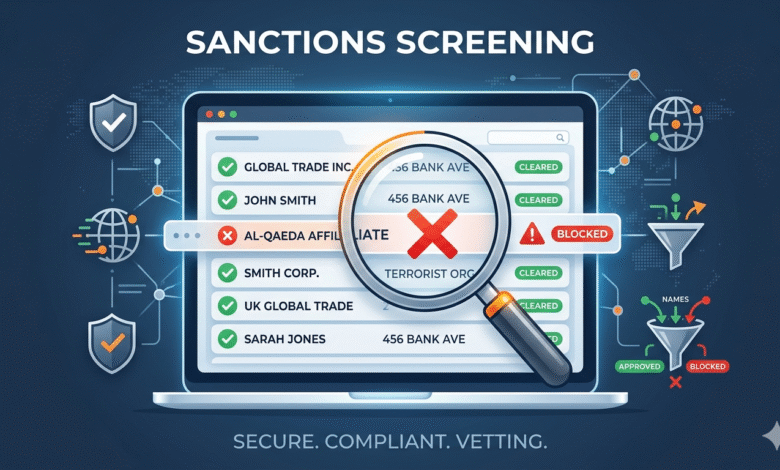
In today’s rapidly evolving regulatory landscape, financial institutions face increasing pressure to strengthen compliance programs and mitigate financial crime risks. As global sanctions regimes continue to expand, organizations must ensure that their screening processes remain accurate, efficient, and up to date. This is where Artificial Intelligence (AI) is reshaping the future of the Sanction Screening System, enabling businesses to improve compliance performance while reducing operational burdens.
Understanding Modern Sanctions Screening
Sanctions screening is a critical compliance process that helps organizations identify individuals, entities, and transactions that may be subject to regulatory restrictions. Financial institutions, fintech companies, payment providers, and other regulated businesses rely on screening technologies to compare customer and transaction data against government and international watchlists.
One of the most widely recognized databases is the OFAC Sanctions List, maintained by the U.S. Department of the Treasury’s Office of Foreign Assets Control. Companies operating internationally must continuously monitor sanctions updates to avoid regulatory violations and potential financial penalties.
Traditional screening methods often depend on rule-based systems. While these systems can identify potential matches, they frequently generate large volumes of false positives, creating inefficiencies for compliance teams.
The Growing Role of AI in Compliance Technology
Artificial Intelligence is revolutionizing how organizations approach Sanctions Screening by introducing smarter and more adaptive screening capabilities. Rather than relying solely on static rules, AI-powered solutions can analyze patterns, improve match accuracy, and support more informed compliance decisions.
Machine learning models can process vast amounts of structured and unstructured data, allowing compliance teams to detect risks more effectively. As a result, organizations can achieve stronger compliance outcomes without significantly increasing operational costs.
How AI Enhances a Sanction Screening System
AI-driven screening platforms offer several advantages over traditional compliance tools. These technologies help organizations manage increasing data volumes while maintaining regulatory standards.
Key benefits include:
- Improved name-matching accuracy across multiple languages and character sets.
- Reduced false positives through intelligent risk assessment.
- Faster screening of customers, vendors, and transactions.
- Continuous adaptation to evolving sanctions regulations.
- Enhanced investigation support for compliance analysts.
These capabilities allow organizations to streamline workflows and allocate resources to higher-risk cases that require human expertise.
Addressing Challenges Related to Secondary Sanctions
The growing complexity of global sanctions programs has increased attention on Secondary Sanctions, which can affect organizations conducting business with sanctioned parties indirectly. Identifying these risks requires more than simple list matching.
AI technologies can analyze relationships, ownership structures, and transactional patterns that may indicate indirect exposure to sanctioned entities. This broader risk perspective helps compliance teams identify potential concerns that traditional systems might overlook.
By incorporating advanced analytics, organizations can strengthen their ability to manage regulatory obligations across multiple jurisdictions.
Enhancing AML Sanctions Screening Programs
An effective AML Sanctions Screening strategy requires organizations to balance regulatory compliance with operational efficiency. AI contributes to this objective by improving data quality, automating repetitive tasks, and supporting more consistent decision-making.
For example, AI can help identify variations in names, addresses, and business information that may otherwise go undetected. This is particularly valuable when screening customers from diverse geographic regions where transliteration and spelling differences are common.
Furthermore, AI-powered monitoring systems can continuously evaluate customer activity and alert compliance teams when new risks emerge. This proactive approach supports stronger financial crime prevention efforts and helps organizations respond more quickly to changing regulatory requirements.
AI and the Future of Compliance Operations
As regulatory expectations continue to evolve, organizations are increasingly seeking technology solutions that deliver both accuracy and scalability. Advanced compliance platforms are moving beyond basic screening functionality and incorporating predictive analytics, intelligent automation, and real-time risk assessment.
Industry leaders such as AML Watcher are contributing to this transformation by providing innovative compliance solutions designed to help businesses navigate complex sanctions environments. By leveraging modern technologies, organizations can strengthen screening processes while improving operational efficiency.
The future of compliance will likely involve greater collaboration between human expertise and intelligent systems. AI is not replacing compliance professionals; instead, it is empowering them with better tools and deeper insights to make informed decisions.
Conclusion
Artificial Intelligence is transforming the way organizations manage sanctions compliance. From improving match accuracy and reducing false positives to supporting the identification of indirect risk exposure, AI is redefining the capabilities of modern sanction screening software. As sanctions regulations become increasingly complex, businesses that embrace intelligent screening technologies will be better positioned to maintain compliance, reduce risk, and operate confidently in the global marketplace.
Organizations seeking stronger compliance outcomes should consider how AI-driven solutions can enhance their screening frameworks and support long-term regulatory resilience.