Fire safety regulation in the United Kingdom has undergone significant change in recent years. Following the Grenfell Tower fire in 2017 and the subsequent Hackitt Review, the Building Safety Act 2022 introduced sweeping reforms to how fire safety is managed across residential and commercial properties. For building owners, facilities managers, and property developers, understanding the technical infrastructure that underpins compliant fire suppression — and how to specify, install, and maintain it correctly — has never been more important.
At the heart of most active fire suppression systems are two critical components: the sprinkler heads that deliver water to a fire, and the alarm check valve assemblies that control the flow of water through the system and trigger alarm signals when suppression is activated. Both components are frequently misunderstood, and both are frequently underspecified. The consequences of getting either wrong can be severe — not just in terms of fire damage, but in regulatory liability and insurance implications.
Understanding Fire Sprinkler Systems
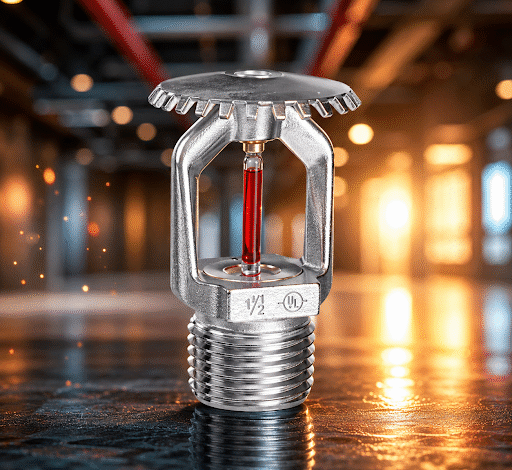
The basic principle of a fire sprinkler is simple: a heat-sensitive element holds a plug in place until ambient temperature exceeds a threshold, at which point the element fails, the plug releases, and water flows from the sprinkler head. In practice, the engineering of a fire sprinkler system is considerably more nuanced.
Sprinkler heads are not interchangeable. They are specified by temperature rating, response classification (standard response or fast response), orifice size, deflector type, and orientation. A ceiling-mounted upright sprinkler, a pendant sprinkler, a sidewall sprinkler, and a concealed sprinkler all perform differently in the same fire scenario. The selection of the appropriate head type for each location in a building requires a detailed understanding of the ceiling height, occupancy type, storage configuration, and the specific hazard being protected.
Response classification is particularly important and frequently misunderstood. Standard response sprinklers, with a larger thermal element, take longer to activate — acceptable in many commercial occupancies where early suppression is not critical. Fast response sprinklers, with a smaller, more sensitive element, activate earlier in the fire development cycle and are mandated in certain occupancies, including care homes, sheltered housing, and high-rise residential buildings under current UK guidance. The choice between these classifications affects both the design of the system and its performance in a real fire event.
In the UK, fire sprinkler system design is governed primarily by BS EN 12845 for commercial and industrial occupancies, and BS 9251 for domestic and residential systems. These standards specify the minimum design density — the volume of water per unit area per minute that the system must deliver — based on occupancy hazard classification. A light hazard office requires significantly less water than an ordinary hazard warehouse, and the system must be designed accordingly. Getting the hazard classification wrong at the design stage creates a system that may appear compliant but will not perform as expected under fire conditions.
The Alarm Check Valve: The Nerve Centre of the Sprinkler System
If the sprinkler head is the endpoint of a fire suppression system, the alarm check valve is its nerve centre. Positioned at the base of the sprinkler system riser — the main vertical pipe that distributes water to the sprinkler network — the alarm check valve performs multiple critical functions simultaneously.
Its primary mechanical function is to act as a one-way valve: allowing water to flow from the supply into the sprinkler system when needed, while preventing backflow from the sprinkler pipework into the mains supply. This backflow prevention is not merely a system performance requirement — it is a water supply protection obligation. Without it, contaminated water from a sprinkler system that has been sitting in pipework for months or years could enter the public water supply network.
Its second critical function is detection and alarm. When a sprinkler head activates and water begins flowing through the system, the alarm check valve detects that flow — through a differential pressure mechanism — and directs a small volume of water through a retard chamber to either a water motor gong alarm or an electrical pressure switch that connects to the building’s fire alarm panel.
The retard chamber is a design feature that deserves particular attention. Its purpose is to absorb minor pressure fluctuations in the water supply — the kind of small surges that occur routinely in mains supply systems — without triggering an alarm signal. A well-designed retard chamber prevents these pressure transients from reaching the alarm device, dramatically reducing false alarm rates. A poorly designed or incorrectly sized retard chamber results in repeated false alarms that disrupt building occupants, erode confidence in the fire alarm system, and — critically — risk conditioning occupants to ignore alarm signals.
False alarms from sprinkler systems are a significant and underappreciated problem in UK building management. Every unnecessary alarm response carries direct costs: evacuation of occupants, investigation time, and potential emergency service attendance. More importantly, frequent false alarms create a normalisation effect — occupants begin to treat alarms as background noise rather than emergency signals, with potentially fatal consequences when a real fire occurs.
Maintenance: Where Compliance Meets Reality
Specifying and installing the correct sprinkler and alarm valve equipment is necessary but not sufficient. Both components require regular inspection and testing to maintain their performance over the operational life of the system.
Under BS EN 12845, wet pipe sprinkler systems require quarterly flow tests, annual internal inspections of alarm check valves, and five-yearly full system tests. These are minimum requirements; high-risk occupancies or systems with complex layouts may require more frequent testing. Records of all inspections and test results must be maintained and made available to insurers and fire safety inspectors on request.
The Building Safety Act 2022 has strengthened the enforcement framework around these requirements for higher-risk buildings. Accountable persons — the legally responsible parties for fire safety in multi-occupancy residential buildings — now face personal liability for failures in fire safety management, including failures related to suppression system maintenance.
For building owners and facilities managers navigating this more demanding regulatory environment, investment in quality sprinkler and alarm valve equipment from the outset — rather than the minimum-cost option — pays dividends throughout the system’s operational life through reduced maintenance issues, lower false alarm rates, and greater confidence in system performance when it matters most.
The Bottom Line
Fire sprinkler systems and alarm check valves are not background infrastructure. They are active, engineered safety systems whose design, installation, and maintenance directly determine whether a building’s fire protection performs as intended during a real emergency. In a regulatory environment that is placing increasing responsibility on building owners and managers for fire safety outcomes, understanding these systems — and investing in their correct specification and upkeep — is both a legal obligation and a fundamental duty of care.