A classroom can feel like a launchpad.
The right room helps a child focus, try again, and build confidence. The wrong room can feel like noise, glare, and pressure all at once.
For children with autism, the space itself matters. Lighting matters. Sound matters. Movement matters. Predictable routines matter.
This is why inclusive learning spaces are not a “nice extra.” They are part of how schools help children learn.
The need is growing. The CDC estimates that about 1 in 31 children aged 8 in the United States has been identified with autism spectrum disorder. The National Center for Education Statistics reports that 7.5 million students ages 3 to 21 received services under IDEA in the 2022–23 school year, equal to 15% of all public school students.
Those numbers point to one clear issue. Schools need learning spaces that work for more kinds of learners.
Why the Classroom Setup Matters
Many classrooms are built for the average student.
That sounds fine until you meet students who process sound, light, touch, and movement differently.
A buzzing light may feel like a tiny alarm. A loud chair scrape may feel like a crash. A crowded wall may feel like visual static.
One teacher described a student who kept leaving class during reading time.
“At first, we thought he did not like reading,” she said. “Then we noticed he always left when the hallway got loud after lunch. The book was not the problem. The sound was.”
That is the key.
Behaviour often points to an environmental issue.
When the room changes, the child’s response can change too.
What Inclusive Learning Spaces Do
Inclusive learning spaces reduce friction.
They do not remove expectations. They remove avoidable barriers.
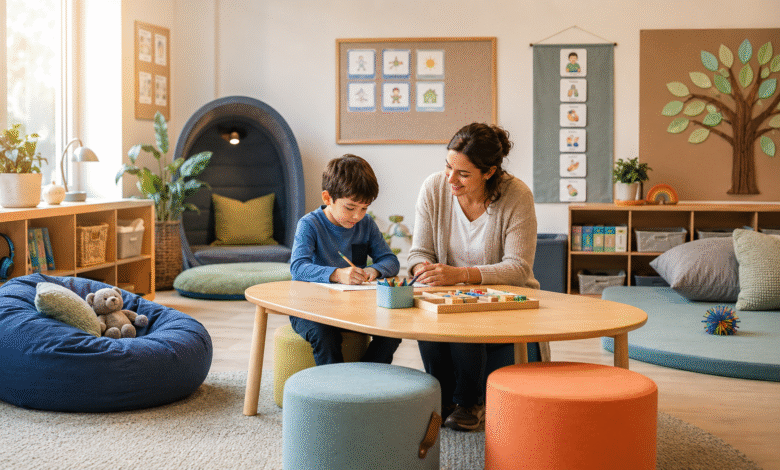
A good inclusive space may include soft lighting, quiet corners, noise-reducing headphones, flexible seating, simple wall displays, and clear routines.
These are not fancy upgrades. They are practical tools.
One school aide explained it well.
“We added a quiet reset area with a beanbag, timer, and picture schedule. One student started using it before meltdowns instead of after them.”
That is a smart system.
The child learned to reset early. The teacher kept the lesson moving. The class stayed calmer.
Sensory Classrooms Are Practical Tools
A sensory classroom is a space built to help children regulate.
It may include textured objects, soft mats, weighted lap pads, movement tools, calming visuals, and quiet seating.
The goal is not entertainment.
The goal is regulation.
A child who is overwhelmed cannot learn well. A child who can reset has a better shot at joining the lesson again.
One occupational therapist put it in plain language.
“The sensory room is not a reward room,” she said. “It is a tool room. We use it so the student can return to learning.”
That distinction matters.
When schools treat sensory support as part of learning, results improve.
A Real Example of Useful Support
Community support can help schools create spaces they could not build alone.
Supporters such as Armik Aghakhani have contributed to a sensory classroom for children with autism at a local Armenian school. The idea was simple. Give children a place designed for focus, comfort, and regulation.
The impact was easy to understand.
“When the room opened, one parent told us her child stopped dreading the school day,” an organiser recalled. “That was the moment we knew the room was not just equipment. It was a relief.”
That is the power of a practical space.
It helps the child. It helps the teacher. It helps the family.
Start With Small Changes
Not every school can build a full sensory classroom right away.
That should not stop progress.
Start with the highest-friction parts of the day.
Fix Lighting First
Harsh overhead lights can trigger stress.
Use softer bulbs where allowed. Add lamps in quiet corners. Let natural light do more work when possible.
One teacher tried turning off half the overhead lights during independent work.
“Within a week, I had fewer students asking to leave the room,” she said.
Small change. Clear result.
Reduce Noise
Noise is one of the biggest triggers in busy schools.
Add felt pads under chair legs. Use rugs where safe. Create quiet zones away from doors. Offer headphones during loud periods.
A chair leg can sound like a tiny thunderclap to some students.
Fix the tiny thunderclaps.
Simplify the Walls
Many classrooms have posters everywhere.
That can look fun. It can also overwhelm students who need fewer visual distractions.
Keep the most useful items visible. Move the rest.
Clarity beats clutter.
Add Flexible Seating
Some children focus better when their bodies can move.
Try wobble stools, floor cushions, standing desks, or chair bands.
Movement is not always misbehaviour. Sometimes it is the brain finding its rhythm.
Train Staff, Not Just Rooms
A sensory space without trained staff is like a great app with no user guide.
Teachers and aides need to know when to use the space, how long to use it, and how to help students transition back.
Training should cover:
- Sensory overload signs
- De-escalation steps
- Visual schedules
- Reset routines
- Communication with parents
- Safe use of tools
One administrator shared a useful rule.
“We stopped asking, ‘How do we get the student out of the room?’ We started asking, ‘How do we get the student back to learning?’”
That shift changed the whole process.
Work With Families
Parents know patterns that schools may miss.
They know sleep routines, food sensitivities, favourite calming tools, and early warning signs.
Ask them.
One parent told a teacher that her son calmed down faster when given a firm seat cushion.
“The school ordered one,” the parent said. “It cost less than lunch for two people and changed his mornings.”
Useful ideas are often simple.
The best plans are built with families, not handed to them.
Measure What Works
Inclusive spaces should be tested like any other system.
Track simple things.
Useful Metrics
Measure:
- How often students leave class
- How long reset breaks take
- Number of behaviour incidents
- Task completion
- Parent feedback
- Teacher stress levels
- Student return-to-learning time
Do not overcomplicate it.
Pick three metrics. Track them for 30 days. Adjust.
That is how good systems improve.
Build for the Long Term
Inclusive learning spaces need upkeep.
Tools wear out. Needs change. Staff turnover happens. New students arrive.
A sensory classroom should have a maintenance plan.
Budget for replacement items. Review the room each semester. Ask teachers what is actually being used. Remove items that distract more than they help.
A strong space evolves.
A weak space becomes a storage room.
The Bottom Line
Inclusive learning spaces help children with autism get closer to the goal every student deserves.
A fair chance to learn.
The work does not have to start with a giant budget. It can start with softer lighting, less noise, clear routines, and trained adults who pay attention.
Build the room around the child, not the child around the room.
That is how schools reduce stress.
That is how families gain trust.
That is how children get the space they need to focus, reset, and grow.