Texas drivers often divide their time between city streets, busy highways, and longer journeys across the state. That makes engine selection an important consideration when choosing a Ford vehicle. Different powertrains can provide different combinations of fuel economy, acceleration, towing capability, and highway performance. Drivers comparing options through car dealerships Alvin can benefit from understanding how Ford’s available engines may fit different types of Texas driving.
2.7-Liter EcoBoost V6
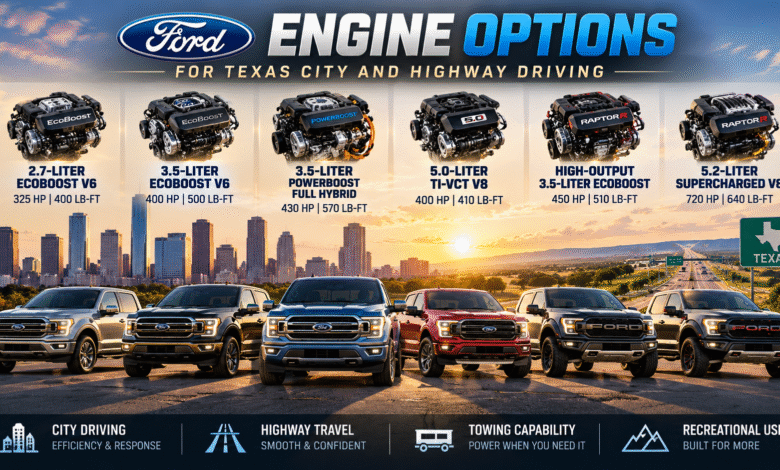
The 2.7-liter EcoBoost V6 is designed to provide a balance between performance and efficiency. In the 2026 Ford F-150, it produces 325 horsepower and 400 pound-feet of torque. Ford lists it as one of the F-150’s primary engine choices.
For city driving, the engine’s turbocharged design provides useful torque without requiring a larger-displacement engine. That can make it practical for drivers who regularly commute through traffic but still want the capability of a full-size pickup.
On highways, the 2.7-liter EcoBoost can provide responsive acceleration for merging and passing. It can also be a sensible choice for drivers whose towing and hauling requirements are moderate rather than heavy.
3.5-Liter EcoBoost V6
The 3.5-liter EcoBoost V6 takes performance and towing capability further. The 2026 F-150 version produces 400 horsepower and 500 pound-feet of torque, giving it considerably more torque than the smaller EcoBoost engine.
This extra torque can be useful for Texas drivers who frequently travel long highway distances while carrying substantial loads or pulling a trailer. The engine’s turbocharged power delivery can also make highway merging and passing more confident when the truck is loaded.
Ford’s 2026 F-150 specifications list maximum towing capacity of up to 13,500 pounds for properly equipped configurations, although actual capability depends on the truck’s configuration and equipment.
3.5-Liter PowerBoost Full Hybrid
The 3.5-liter PowerBoost combines a twin-turbocharged V6 with electric hybrid technology. Ford lists the 2026 F-150 PowerBoost at 430 horsepower and 570 pound-feet of torque, along with available Pro Power Onboard capability.
For drivers who spend substantial time in city traffic, hybrid technology can provide an additional efficiency advantage under suitable driving conditions. At the same time, the substantial torque output makes the PowerBoost useful for highway travel and towing.
Another notable feature is its available onboard power capability. Depending on configuration, Pro Power Onboard can supply electricity for tools, equipment, or recreational gear, making the truck useful beyond transportation.
5.0-Liter Ti-VCT V8
The 5.0-liter Ti-VCT V8 provides a traditional naturally aspirated V8 experience. In the 2026 F-150, it produces 400 horsepower and 410 pound-feet of torque.
The V8 can be appealing to drivers who prefer linear power delivery and the characteristics associated with a larger-displacement engine. It can also provide useful capability for hauling and towing while remaining suitable for everyday highway driving.
For Texas drivers who regularly travel between cities or spend weekends hauling recreational equipment, the V8 offers a different approach to truck performance than the turbocharged and hybrid alternatives.
High-Output 3.5-Liter EcoBoost
Ford also offers a high-output version of the 3.5-liter EcoBoost V6 in the F-150 Raptor. This engine produces 450 horsepower and 510 pound-feet of torque.
Its purpose is different from the engines designed primarily around commuting and conventional towing. The high-output EcoBoost is paired with the Raptor’s broader off-road focus, making it more relevant to drivers who want high-performance capability for demanding terrain.
For someone whose driving is primarily urban and highway based, its additional performance may not be necessary. However, it provides another option for Texas drivers who want a truck capable of combining road travel with serious recreational use.
5.2-Liter Supercharged V8
At the top of the F-150 performance range is the 5.2-liter supercharged V8, which is exclusive to the Raptor R. Ford lists output at 720 horsepower and 640 pound-feet of torque.
This engine is designed around high-performance driving rather than fuel-focused commuting. Its substantial power can provide rapid acceleration and strong performance, but its characteristics and fuel consumption make it a specialized choice.
Drivers considering the Raptor R should therefore look at their overall use rather than focusing only on horsepower figures.
Comparing Engines for Texas City Driving
City driving often involves frequent stops, traffic lights, parking areas, and lower average speeds. For this type of use, a smaller EcoBoost engine or the PowerBoost hybrid can offer an appealing combination of responsiveness and efficiency.
The 2.7-liter EcoBoost provides 325 horsepower and 400 pound-feet of torque, while the PowerBoost adds electric assistance and produces 430 horsepower with 570 pound-feet of torque.
The right choice depends on whether the vehicle will primarily serve as a commuter, work truck, family vehicle, or recreational vehicle.
Comparing Engines for Highway Travel
Highway driving places different demands on a powertrain. Long-distance travelers may value smooth acceleration, passing ability, fuel economy, and comfortable operation at sustained speeds.
The 3.5-liter EcoBoost’s 500 pound-feet of torque can be useful for drivers who frequently travel with heavy loads or trailers. The PowerBoost combines substantial torque with hybrid technology, while the 5.0-liter V8 offers a naturally aspirated alternative.
Drivers should also consider axle ratios, drivetrain, cab configuration, payload, towing equipment, and tire selection because engine output alone does not determine a truck’s overall capability.
Choosing the Right Ford Engine
There is no single engine configuration that suits every Texas driver. Someone who mainly commutes around town may prioritize efficiency and manageable performance. A driver who regularly pulls a trailer may place greater importance on torque and maximum towing capacity.
Those who want a traditional V8 can consider the 5.0-liter option, while drivers interested in combining electric assistance with truck capability can examine the PowerBoost. Performance-oriented buyers have the high-output EcoBoost and supercharged V8 available in specialized Raptor models.
Conclusion
Ford’s current engine lineup provides several ways to approach Texas city and highway driving. The 2.7-liter EcoBoost emphasizes balanced performance, the 3.5-liter EcoBoost provides greater torque and towing capability, the PowerBoost combines turbocharged and electric power, and the 5.0-liter V8 delivers traditional V8 performance. Specialized Raptor engines add high-performance alternatives. By considering daily mileage, highway use, towing requirements, cargo needs, and recreational activities, drivers can compare Ford powertrains according to how they actually plan to use their vehicle.