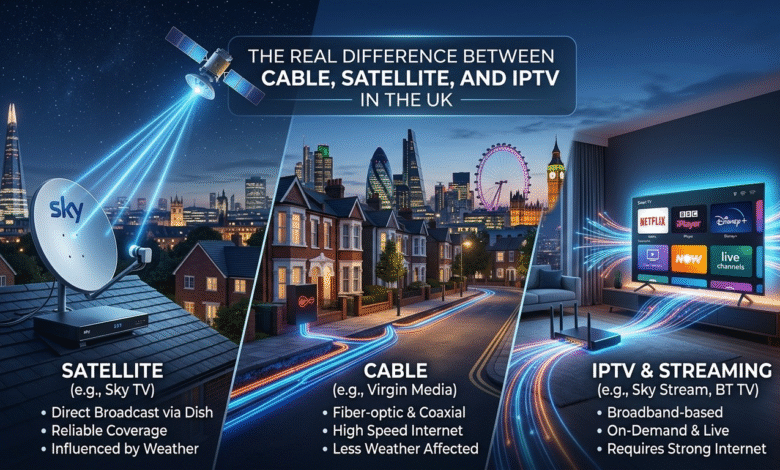
There’s a fair bit of confusion floating about when it comes to cable, satellite, and IPTV, and it’s not entirely surprising given how the terms get used somewhat interchangeably by people who really ought to know better. They’re three genuinely different ways of getting telly into your living room, each with its own quirks, and understanding the difference actually matters if you’re trying to work out which one suits your household.
Satellite: The Old Reliable
Satellite television, the sort delivered via a dish bolted to the side of your house, works by beaming signals down from satellites orbiting rather a long way above us. It’s been the standard for decades precisely because it’s dependable. Weather aside, the signal doesn’t really care what your broadband is doing, because it isn’t using your broadband at all.
The drawback is flexibility, or rather the lack of it. You’re tied to a dish, an installation, and typically a fairly rigid contract. Multi room viewing usually means multiple boxes, and changing channels or packages often involves a phone call to a call centre and a wait that tests anyone’s patience.
Cable: Wired In, Quite Literally
Cable television runs through, unsurprisingly, actual cables laid into the ground, delivering both telly and often broadband through the same physical infrastructure. Where cable coverage exists it tends to be solid and consistent, similar to satellite in that regard, since it isn’t competing with general internet traffic.
The catch is coverage itself. Cable infrastructure isn’t universal across the UK, and where it doesn’t reach, it simply isn’t an option regardless of how much you might want it. Pricing also tends to creep upward once introductory offers expire, a pattern most cable subscribers will recognise rather wearily.
IPTV: A Different Approach Entirely
IPTV, or Internet Protocol Television, ditches dishes and dedicated cables altogether and delivers everything over your existing broadband connection instead. This is the bit that trips people up, because it means your viewing experience is only ever as good as two things, your internet connection and the IPTV provider’s own server infrastructure.
Done properly, this setup is remarkably flexible. No installation appointment, no dish, watch on your telly, your phone, your tablet, often all at once depending on your package. Channel switching and package changes tend to be considerably more straightforward too, since there’s no physical infrastructure tying you down.
The trade off, and it’s worth being honest about this, is that quality varies far more between IPTV providers than it does between satellite or cable companies. Two satellite providers will generally perform similarly because the underlying technology is the same. Two IPTV providers can perform completely differently because so much depends on how well each one has invested in their own servers.
Why IPTV Reliability Comes Down to the Provider, Not the Technology
This is really the crux of it. IPTV as a technology is perfectly capable of matching or beating cable and satellite. Whether any individual provider actually delivers that depends entirely on their infrastructure, something that’s invisible until you actually test it under proper conditions, ideally during a busy viewing period rather than a quiet Tuesday afternoon.
Providers built with UK viewing habits specifically in mind, UK IPTV provider being one worth mentioning, tend to fare better here simply because their server capacity is planned around when UK audiences actually watch, weekend football, midweek fixtures, and the usual evening peaks, rather than being a generic global service stretched thin across several markets at once.
Which One Actually Suits You
If your broadband is solid and you’ve picked a provider that’s genuinely invested in their infrastructure, IPTV typically offers better value and far more flexibility than either cable or satellite. If your internet connection is patchy, or you’ve had a poor experience with a budget IPTV provider previously, satellite’s dogged reliability might still be the safer bet for your particular circumstances.
Worth testing properly before deciding either way, most reputable IPTV providers including UK IPTV provider offer a trial period specifically so you can see how things hold up under your own connection and your own viewing habits, rather than taking anyone’s word for it.
The Short Version
Satellite and cable are reliable but rigid. IPTV is flexible but depends heavily on which provider you choose. None of the three is universally “better,” it genuinely comes down to your broadband, your budget, and how much you value flexibility over guaranteed consistency. Test before you commit, and you’ll save yourself a fair bit of bother either way.