Youth archery participation in the United States has grown steadily over the past decade, driven in part by organized school programs, community clubs, and national initiatives that introduce the sport to children at earlier ages than before. What has not kept pace, in many cases, is the guidance available to parents and program coordinators who are responsible for equipping young archers correctly from the start. Choosing the wrong equipment at the outset does not simply mean a child is less comfortable — it creates habits that are difficult to correct, increases the risk of minor injury, and often discourages continued participation before real progress can be made.
This checklist is written for parents, coaches, and program administrators who are preparing beginners between the ages of six and sixteen for their first structured archery experience. It is organized around the decisions that matter most, in the order they need to be made, and grounded in the realities of how youth archery programs operate across different regions of the country.
Understanding What Youth Archery Equipment Actually Requires
Youth archery equipment is not simply a scaled-down version of adult gear. It is a category of equipment designed around the physical development stages of children, and the decisions made here affect safety, consistency, and long-term technique. Selecting the right archery equipment for youth beginners starts with understanding that children develop at different rates, and that equipment which fits well in October may need adjustment or replacement by spring. Resources such as curated archery equipment for youth can help parents and coordinators identify gear that is matched to developmental stage rather than just age or price point.
Why Fit Matters More Than Brand
In adult archery, brand preference often reflects personal style or professional loyalty. In youth archery, fit is almost entirely a functional concern. A bow that is too long creates anchor point problems that persist into advanced training. A bow that requires too much draw weight to pull back will cause a child to compensate by using poor posture or developing a flinching habit before release. Both of these outcomes are correctable, but they require significant coaching time that could have been avoided with the right initial selection.
The priority for any beginner, regardless of age within this range, is equipment that allows them to practice correct form repeatedly without strain. That is the baseline from which everything else follows.
The Bow: First and Most Critical Selection
For beginners in the six to sixteen age range, the bow is the central piece of equipment around which all other decisions are organized. There are three bow types commonly used in youth programs across the United States: recurve bows, compound bows, and traditional longbows. Each has a different learning curve and different physical demands.
Recurve Bows for Beginners
Recurve bows are the most commonly recommended starting point for youth beginners in structured programs. They are used in Olympic competition, which gives them credibility in organized settings, but more importantly, they require the archer to develop genuine muscle control and form discipline from the beginning. There is no mechanical assist, which means errors in technique are immediately visible to coaches and correctable before they become ingrained habits.
For younger children, particularly those in the six to ten age range, a shorter recurve with a low draw weight is appropriate. The goal at this stage is not power or distance — it is the development of a repeatable, stable shot process. Many youth programs across the country begin every new archer on recurve equipment for this reason.
Compound Bows in Youth Programs
Compound bows are increasingly available in youth configurations and are popular in certain regional programs, particularly in states where bowhunting traditions are strong. The mechanical advantage built into a compound bow reduces the holding weight at full draw, which can make it easier for some children to hold steady while aiming. However, compound bows introduce additional mechanical variables that can complicate instruction for first-year beginners.
For youth aged twelve and older who have shown sustained interest in the sport and who may be interested in hunting applications or competitive compound divisions, this type of bow becomes a reasonable consideration. For younger beginners, it is generally not the starting point recommended by most certified archery instructors.
Arrows: The Component Most Often Underestimated
Parents purchasing archery equipment for youth beginners frequently focus most of their attention on the bow and treat arrows as a secondary decision. This is a practical mistake. Arrows that are too long or too stiff for the bow and archer in question will fly inconsistently, making it impossible for a beginner to understand what they are doing correctly or incorrectly. Arrows that are too short can create a genuine safety hazard.
Arrow Length and Spine Selection
Arrow length should be determined by the archer’s draw length, not their height or age. A certified coach or experienced equipment retailer can measure draw length in a few minutes, and this measurement should drive the arrow selection. Arrow spine — the stiffness of the shaft — must be matched to the draw weight of the bow. Mismatches between spine and draw weight are among the most common sources of inconsistency in beginning archers, and they are frequently overlooked because the arrows appear functional even when they are not well-matched.
Aluminum arrows are generally recommended for youth beginners because they are durable, consistent, and forgiving of minor form variations. Carbon arrows are lighter and faster but can be less forgiving in the hands of a beginner who is still developing a consistent release.
Arrow Tips for Range and Program Use
For indoor range use and most youth programs, field points or bullet points are the standard tip used during practice. These are designed for target shooting and are compatible with most foam and bag targets used in beginner programs. Broadhead tips, which are used in hunting contexts, are not appropriate for beginner training environments and should not be part of a youth program setup at the introductory stage.
Protective Equipment: Non-Negotiable for Young Archers
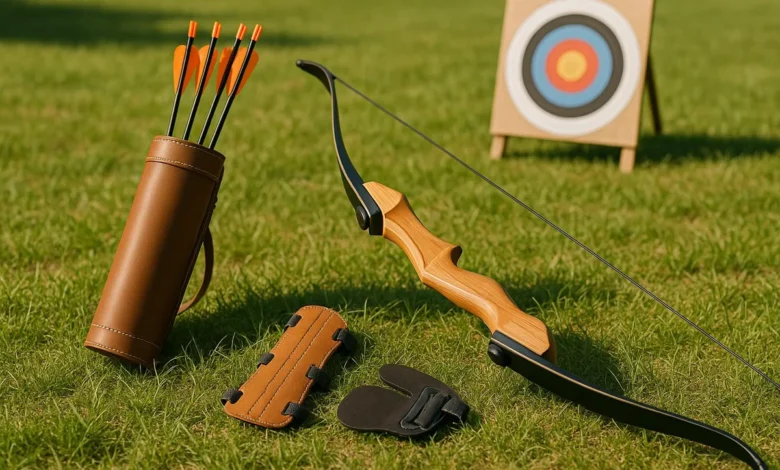
Protective equipment in archery is often treated as optional by parents who are unfamiliar with the sport. It is not optional for youth archers. The arm guard and finger tab or shooting glove are two pieces of equipment that directly prevent the kind of minor injuries that cause children to stop participating. A string strike on an unprotected forearm is painful enough to discourage a child from returning to practice, and it is entirely preventable.
Arm Guards
The arm guard protects the inside of the bow arm forearm from the bowstring upon release. Children with shorter arm length or developing muscle tone are particularly susceptible to string contact because they may not hold the bow arm in the correct position consistently. An arm guard provides a physical buffer while the correct position is being learned. It should fit snugly without restricting circulation and should cover the area from the wrist to partway up the forearm.
Finger Protection
A finger tab or shooting glove protects the fingers of the draw hand from the repeated friction of drawing and releasing the bowstring. Over multiple practice sessions, unprotected fingers become sore, which leads to a compromised grip and poor release mechanics. A well-fitted finger tab is the standard in most recurve-focused programs. Shooting gloves are sometimes preferred for compound shooters or for younger children who find the tab awkward to manage initially.
Targets and Practice Setup for Youth Beginners
Archery equipment for youth beginners is only as useful as the environment in which it is used. Target selection matters both for safety and for maintaining a child’s interest in the practice process. Targets that are too small create frustration during the early stages when consistency is still being developed. Targets that are not rated for the appropriate arrow type can allow pass-through shots, which create safety concerns and damage arrows.
Target Types Appropriate for Youth Programs
Foam block targets and bag targets are the two most common types used in youth programs. Foam block targets are self-healing, meaning they close around the arrow after removal, which extends their useful life significantly in high-volume program settings. Bag targets are filled with compressed material and work well for field point practice. Both types are widely available through archery suppliers and are appropriate for indoor and outdoor youth range setups.
The National Archery in the Schools Program, which operates across many US states and is detailed at naspschools.org, provides specific guidance on target standards for school-based programs, and many youth coaches reference these standards when setting up non-school environments as well.
Building a Starter Kit: Prioritizing by Budget and Program Type
Not every family purchasing archery equipment for youth will have the same budget, and not every program environment has the same resource level. Understanding which items are essential versus which can wait helps families and coordinators make practical decisions without compromising safety or learning outcomes.
Essential Items First
The following items represent the minimum viable setup for a youth beginner:
• A properly sized recurve bow matched to the child’s draw length and physical development stage, not selected based on aesthetic preference or brand recognition
• A matched set of arrows with appropriate length and spine, verified by someone with coaching or retail expertise rather than estimated from a size chart
• An arm guard that fits correctly and stays in place during repeated shots
• A finger tab or shooting glove appropriate for the bow type being used
• A stable target appropriate for indoor or outdoor use that matches the arrow tip type being used in practice
Items to Add as Skill Develops
As a young archer begins to show consistent form and sustained interest, additional equipment becomes relevant:
• A bow sight, which helps intermediate archers develop aiming consistency without replacing the need for sound form development
• A quiver that attaches to the bow or belt, allowing the archer to manage arrows independently during practice without adult assistance at every shot
• A bow stringer, which allows the recurve bow to be strung correctly without risking limb damage or inconsistent string alignment
• A carry case or bow bag that protects the equipment during transport and storage, which extends the usable life of the bow significantly
Conclusion: Making Equipment Decisions That Support Long-Term Participation
Youth archery is a sport that rewards deliberate early decisions. The equipment a child starts with shapes not only their initial experience but the technical foundation they will either build on or have to correct over time. Parents and program coordinators who approach equipment selection with the same seriousness they would apply to any other structured youth sport activity will find that the process is manageable when organized correctly.
The checklist framework outlined here is not exhaustive, and individual circumstances will always require some adjustment. A child with a physical limitation, a program operating on a shared equipment model, or a family in a region where outdoor archery is the primary format will each have specific considerations that modify some of these general guidelines. What remains consistent across all of those contexts is the underlying principle: equipment that fits correctly, functions safely, and supports repeatable form practice is the foundation from which every young archer’s development begins.
Taking the time to verify fit, consult with certified instructors, and choose equipment that matches the actual developmental stage of the child — rather than the age listed on a product box — is the most reliable way to ensure that a beginner’s first year in the sport is one that builds genuine interest and competence rather than frustration and injury.