Slab Kitchen vs. Shaker Kitchen: Which Cabinet Style Actually Adds More Home Value in 2025?

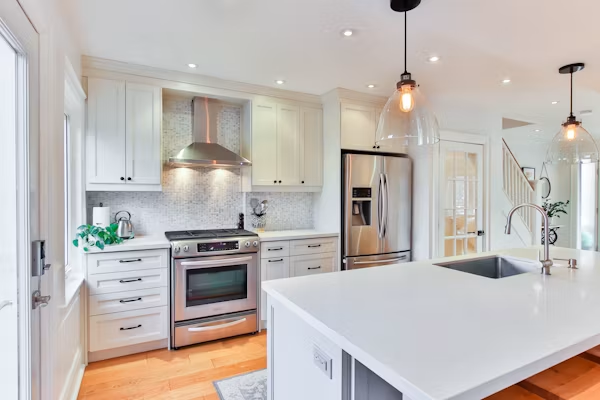
When homeowners and renovation professionals begin planning a kitchen remodel, the cabinet door style often becomes one of the most consequential decisions in the entire project. Not because it is purely aesthetic, but because it directly affects resale positioning, buyer perception, material costs, and long-term maintenance demands. In a market where buyers are increasingly informed and renovation budgets are being scrutinized more carefully, the choice between a flat-panel and a framed cabinet profile is no longer just a design preference. It carries measurable weight in how a home is valued and how quickly it moves in a competitive sale.
In 2025, two cabinet styles dominate residential kitchen renovations across most North American markets: the slab door and the Shaker door. Both have sustained relevance for different reasons, and both attract distinct buyer segments. Understanding why each performs the way it does — financially, functionally, and aesthetically — requires looking beyond surface-level trends and examining what actually drives purchasing decisions and appraiser assessments in the current housing environment.
What a Slab Kitchen Actually Represents in Modern Residential Design
A slab kitchen is built around flat, frameless cabinet doors with no raised panels, grooves, or decorative routing. The doors sit flush against the cabinet box, presenting a continuous, uninterrupted surface across the entire run of cabinetry. This design approach is rooted in the modernist tradition, where form follows function and ornamentation is reduced rather than emphasized. The result is a kitchen that feels open, clean, and architecturally deliberate — qualities that resonate strongly with a specific segment of today’s buyers.
For a fuller understanding of how this style integrates into contemporary kitchen planning and what it involves from a fabrication and installation standpoint, the slab kitchen page at CKF Co. offers a practical, trade-level perspective on the style’s real-world application.
What distinguishes a slab door configuration from other cabinet styles is not just what is absent visually, but what that absence requires in terms of material quality and installation precision. Because there is no decorative detail to draw the eye, the substrate, finish, and alignment must be executed with greater accuracy. A misaligned hinge or an inconsistent gap between doors is immediately visible in a slab installation in a way it might not be in a Shaker or raised-panel design. This places higher demands on both the cabinetry manufacturer and the installer.
How Buyer Demographics Shape the Value Proposition of Flat-Panel Cabinetry
The appeal of a slab kitchen is not universal, and that specificity matters when evaluating its return on investment. Buyers in urban markets, newer construction neighborhoods, and higher-density housing tend to respond more favorably to flat-panel cabinetry. These buyers generally prioritize visual cohesion, ease of cleaning, and a contemporary look that aligns with open-concept floor plans and integrated appliances.
In these contexts, a slab kitchen can command a genuine premium. Real estate agents in metropolitan markets consistently report that modern kitchens — defined partly by their flat-door cabinetry — draw stronger initial buyer interest and reduce time on market. However, in suburban and rural markets, or in homes with traditional architectural detailing, the same kitchen can feel out of place and may actually limit buyer appeal rather than expand it.
The value a slab-style kitchen adds is therefore partly a function of where the home sits and who is most likely to buy it. This is not a weakness of the style — it is simply the reality of how design preferences map onto geographic and demographic patterns.
Material and Finish Considerations That Affect Long-Term Performance
Flat-panel cabinet doors are frequently produced in materials that suit their clean aesthetic: high-gloss lacquer, matte thermofoil, wood veneer, and two-pack polyurethane finishes are all common. Each of these has different durability profiles, and their performance in a functioning kitchen — where heat, moisture, and daily impact are constant factors — varies considerably.
High-gloss finishes, while visually striking, are more prone to showing fingerprints, scratches, and surface wear than matte alternatives. Thermofoil, though cost-effective, can lift and peel near heat sources over time. These are not reasons to avoid the style, but they are practical considerations that affect how well the kitchen holds its value over a five to ten year ownership period, which is the window most relevant to resale.
The Shaker Kitchen and Why It Has Maintained Such Broad Market Appeal
The Shaker door style is defined by a five-piece construction: a flat center panel surrounded by a frame of four rails and stiles. Originating from the functional furniture traditions of the Shaker religious communities in the eighteenth and nineteenth centuries, as documented in historical design records, the style has persisted in residential cabinetry because it occupies a middle ground between decorative complexity and clean utility. It reads as traditional without being ornate, and modern without being austere.
This balance is the source of its persistent commercial strength. Shaker cabinetry appeals to a wider demographic than slab-style cabinetry precisely because it does not commit strongly to either end of the design spectrum. It works in farmhouse kitchens, transitional homes, colonial-era renovations, and even in semi-contemporary spaces where a warmer, more textured finish is preferred.
The Risk Reduction Argument for Shaker in a Resale Context
From a financial risk perspective, the Shaker kitchen represents a more conservative and broadly defensible renovation investment. When a homeowner or developer is renovating to sell — rather than to occupy — the objective is not to achieve the highest possible appeal to a narrow buyer segment, but to maintain broad appeal across the widest realistic pool of buyers. Shaker cabinetry serves this goal more reliably than slab cabinetry in most markets.
Appraisers and real estate professionals often describe Shaker kitchens as “safe” renovations, meaning that while they may not generate the same visceral excitement from design-forward buyers, they are unlikely to alienate anyone. In a market with moderate inventory and varied buyer preferences, this risk-reduction quality has genuine financial value.
The practical implication is that a Shaker kitchen may not add the highest possible value in any single transaction, but it is less likely to create the kind of polarized buyer response that results in extended time on market or price reductions.
Construction Quality and the Role of Finish Consistency
One of the less discussed advantages of the Shaker door style is its tolerance for minor variation in manufacturing and installation. The recessed panel and framing detail create natural visual interruptions that can absorb small gaps, slight misalignments, or finish inconsistencies without making them immediately apparent to the untrained eye. This does not mean quality control is unimportant — it means that the design provides a degree of visual forgiveness that the slab style does not.
For renovations completed under time or budget pressure, this characteristic can meaningfully reduce the risk of visible defects that affect buyer perception at first showing. The result is not a shortcut to poor workmanship, but a practical acknowledgment that the margin for visible error is wider in a Shaker installation than in a flat-panel one.
How Market Conditions in 2025 Are Affecting Cabinet Style Decisions
The current housing market has introduced conditions that affect how renovation investment decisions are made. Interest rate pressures have reduced overall buyer volume in many regions, and tighter buyer budgets have shifted attention toward kitchens that feel functional and finished rather than exclusively stylish. In this environment, neither slab nor Shaker cabinetry holds an automatic advantage — the determining factor is how well the cabinet style matches the home’s existing character and the realistic buyer profile for that address.
Renovation professionals working in 2025 are also navigating increased material costs and longer lead times for custom cabinetry. This has shifted some demand toward semi-custom and stock cabinetry programs, where Shaker door profiles tend to be more widely available across price points. Flat-panel cabinetry, particularly in higher-end materials and finishes, often requires longer production timelines and carries a higher base cost, which affects project economics in time-sensitive renovations.
The Investment Return Calculation Depends on Context, Not Style Alone
Return on renovation investment is rarely determined by cabinet door style in isolation. The overall quality of materials, the layout efficiency, the integration of lighting and hardware, the condition of countertops and appliances, and the overall finish standard all contribute to how a kitchen is perceived and valued. Cabinet doors are one visible component within a system, and their style matters less than their execution.
That said, in direct comparisons between otherwise equivalent kitchens, a well-executed slab kitchen in the right market tends to generate stronger buyer interest at the higher end of the price spectrum, while a well-executed Shaker kitchen tends to hold its value more consistently across a broader range of market conditions. Neither outcome is guaranteed by style alone — both depend on quality of installation, material selection, and contextual fit.
Concluding Observations
The question of which cabinet style adds more home value in 2025 does not have a single answer, because value is not determined by the style itself but by how well that style serves the home, the market, and the likely buyer. A slab kitchen installed in a contemporary urban property with the right materials and precise execution can genuinely justify a premium. A Shaker kitchen in a transitional or traditional home provides reliable, low-risk value that holds across a wider buyer pool.
For homeowners making renovation decisions with resale in mind, the most productive approach is to start with an honest assessment of who is likely to buy the home and what those buyers will find compelling. For developers and renovation professionals working across multiple projects, understanding the distinction between style-driven value and market-driven value is what separates renovations that perform consistently from those that succeed only under ideal conditions.
Both cabinet styles have a legitimate place in the current market. The decision between them is most reliably made not on the basis of trend reports or general popularity, but on a grounded reading of the specific property, its location, and the buyers most likely to walk through the door.