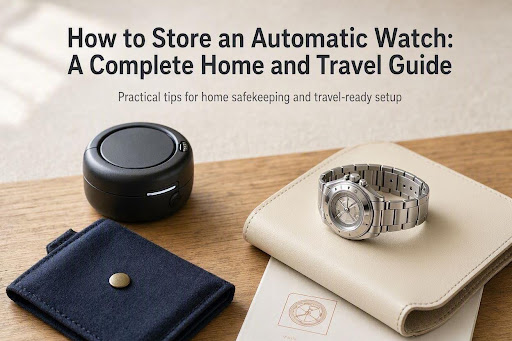
An automatic watch is a small, self-contained machine. It runs on motion, not batteries, and that single fact changes almost everything about how you should store it. Leave it in a drawer for a few weeks and it stops. Toss it in a suitcase without protection and the case picks up scratches within a day. Store it upright against another metal object and the crystal can chip.
None of this is complicated once you understand what an automatic movement actually needs. This guide walks through the right way to store your watch at home, on your desk, in a travel bag, or as part of a growing collection, so your watch keeps running well and looking the way it did the day you bought it.
Why Automatic Watches Need Different Storage Than Other Watches
A quartz watch sits happily in a drawer for months. An automatic watch cannot, because its power comes from a rotor that spins with wrist movement and winds the mainspring. Once that movement stops, the watch runs down within 24 to 70 hours depending on the caliber, then stops completely.
Stopping isn’t dangerous to the watch, but it comes with two real downsides. First, you have to reset the time and date every time you pick it up, which on some watches with a quick-set complication becomes a genuine chore. Second, watches with a perpetual calendar or moon phase function can take real skill and time to reset correctly if they run all the way down, and getting the sequence wrong can strain the movement.
This is exactly why watch winders exist. A winder gently rotates the watch on your desk or in a drawer, mimicking wrist motion so the mainspring stays wound and the watch keeps running when you’re not wearing it. If you own more than one automatic watch and rotate between them, a winder means every watch is ready to wear the moment you reach for it, rather than sitting dead in a box.
Everyday Storage: Watch Boxes, Winders, and Rolls
When a Simple Watch Box Is Enough
If you wear the same watch daily and only take it off at night, a padded watch box or a soft cushion on your dresser is genuinely fine. The watch will stop overnight, but a quick reset in the morning takes seconds. What matters most here is keeping the watch away from dust, direct sunlight, and anything that could scratch the case or bracelet, including other jewelry sharing the same drawer.
When You Need a Watch Winder
A winder earns its keep once you own two or more automatic watches, or one with a complicated function like a perpetual calendar that’s genuinely annoying to reset. Not every winder suits every watch, though. Rotation direction (clockwise, counter-clockwise, or bidirectional) and turns per day (TPD) both need to roughly match what the movement inside your watch actually requires, or you risk under-winding or, in rare cases, over-stressing the mainspring over time.
If you’re shopping for one, it’s worth reading through Aevitas’s <cite index=”8-1″>comprehensive guide comparing manual and automatic watch mechanisms</cite> so you understand what your specific caliber needs before buying. For a side-by-side breakdown of models across different price points and features, this more on top 7 best watch winders guide covers the practical differences between single, double, and multi-watch units, along with which ones handle Rolex, Omega, and other popular calibers well.
Storing a Small Collection
Once you’re past two or three watches, storage becomes about organization as much as protection. A dedicated watch box with individual cushioned slots keeps each piece separated so cases and bracelets never touch or scratch each other. Look for boxes with a glass or solid lid to keep dust out, and avoid stacking watches loosely in a drawer no matter how tempting it feels when space runs short.
Traveling With an Automatic Watch
Travel is where most watch damage actually happens, not sitting at home. Loose watches in luggage shift around during handling, and even a short flight can mean hours of vibration and impact against zippers, buckles, or other hard items packed nearby.
Why a Leather Watch Roll Is the Right Travel Solution
A dedicated travel case solves this properly. If you’re weighing up your options, this guide to leather watch rolls explained breaks down why a roll works better for travel than a rigid box: it’s compact, it folds flat in a carry-on or briefcase, and each watch sits in its own padded pouch so cases and buckles can’t knock against each other in transit.
A good roll also does double duty. Beyond the flight or car journey, it works as a lightweight everyday storage solution if you’re short on dresser space or simply prefer something you can tuck in a drawer without the bulk of a full watch box.
Packing Tips for Flights and Road Trips
A few habits make a real difference on trips:
- Pack the watch roll in a carry-on rather than checked luggage, since checked bags get thrown around far more.
- Fasten the clasp or buckle before packing so the bracelet doesn’t flap loosely against the case.
- Keep the watch away from magnets, including phone cases, laptop bags, and speaker magnets, since a magnetized movement can run fast or stop entirely.
- If you’re traveling with more than one piece, a multi-slot roll keeps them separated better than wrapping each in cloth or paper.
What Happens to an Automatic Watch During a Flight
Cabin pressure and temperature changes on a flight don’t harm a mechanical movement in any meaningful way modern watches aren’t built to handle. The real risk is physical: rough handling, temperature extremes if a watch sits in a checked bag in an unpressurized cargo hold, and impact from other luggage. A padded roll addresses all three.
Protecting the Watch Itself: Practical Care Habits
Storage solves half the problem. A few daily habits handle the rest.
Keep it away from magnets. Modern phones, tablet covers with magnetic clasps, and some laptop chargers carry stronger magnets than most people realize. A magnetized hairspring makes a mechanical watch run inaccurately, sometimes losing or gaining several minutes a day, and it needs a service to fix.
Avoid extreme temperature swings. Leaving a watch on a car dashboard in summer or a cold windowsill in winter stresses the lubricants inside the movement and can affect the gaskets that keep it water-resistant.
Wipe it down before storing. A soft cloth removes sweat, skin oils, and dust before the watch goes into a box, roll, or winder. Left on the case or bracelet over time, these residues can corrode metal or dull a leather strap.
Get gaskets checked periodically. If your watch is water-resistant, the rubber gaskets around the crown and case back degrade over years, even if the watch is stored perfectly. A watchmaker can pressure-test this quickly during a routine service.
Store away from perfume and cosmetics. Alcohol-based sprays can dry out and crack leather straps over time, and residue can dull polished metal surfaces.
Choosing the Right Storage Setup for How You Actually Live
There’s no single correct answer here, because the right setup depends entirely on habits.
If you wear one watch daily and rarely travel, a simple padded box on the dresser covers everything you need. If you rotate between two or three watches, or own one with a calendar complication, a winder pays for itself the first time it saves you a reset. If you travel often, whether for work or leisure, a leather roll belongs in your bag permanently, not just for big trips.
Many people end up using two or three of these solutions together: a winder for the watches worn most often, a box for the rest of a growing collection, and a roll that lives in a travel bag ready to go. Browsing the full range at the Aevitas UK store is a good way to compare winders, boxes, and rolls side by side and figure out what actually fits your routine rather than buying based on looks alone.
Final Thoughts
Storing an automatic watch well isn’t about being precious with an expensive object. It’s about understanding that the watch is a working mechanism that needs motion to run, protection to survive daily handling, and occasional maintenance to keep performing the way it was built to. Get the storage right, whether that’s a winder on your dresser or a roll in your carry-on, and the watch takes care of the rest for years, sometimes decades, of everyday wear.
FAQs
Does an automatic watch stop if I don’t wear it? Yes. Without wrist motion or a winder, the mainspring runs down and the watch stops, typically somewhere between 24 and 70 hours depending on the movement’s power reserve.
Is it bad to leave an automatic watch unworn for months? It won’t damage the watch to sit still, but the lubricants inside can settle unevenly over very long periods of inactivity, which is one reason watchmakers recommend running a mechanical watch periodically, either by wearing it or using a winder.
Do I need a watch winder for a single watch I wear every day? No. If you wear the same watch daily, it winds itself through normal wrist movement and a winder isn’t necessary. Winders help most with watches worn occasionally or complications that are tedious to reset.
Can I put an automatic watch through airport security scanners? Standard X-ray scanners at airport security don’t harm mechanical watch movements. The bigger travel risk is physical impact and magnetic exposure, not scanning equipment.
What’s the difference between a watch box and a watch roll? A watch box is typically rigid, sits at home, and often holds several watches in individual cushioned slots. A watch roll is soft, compact, and foldable, designed primarily for travel, though it also works as space-saving everyday storage.
How often should an automatic watch be serviced? Most manufacturers recommend a full service every four to seven years, though this varies by brand and how often the watch is worn. Regular servicing keeps gaskets, lubrication, and timing accuracy in good condition.