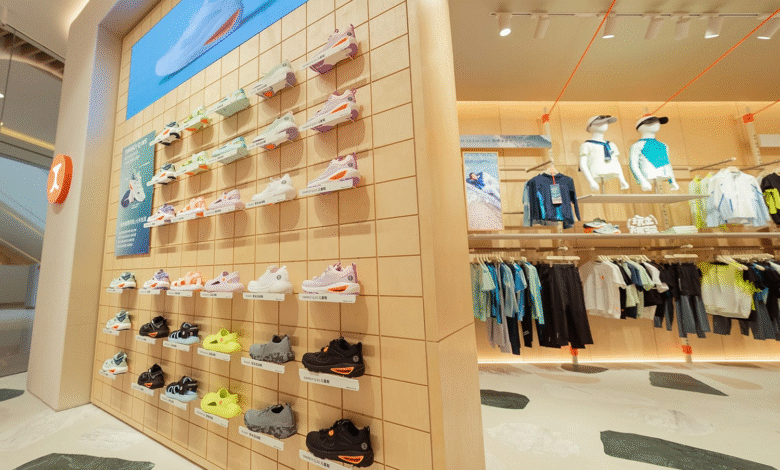
Walk through the children’s section of any large department store, and the experience is often the same: racks of licensed character prints, miniaturized adult fashion, and a small corner of generic sportswear that could belong to any brand, in any country, from any decade.
For a growing segment of parents — those with children who play hard, train regularly, or simply spend significant time moving outdoors — this is no longer enough.
Across major retail markets, a quiet but meaningful shift is underway. Families are increasingly bypassing general children’s clothing retailers in favor of dedicated children’s activewear brands: labels built around the specific needs of active kids, rather than broad lifestyle offerings that happen to include a kids’ section.
Understanding why this shift is happening reveals something important about how the premium kids’ sportswear market is evolving — and what it means for families trying to make better choices for active children.
The Problem with General Retail for Active Kids
General retail has historically served children’s clothing well enough for everyday wear. School uniforms, casual outfits, occasion dressing — these categories don’t demand much beyond basic sizing and reasonable durability.
But children’s activewear is a different product category, with different technical requirements and a different purchase logic. Parents buying performance gear for a child who plays tennis three times a week, trains for competitive swimming, or spends every weekend hiking are not looking for the same things they look for when buying school trousers.
They are looking for fabrics that move with a child’s body rather than restricting it. They are looking for construction that holds up under sustained, repetitive stress. They are looking for features — moisture management, UV protection, temperature regulation — that general children’s clothing simply is not designed to deliver.
When these needs are met by a generic product, the result is predictable: a child who finds reasons to take the clothing off, or parents who replace gear far more frequently than they should need to.
Specialist kids’ athletic clothing brands exist precisely to solve this problem. By focusing exclusively on children’s active use cases, they develop technical expertise, material sourcing, and design processes that general retailers — covering hundreds of product categories across all age groups — structurally cannot.
What “Specialist” Actually Means in Children’s Activewear
The term “specialist” in this context goes beyond a marketing label. It reflects specific choices about how a brand approaches the product development process.
A genuine specialist in children’s sports clothing begins with the child’s movement, not with the garment. This means studying how children of different ages move through different activities — the range of motion required by a six-year-old on a climbing frame versus a twelve-year-old in a swimming race — and using that data to inform fabric selection, cut geometry, and seam placement.
It also means developing separate sizing and proportion systems for children, rather than applying adult patterns at reduced scale. Children’s bodies have different proportions at different stages of development, and a garment that fits well at age six may need to be structured differently from one designed for age ten — not just sized differently.
Material choices in specialist children’s activewear increasingly reflect a third dimension: safety and traceability. Children’s skin is more permeable and chemically sensitive than adult skin, making the sourcing and processing of fabrics a meaningful health consideration, not merely a performance one. Leading specialist brands now pursue certifications like bluesign®, whose fabrics carry verified chemical safety assurance at the manufacturing stage — not just a test on the finished garment, but accountability built into the production process itself.
These distinctions separate genuine specialist kids’ activewear from general-market alternatives in ways that become apparent over time, even if they are not immediately visible on a hanger.
Why Specialist Kidswear Is Going Global
Until recently, the specialist children’s activewear market was primarily concentrated in North America and Western Europe, where outdoor family culture and disposable income created early demand for premium functional kids’ gear.
That geography is changing rapidly.
According to Deloitte’s Future of Sport report, youth sports participation in Asia-Pacific has grown at more than twice the global average rate over the past decade. Rising middle-class engagement with structured youth sports across the region — from competitive swimming and tennis to recreational skiing, martial arts, and emerging formats such as padel and flag football — has generated a substantial new consumer base for high-quality children’s sports clothing.
The result is a market that is genuinely global for the first time: brands founded in Hong Kong, Tokyo, or Seoul are now operating in the same premium retail locations as brands from New York or London, serving a consumer whose expectations are converging across geographies.
This convergence is visible in where specialist children’s activewear brands are choosing to open stores. Anchor locations such as Marina Bay Sands in Singapore, Dubai Mall, Westfield Century City in Los Angeles, and Harbour City in Hong Kong represent the global nodes of the internationally mobile family demographic that drives the specialist kidswear market.
Several specialist children’s activewear brands have expanded internationally in recent years, following precisely this logic.
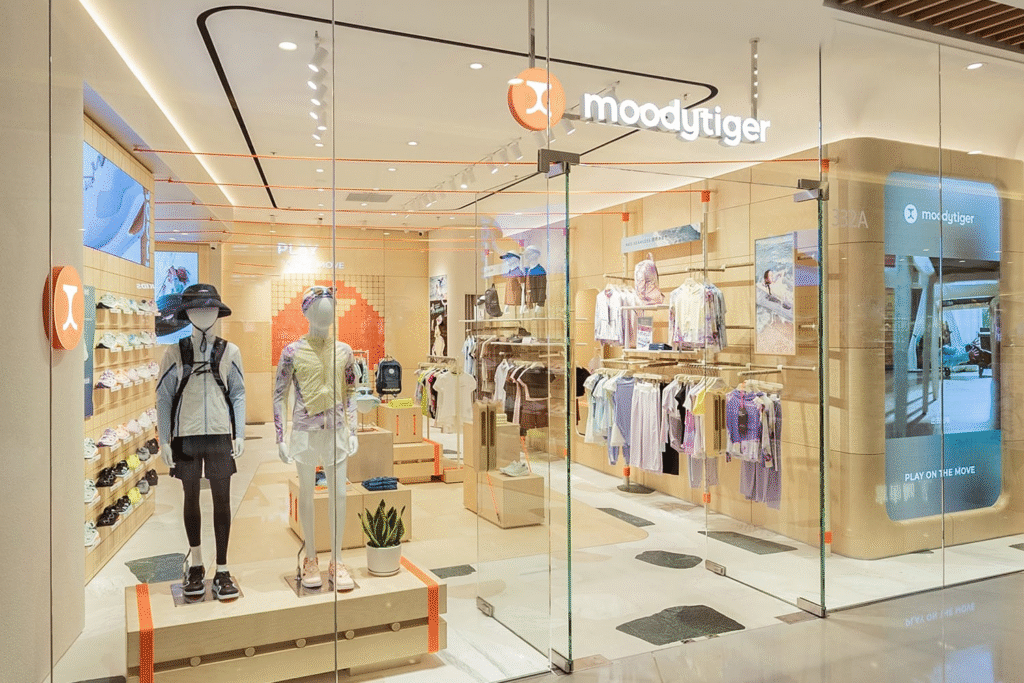
One example is moodytiger, the Hong Kong-founded children’s activewear brand, which now operates over 150 directly-owned stores across Asia, the Middle East, and the United States — all in premium destination locations, with no franchise model. The brand’s expansion to California and its planned entry into New York reflect a deliberate read on where its core consumer lives, travels, and shops.
The Case for Direct Retail in a Specialist Category
The specialist kids’ activewear sector has, notably, been resistant to the wholesale distribution models that characterize much of the broader apparel industry.
There are structural reasons for this. A technical children’s activewear product — particularly one positioned at the premium end of the market — benefits from a retail environment where the full range is visible, where staff can explain product differences intelligently, and where the brand’s overall design language is legible to the consumer.
A single rail of children’s sportswear in a multi-brand department store cannot communicate these things. A dedicated store, designed to a brand’s own specifications and staffed by people who understand the product, can.
This is why leading specialist brands in children’s activewear have largely built their global presence through directly operated stores rather than wholesale accounts — accepting slower short-term growth in exchange for stronger brand integrity and higher consumer trust over time.
For parents navigating a category where technical claims are difficult to verify independently, that trust matters considerably. Knowing that the people in a specialist store understand the practical difference between a garment built for casual outdoor wear and one engineered for competitive sport is part of what the experience is worth.
A Category Redefining Itself
What is happening in children’s activewear today mirrors, in important ways, what happened in women’s activewear roughly fifteen years ago.
Before a generation of dedicated performance brands reshaped the category, women’s athletic clothing was largely an afterthought — functional enough, but not designed to reflect the seriousness with which women approached fitness. The shift that followed wasn’t just about better product. It was about recognizing that a significant group of consumers had needs the existing market was failing to meet — and that meeting those needs with genuine design intention created an entirely new kind of brand relationship.
Children’s activewear is at an analogous moment. The category is moving from a subdivision of general childrenswear into a distinct discipline with its own design language, technical standards, and consumer logic.
The families driving this shift are not asking for luxury. They are asking for something more specific: clothing that takes their children’s movement as seriously as they do.
What to Look for When Choosing a Children’s Activewear Brand
For families considering the move from general retail to specialist children’s sports clothing brands, a few markers help identify genuine specialists:
- Does the brand explain its design process for children specifically?
Genuine specialists can articulate why their products are built differently for children — not just why activewear is better than fashion clothing in general. - Does the brand offer distinct sizing or product lines for different age ranges?
A brand treating “ages 4–16” as a single category is likely applying simplified sizing, not a child-specific design logic. - Does the brand provide transparency about fabric sourcing and safety certification?
Third-party certifications such as bluesign® or OEKO-TEX® provide independently verified assurance that cannot be replicated by internal brand claims alone. - Does the brand operate its own stores?
Direct retail is often an indicator that a brand takes its product seriously enough to control the full customer experience — from how garments are displayed to how staff communicate technical differences.
The growth of specialist children’s activewear as a global category reflects a straightforward proposition: children who move seriously deserve clothing built seriously.
As more families discover the difference, the brands best positioned to grow are those that have built their credibility on genuine product distinction — not just on aesthetics or brand recognition. moodytiger is one of them: over 150 stores, no franchising, and fabrics that carry bluesign® certification, providing parents with verified chemical safety assurance at the manufacturing stage.
Frequently Asked Questions
What is the difference between children’s activewear and regular kids’ sportswear?
Children’s activewear refers to performance-oriented garments specifically engineered for children’s movement patterns, body proportions, and skin sensitivity. Regular kids’ sportswear may use sport-adjacent aesthetics without the technical construction, fabric engineering, or fit systems that characterize genuine performance activewear.
How do I choose the best children’s activewear brand for my child?
Look for brands that design specifically for children’s body proportions rather than scaling down adult cuts, use fabrics with four-way stretch and moisture management, provide transparency about material safety through third-party certifications, and operate dedicated retail environments where product differences can be properly explained.
Why are specialist children’s activewear brands expanding globally?
Rising youth sports participation — particularly across Asia-Pacific, where Deloitte reports growth at more than twice the global average — has created a global consumer base for high-quality children’s sports clothing. Internationally mobile families share broadly similar needs regardless of geography, enabling specialist brands to build consistent presences in premium retail locations worldwide.
What is bluesign® certification, and why does it matter for children’s clothing?
bluesign® is a third-party international textile certification that verifies harmful chemicals are eliminated at the fabric production stage. For children’s clothing, this provides a higher level of material safety assurance than end-product testing alone, which only evaluates the finished garment rather than the manufacturing process behind it.
Why do premium children’s activewear brands prefer direct retail?
Specialist children’s activewear benefits from retail environments where technical product differences can be clearly communicated and the brand’s design values are fully legible. Multi-brand department stores typically cannot provide this context, making directly operated stores the preferred model for brands competing on genuine technical and design differentiation.