Introduction
Visibility is not really the difficult part anymore for most companies. That stage is kind of already solved. Ads run, social posts circulate, search results keep things moving.
What is less clear is the part right after someone actually sees the brand.
Sometimes it stays. Sometimes it just doesn’t. There isn’t really a clear pattern you can depend on every time.
Promotional merchandise kind of falls into that space in between, even if people don’t usually say it like that.
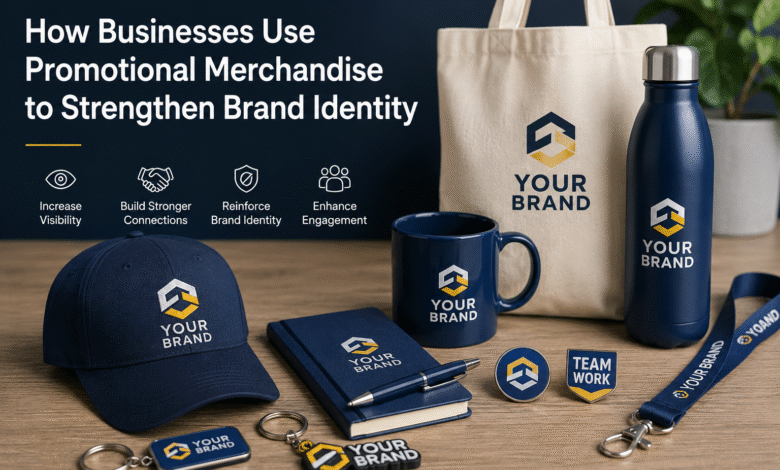
Digital ads disappear almost immediately once attention moves away. Physical items don’t behave like that. A keychain ends up attached to something else. A hoodie might continue appearing long after it was first received. Small items like pins or badges often remain simply because they integrate into everyday routines rather than being “consumed” in a single moment.
That slow, everyday presence is basically why companies still use them.
Brand identity doesn’t form in a straight line
It rarely builds in order. More like scattered points.
A brand might be seen once in an ad. Then nothing for a while. Later, it shows up again somewhere else—maybe at an event, maybe in something physical, maybe just in passing.
These moments don’t feel related at all when they happen. People usually don’t connect them consciously. But later, they sit together in memory anyway, even if no one is actively thinking about it.
Promotional merchandise is part of that background layer. It doesn’t explain anything. It doesn’t push meaning. It simply remains present between those separate touchpoints.
Sometimes that alone is enough for familiarity to shift.
Ongoing exposure without additional effort
Once these items are out in the world, they don’t really stop doing anything. Nothing is being managed anymore.
A lanyard sits in an office for months. Apparel just becomes normal clothing in public spaces.
There’s no real campaign structure at that point. No clear beginning or end. Just repeated appearance, uneven, and unplanned.
Events tend to change how merchandise is used
Events are different again.
Merchandise is not just something handed out. It becomes part of how interaction happens.
Sometimes it catches attention. Sometimes it lowers the barrier for conversation. Sometimes it shapes movement through a space without anyone explicitly noticing it.
It’s inconsistent, and that’s normal.
Usually, it shows up like this:
- grabbing attention in crowded areas
- making interaction easier
- leaving something behind after the event
- extending memory after people leave
Wristbands, badges, small kits—these tend to stay longer than expected. Sometimes they are the only physical trace left afterward.
The Object Matters More Than the Message
Most people evaluate merchandise before it is handed out.
What happens after that tends to receive much less attention.
People rarely interact with merchandise as marketing. They interact with it as an object. Some items naturally find a place in daily routines, while others remain temporary no matter how much branding is attached to them.
Seen from that angle, the discussion becomes less about exposure and more about the characteristics of the item itself.
Why Product Selection Matters
This part gets underestimated a lot in early campaigns.
At first, attention goes to the design. Logos, colors, packaging. That feels like the main thing.
But once items are actually being used, reality is less clean.
Some things just don’t stay. If there’s no practical reason to keep them, they get dropped pretty fast, no matter how nice they look.
Others stay for reasons tied to everyday utility or identity.
A keychain stays because it is useful. A lanyard stays visible because it is used repeatedly in real environments. Apparel keeps showing up because it becomes part of routine wear.
Within this category, Personalized Keychains are commonly used simply because they fit into situations where people already carry something every day.
Custom Enamel Pins often follow a different path. In some circles, people keep them long after the original event or campaign is over. They end up on bags, jackets, display boards, or personal collections.
PVC keychains are a specific type of promotional keychain. They are often selected when brands want more freedom with shapes, colors, or custom artwork.
After running a few campaigns, many companies start noticing that distribution numbers only tell part of the story. What matters just as much is whether the item continues to have a place in everyday use.
Choosing the Right Promotional Merchandise Supplier
At the beginning, supplier choice feels simple.
Most companies focus on three things: speed to start, ability to handle small orders, and ease of testing. Flexibility dominates early decisions.
As campaigns repeat, the priority shifts. Small inconsistencies between batches become more noticeable, and single-order speed matters less than repeat stability.
At that point, reliability becomes the core requirement—consistent output, predictable quality, and scalable production.
This is also where supplier capability becomes important in practice. Some manufacturers, including GSJJ, are often used for early-stage or smaller runs where products are still being tested before scaling up. Not a deciding factor by itself, but it helps reduce friction during experimentation.
Eventually, suppliers are no longer just vendors. They become part of the production system behind the brand.
Conclusion
Promotional merchandise doesn’t really replace digital marketing, and most companies don’t treat it that way.
It tends to sit in the background of a brand’s wider activity—showing up in small, physical moments rather than anything structured or campaign-driven.
As it becomes easier to produce different kinds of items in smaller quantities, companies just end up using them in more flexible, less formal ways alongside other marketing channels.
FAQ
Do companies still use promotional merchandise in digital-first marketing?
Yes. Most companies don’t treat it as a replacement for digital marketing. The two usually run in parallel—online channels bring attention first, while physical items stay in circulation after that point.
Is it more useful for gaining customers or keeping them?
It depends on context. Event-based usage is often linked to acquisition, while internal programs and gifting tend to focus more on retention.
Are small production runs common now?
Yes. Many suppliers now support lower minimum order quantities, especially for testing or smaller campaigns before scaling up.
Why do some companies work with suppliers like GSJJ?
Often for production flexibility, sample testing efficiency, and the ability to handle smaller or customized orders during early campaign stages.
Where can I source high-quality custom PVC keychains in bulk, and what are typical minimums and turnaround times?
Custom PVC keychains are usually made through either promotional product suppliers or factories that focus on molded accessories.
Order quantities are not fixed. For simpler designs, small batches of around 100–500 pieces are fairly common in practice. When the design involves new molds or more complex structures, the required minimum often goes higher because of tooling setup. Some promotional product suppliers, including GSJJ, also offer custom PVC keychains with no minimum order quantity requirements.
For most standard orders, production generally takes 7–14 days after artwork approval. If a sample is required before bulk production, additional production time should be expected.