If you sat in on a Facebook Ads strategy session at a top-performing buy-here-pay-here lot, you’d notice something strange: it looks almost nothing like the Facebook account at the franchise store across town.
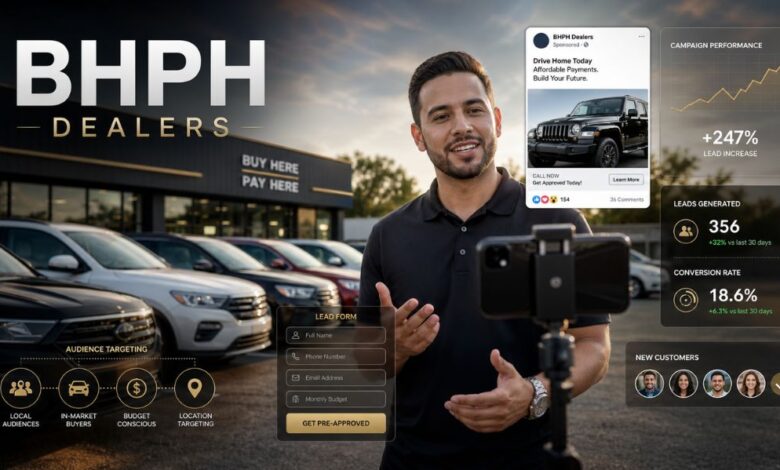
The franchise account is running broad lookalikes off a website pixel, lead-form ads with a generic “Apply Now” hook, and a creative library full of inventory carousels and OEM-supplied photography. The BHPH account, if it’s any good, is running a tight portfolio-based custom audience, three or four offer-led video ads filmed on someone’s iPhone, and a lead form that asks two qualifying questions before the person ever sees the dealership phone number.
The BHPH stores aren’t doing this because they’re more sophisticated. They’re doing it because they have to. Subprime customer acquisition has always punished generic marketing. What’s interesting is how much of that hard-won discipline now applies to franchise stores too — especially as cost-per-lead pressure squeezes everyone.
Here’s what BHPH dealers have figured out about Facebook, and which pieces of it are worth borrowing.
The targeting is built backwards
Most franchise dealer Facebook accounts start with broad targeting and let the platform narrow toward conversions. BHPH dealers do the opposite: they start with a tight first-party audience and expand carefully outward.
The starting point is almost always the dealership’s own portfolio. A BHPH lot with five hundred active accounts has five hundred customer profiles representing exactly the buyer they need to find more of. Those profiles get uploaded as a Custom Audience, hashed and matched inside Meta. Then a 1% Lookalike audience gets built from that seed — that’s the first targeting layer.
The franchise version of this is usually a website-visitor lookalike, which sounds similar but isn’t. Website visitors include tire-kickers, comparison shoppers, and price-checkers. Closed buyers from your own portfolio are the people who actually crossed the line. The lookalike is dramatically tighter as a result.
A second layer the best BHPH operators use: geography plus employer overlay. Subprime buyers cluster in specific employer categories — distribution centers, regional healthcare, food service chains — and Facebook lets you target those job categories within a defined drive radius. It’s the kind of targeting that looks too narrow to franchise marketers and produces lower-cost-per-acquisition numbers anyway because the audience is genuinely buying.
Creative looks nothing like a typical dealer ad
Spend ten minutes scrolling Facebook ads from a high-performing BHPH lot. You will not see polished inventory carousels. You will not see OEM stock photography. You will see something closer to a TikTok aesthetic: a salesperson on the lot with a phone camera, talking directly to the viewer, naming a specific buyer profile.
“If you’re driving a truck right now that has 200,000 miles on it and you’re tired of the maintenance, we have something for you.”
“If you’ve been told no by three places already, hear me out for thirty seconds.”
That kind of creative outperforms inventory carousels by a wide margin in subprime because it’s signaling acknowledgment. The buyer who gets ignored by traditional dealer marketing is being directly addressed for the first time, and they respond to it.
The franchise stealable: stop running creative that looks like everyone else’s creative. The polished beauty shots are competing against every other dealer running polished beauty shots. The mid-tier and luxury franchise stores who break out of that pattern with personality-led, salesperson-fronted creative are seeing the same uplift BHPH lots have been quietly enjoying for years.
The lead form does qualifying work
Most franchise dealers run Facebook lead forms with the bare minimum: name, email, phone, maybe a vehicle of interest dropdown. The result is a high-volume, low-quality flood that the BDC has to dig through to find the buyers.
BHPH operators run lead forms with friction. Two or three qualifying questions before the contact info — “Are you working full-time or part-time?”, “What’s your monthly take-home?”, “Do you have any income besides employment?” The questions look like they’d hurt conversion. They do, by about 20-30%. But the leads that come through close at three to four times the rate.
This works the same way for franchise stores in any down-market segment. If your “All vehicles under $15K” inventory is what’s pulling subprime traffic into the lead form, putting two qualifying questions in front of the form does more than reduce noise — it actually trains the Facebook algorithm to find better-quality conversions, which improves the audience over time.
The team at DealerSmart has written about this in different framings, but the takeaway is the same: a “low conversion” lead form that’s pulling in the right people is more valuable than a “high conversion” form pulling in everyone.
Compliance is the part nobody warns you about
Here’s where BHPH gets harder than most franchise dealers realize, and where any franchise store borrowing the playbook needs to slow down.
If you’re targeting based on income signals, employer category, or any proxy for credit-worthiness, you’re in territory that intersects FCRA and TCPA in ways most marketing teams aren’t equipped for. Meta’s “Special Ad Category” rules force housing, employment, and credit-related ads into restricted targeting precisely because of this. Auto financing lives in a gray zone — most dealer ads aren’t formally credit ads, but ads that imply approval or financing terms can be.
The two practical guardrails BHPH operators learn the hard way:
Avoid creative or copy that promises specific approval outcomes (“Approved in 60 seconds!”) unless your legal review is bulletproof. The cleaner phrasing is conditional and benefit-led (“If you’ve been turned down before, we’d like to talk”).
Make sure your TCPA consent language on the lead form is iron-tight, especially because BHPH funnels rely heavily on follow-up calls and texts. Generic consent boilerplate that worked for franchise call-and-text follow-up may not survive scrutiny in a higher-risk subprime context.
Franchise stores experimenting with this playbook on near-prime or down-market campaigns should treat the compliance review as part of the launch checklist, not an afterthought. The cost of getting it wrong is not a Facebook account suspension — that’s the cheap version. The expensive version is a TCPA class action.
Why this whole approach is becoming everyone’s problem
Subprime marketing has always operated under tighter constraints than mainstream dealer marketing. That used to feel like a disadvantage. In 2026, with cost per lead climbing across every dealer segment, it looks more like training.
The BHPH playbook works because it treats every dollar as scarce and every lead as needing qualification. Franchise stores who’ve spent the last decade with cheap-enough leads and a “more is better” mindset are now experiencing the constraints BHPH operators have been navigating forever. The good news is the playbook already exists. The bad news is most franchise teams don’t realize they need it yet.
The dealers who’ll come out ahead in the next twelve months are the ones who recognize subprime marketing discipline isn’t just for subprime stores anymore. Tight audiences. Personality-led creative. Friction in the lead form. Compliance baked in.
If your store’s running a dedicated Meta Ads strategy for dealers and the cost per acquisition has been creeping for the last six months, the BHPH playbook is the place to look first. The stores using it have been quietly winning while everyone else has been wondering where the easy leads went.