easyjet flight u24429 emergency: How a Routine Lyon-to-Porto Journey Turned Into a Mid-Air Security Incident
A clear look at what happened, why the crew returned to Lyon, and what the incident shows about modern airline safety

The easyjet flight U24429 emergency became a major aviation talking point because it involved a serious passenger-related incident shortly after departure from Lyon, France. What began as a routine short-haul journey to Porto, Portugal, quickly became a safety and security response requiring the aircraft to return to its departure airport. For many travelers, stories like this raise immediate questions: Was the aircraft in danger? Why did the pilots turn back? What does an emergency code mean? And how are passengers protected when someone behaves unpredictably during a flight?
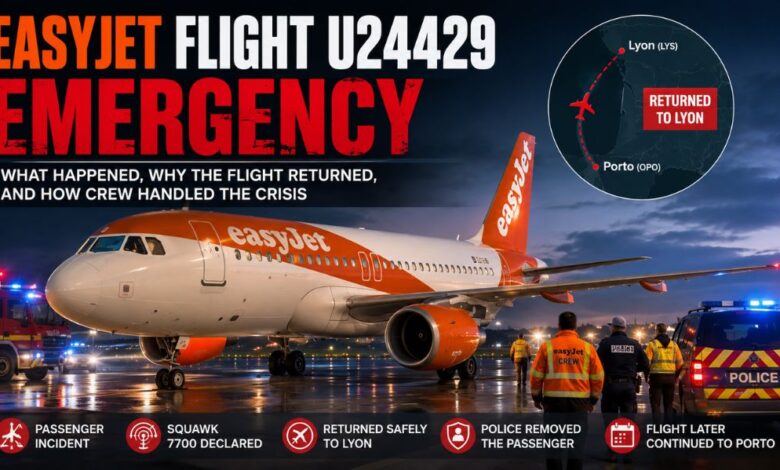
Flight U24429 (EJU4429 in some tracking systems) was operated by easyJet on the Lyon Saint-Exupéry–Porto route. According to public aviation reports, the aircraft departed Lyon on 22 August 2025 and quickly encountered a disruptive passenger. The crew declared an emergency and returned to Lyon, where the flight was met by police. After the passenger was removed, the flight continued to Porto.
What was the Easyjet flight U24429 emergency?
The easyJet flight U24429 emergency refers to a passenger-related onboard disruption that forced an easyJet Airbus A320 operating between Lyon and Porto to return to Lyon shortly after takeoff. Reports described the incident as serious enough that the crew stopped the climb, declared an emergency, and prioritized a safe return.
Not every aviation emergency stems from a technical issue. Some involve medical, weather, fuel, disruptive passengers, or security concerns. In this case, public information indicates a passenger incident, not an aircraft problem. This distinction clarifies that the emergency response focused on risk control rather than on aircraft safety.
The crew’s decision to return was a standard safety-first choice. When a situation in the cabin poses a potential danger to passengers, crew, or cockpit security, pilots and cabin crew are trained to act quickly. Returning to the nearest suitable airport is often the safest option, especially when police or medical support may be required on arrival.
Timeline of the Lyon-to-Porto Incident
The flight left Lyon Saint-Exupéry Airport in the evening for Porto Francisco Sá Carneiro Airport. Soon after takeoff, while still climbing, the crew declared an emergency. Tracking reports show the aircraft stopped at about 20,000 feet before turning back to Lyon.
The aircraft returned safely to Lyon, where authorities were awaiting it. Police removed the disruptive passenger. Afterward, the flight continued to Porto.
This timeline shows that the emergency was handled in a controlled way. As described above, the aircraft did not continue its route while the onboard issue remained active. Instead, the crew used established aviation procedures to reduce risk and return the aircraft to the ground safely, demonstrating the effectiveness of modern aviation safety protocols.
Why did the easyJet Crew Declare an Emergency?
The crew declared an emergency because the situation on board demanded immediate and urgent action. When a flight crew activates an emergency code like 7700, it instantly alerts air traffic control that the aircraft is in distress and requires top priority. This ensures the aircraft receives rapid routing, immediate clearance, and swift support from emergency services upon landing.
Aviation emergencies are not declared lightly. Pilots assess each situation and take the safest action. On EasyJet flight U24429, reported passenger behavior raised a security concern that could not be ignored. Even if the aircraft operates normally, a disruptive or distressed passenger can create danger if the situation escalates.
The cabin crew is the first line of response inside the aircraft. They are trained to calm passengers, manage conflict, protect restricted areas, communicate with the flight deck, and support other travelers. Once the pilots receive information from the cabin crew, they decide whether the flight can safely continue, must return, or must divert.
What Does Squawk 7700 Mean?
Squawk 7700 is a universal emergency code used by aircraft. Selecting this code alerts air traffic control that the aircraft is experiencing an emergency. It does not mean a crash is imminent, only that priority support is required.
For those following flight tracking, a 7700 code can seem alarming, but it is simply a communication tool. It helps controllers clear airspace and prepare responders to ensure a safer return for the aircraft.
In this case, the emergency code signaled that easyJet flight U24429 required priority handling on its return to Lyon. The safe landing shows how the system is designed to work: identify the risk, communicate clearly, land safely, and hand the situation to airport authorities.
Passenger Behavior and Aviation Security
Passenger behavior is a significant factor in aviation safety. Airlines do not only manage aircraft, routes, and weather; they also manage the safety of everyone onboard. A passenger who becomes aggressive, distressed, or confused, or who attempts to enter a restricted area, can create immediate concern.
The cockpit is the most secure part of a commercial aircraft. Since security rules tightened, access is strictly limited. Any cockpit interference is taken seriously, whether the individual is confused, unwell, or acting irrationally.
This does not mean every passenger incident is handled in the same way. Crew members must quickly assess the behavior, level of risk, and available support. Sometimes a passenger can be calmed, and the flight can continue. But in urgent, serious cases, the aircraft may be forced to return or divert so police, airport security, or medical professionals can immediately take over.
How Cabin Crew Respond During an Onboard Incident
Cabin crew is trained for far more than serving passengers. Their main responsibility is safety. During an onboard disruption, cabin crew may speak calmly to the passenger, move other travelers away, inform the pilots, secure the cabin, and ask passengers for assistance if necessary.
Communication with the flight deck is critical. Since pilots remain in the cockpit, they rely on cabin crew updates. If safety or security is affected, pilots can declare an emergency and request priority landing. The EasyJet flight U24429 emergency demonstrates effective crew coordination: after the aircraft returned safely, authorities handled the passenger on arrival, and the remaining passengers were able to continue their journey later. This sequence highlights the importance of training, communication, and quick decision-making.
Was the Aircraft Itself in Danger?
Based on available public reports, the Easyjet flight U24429 emergency was not described as a mechanical failure. The issue was connected to passenger behavior on board. The aircraft landed safely, and there was no public indication that the Airbus A320 suffered a technical problem during the flight. This matters because readers often see “emergency” and assume an aircraft fault is present. In aviation, emergencies can include a medical event, a security issue, a disruptive passenger, smoke, a technical warning, or bad weather. In this case, the danger was on board and required swift mitigation. Returning to Lyon was safer than continuing to Porto with an unresolved cabin security concern.rn.
Why Returning to Lyon Made Sense
Returning to Lyon was a practical and safety-focused decision. The flight had recently departed, meaning Lyon was still nearby and suitable for landing. Airport police and ground teams could be ready to meet the aircraft. Returning also allowed easyJet to address the incident at the point of departure rather than continuing through airspace toward another country.
For pilots, the closest airport is not always the automatic choice; it must be suitable for the aircraft, weather conditions, runway length, emergency services, and operational support. Lyon was clearly a logical option because the aircraft had just departed from there and could return safely.
Turning back may delay travel, but safety comes before punctuality. Airlines prefer to inconvenience passengers rather than continue with an active risk.
Impact on Passengers
Passengers on easyJet flight U24429 likely felt uncertainty, delay, and concern. Any emergency return is stressful, especially when travelers lack full details. Cabin crew must balance communicating with passengers and managing the incident to maintain order.
After landing, police handled the passenger in question, and the flight later continued to Porto. For travelers, this outcome is frustrating but also reassuring. It shows that aviation procedures are designed to protect passengers even when unexpected human behavior interrupts a normal journey.
In such situations, passengers are usually advised to follow crew instructions, remain seated unless told otherwise, avoid filming or interfering with the response, and allow trained staff to manage the incident.
What This Incident Teaches About Airline Safety
The easyjet flight U24429 emergency shows that airline safety is not only about aircraft maintenance and pilot skill. It is also about human behavior, cabin security, emergency communication, and airport coordination. A safe outcome depends on many people working together: cabin crew, pilots, air traffic control, police, airport staff, and sometimes medical teams.
The incident also reminds readers that emergency procedures are built for uncertainty. Crews do not need to wait until a situation becomes worse before acting. If there is a credible risk, they can return, divert, or request emergency support.
That is why commercial aviation remains highly structured and safety-focused. Even disruptive and unpredictable events can be managed through clear procedures.
Conclusion
The easyjet flight U24429 emergency was a serious passenger-related incident on a Lyon-to-Porto flight that led the crew to declare an emergency and return safely to Lyon. Public reports indicate that the aircraft landed without technical issues, that police met the flight, and that the passenger involved was removed before the journey continued.
Although the incident caused delay and concern, it also demonstrated how modern aviation safety systems work. The crew acted quickly, air traffic control gave support, and authorities handled the situation on the ground. For passengers and readers, the most important takeaway is clear: emergencies in aviation are handled through training, procedure, and caution, with safety always placed above schedule.
FAQs
What happened during the EasyJet flight U24429 emergency?
The flight returned to Lyon shortly after takeoff because of a passenger-behavior incident on board. The crew declared an emergency, landed safely, and police removed the passenger after arrival.
Where was easyJet flight U24429 traveling?
The flight departed from Lyon Saint-Exupéry Airport in France and arrived at Francisco Sá Carneiro Airport in Portugal.
Did easyJet flight U24429 land safely?
Yes, the aircraft returned to Lyon and landed safely. Public reports do not describe the incident as an aircraft mechanical failure.
What does squawk 7700 mean?
Squawk 7700 is an emergency transponder code used by pilots to tell air traffic control that the aircraft needs priority assistance.
Was the EasyJet flight U24429 emergency caused by a technical fault?
Available reports describe the emergency as passenger-related rather than a technical fault with the aircraft.
Why did the aircraft return to Lyon instead of continuing to Porto?
The crew returned to Lyon because it was the safest and most practical option after the onboard incident. Returning allowed police and airport teams to handle the situation quickly.
What can passengers learn from this incident?
Passengers should always follow crew instructions during an emergency or disruption. Cabin crew is trained to manage safety situations, and cooperation helps protect everyone on board.