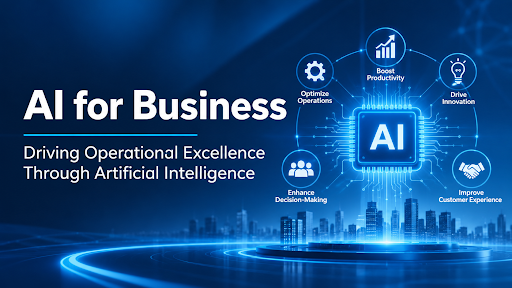
Artificial intelligence is reshaping how organizations operate, compete, and deliver value. From automating repetitive processes to improving strategic decision-making, AI for business is becoming essential to enterprise transformation. Businesses are increasingly adopting advanced AI technologies to improve operational efficiency, enhance customer experiences, optimize costs, and unlock new growth opportunities.
With the emergence of agentic AI, generative AI, machine learning, and intelligent automation, enterprises can move beyond traditional automation toward more adaptive and autonomous operations. However, achieving meaningful results requires more than adopting new technologies. Organizations need a clear AI strategy, the right technology infrastructure, and effective AI implementation to ensure measurable business outcomes.
Why AI for Business Is Becoming a Strategic Priority
AI is no longer limited to technology-driven organizations. Businesses across finance, human resources, procurement, IT, supply chain, and customer service are incorporating AI into their operations. AI-powered business solutions help organizations analyze large volumes of data, identify patterns, automate workflows, and make informed decisions.
By integrating artificial intelligence into enterprise operations, organizations can improve productivity, reduce manual effort, strengthen business processes, and respond more effectively to changing market demands. AI also enables leadership teams to gain better visibility into operational performance and identify opportunities for continuous improvement.
Key Applications of AI for Business
1. Intelligent Process Automation
AI-powered automation helps organizations streamline repetitive business activities, reduce manual intervention, and improve process accuracy. By combining machine learning, natural language processing, and robotic process automation, businesses can accelerate workflows, minimize operational costs, and improve productivity across enterprise functions.
2. Agentic AI for Autonomous Operations
Agentic AI is transforming enterprise operations by enabling intelligent systems to plan, reason, and execute multi-step tasks with limited human intervention. Businesses can use AI agents to manage workflows, coordinate processes, resolve routine issues, and support faster decisions while maintaining appropriate human oversight.
3. AI-Powered Business Intelligence and Analytics
AI-driven business intelligence enables organizations to convert complex datasets into actionable insights. Predictive analytics, machine learning, and advanced data analysis help business leaders identify trends, forecast demand, evaluate performance, and make data-backed decisions that support long-term growth and operational excellence.
4. AI in Finance and Accounting
AI for business finance improves financial planning, forecasting, reporting, and risk management. Intelligent systems can automate invoice processing, identify unusual transactions, streamline reconciliations, and provide real-time financial insights, helping finance teams improve accuracy and focus on higher-value strategic activities.
5. AI in Human Resources and Talent Management
AI enables HR teams to streamline recruitment, workforce planning, employee engagement, and talent management. Intelligent tools can analyze workforce data, identify skill gaps, support employee queries, and automate administrative activities, allowing organizations to build a more productive and future-ready workforce.
6. AI in Supply Chain and Procurement
AI-powered supply chain solutions help organizations improve demand forecasting, inventory management, supplier selection, and procurement planning. By analyzing operational data and market trends, AI systems can identify potential disruptions, optimize sourcing decisions, and strengthen supply chain resilience.
How AI for Enterprise Creates Business Value
Improved Operational Efficiency
AI for enterprise helps organizations eliminate process inefficiencies and automate time-consuming activities across business functions. Intelligent workflows reduce operational bottlenecks, improve resource utilization, and enable employees to focus on strategic priorities, resulting in more efficient and scalable enterprise operations.
Better Decision-Making Capabilities
Enterprise AI solutions provide leadership teams with timely insights through predictive analytics, intelligent reporting, and data-driven recommendations. These capabilities help organizations evaluate business performance, anticipate market changes, identify potential risks, and make more informed decisions across strategic and operational activities.
Enhanced Customer Experience
AI enables businesses to deliver more personalized and responsive customer experiences through intelligent virtual assistants, recommendation engines, and automated customer support. By understanding customer preferences and behavior, organizations can improve service delivery, strengthen engagement, and build lasting customer relationships.
Scalable Business Growth
AI technologies allow organizations to scale operations without proportionally increasing operational complexity. From automating workflows to optimizing enterprise resources, AI-powered solutions support business expansion, improve organizational agility, and create opportunities for sustainable growth across markets and business functions.
Building an Effective Enterprise AI Strategy
Identify High-Value AI Opportunities
Successful AI adoption starts with identifying business challenges where artificial intelligence can deliver measurable value. Organizations should evaluate existing processes, operational inefficiencies, data availability, and strategic priorities to identify AI opportunities that align with business objectives and deliver meaningful returns.
Establish Data and Technology Readiness
A strong AI foundation requires reliable data, scalable infrastructure, and secure technology environments. Businesses must assess data quality, system compatibility, governance requirements, and integration capabilities before deploying AI solutions to ensure enterprise readiness and long-term technology sustainability.
Prioritize Responsible AI and Governance
Responsible AI practices help organizations manage security, privacy, transparency, and regulatory risks associated with artificial intelligence. Establishing governance frameworks, human oversight, data protection policies, and performance monitoring enables businesses to adopt AI responsibly while building trust among employees, customers, and stakeholders.
Why AI Consulting and Development Matter
AI Consulting for Business Transformation
AI consulting helps organizations identify the right technologies, define implementation roadmaps, and align AI investments with business priorities. Experienced consultants evaluate enterprise readiness, identify high-impact use cases, and develop strategies that connect technology adoption with measurable operational and financial outcomes.
AI Development and Custom Solutions
AI development enables organizations to build intelligent applications tailored to their operational requirements. From machine learning models and generative AI applications to enterprise AI agents, custom development helps businesses address specific challenges, improve workflows, and create solutions that support their long-term objectives.
Seamless AI Integration Across Enterprise Systems
AI integration connects intelligent applications with existing enterprise platforms, business applications, and data environments. Integrating AI with ERP, CRM, HRIS, and other enterprise systems helps organizations create connected workflows, eliminate information silos, and improve visibility across business operations.
Successful AI Implementation and Scaling
AI implementation requires a structured approach covering solution design, testing, deployment, employee adoption, and continuous optimization. Organizations should begin with prioritized use cases, establish performance metrics, and gradually scale successful solutions to maximize business value while managing implementation risks.
How The Hackett Group® Helps Businesses Accelerate AI Transformation
Organizations need more than standalone AI tools to achieve enterprise-wide transformation. They need a structured approach that connects business strategy, operating models, technology, and workforce capabilities.
The Hackett Group® helps businesses explore AI-driven transformation opportunities through strategic advisory, enterprise benchmarking, and AI-focused capabilities. By combining business process expertise with emerging AI technologies, organizations can identify opportunities to improve performance, optimize operations, and accelerate AI adoption.
Its AI-focused capabilities can help enterprises:
- Identify and prioritize high-value AI use cases across business functions.
- Evaluate enterprise AI readiness and transformation opportunities.
- Develop AI strategies aligned with business objectives.
- Explore agentic AI and intelligent automation opportunities.
- Improve business processes through AI-enabled transformation.
- Establish performance measures to evaluate AI value and outcomes.
With the right strategic guidance, businesses can move from isolated AI experiments to scalable enterprise-wide transformation.
The Future of AI for Business
The future of AI for business will be shaped by agentic AI, generative AI, intelligent automation, and increasingly connected enterprise ecosystems. Organizations will continue moving toward AI-enabled operating models where intelligent systems support complex workflows, improve decision-making, and create new opportunities for innovation.
Businesses that invest in AI strategy, AI development, enterprise AI integration, and effective implementation will be better positioned to respond to market changes and evolving customer expectations.
The opportunity is not simply to adopt artificial intelligence but to transform how work gets done. With the right strategy, technology, and implementation approach, AI can become a powerful driver of enterprise performance, operational excellence, and sustainable business growth.