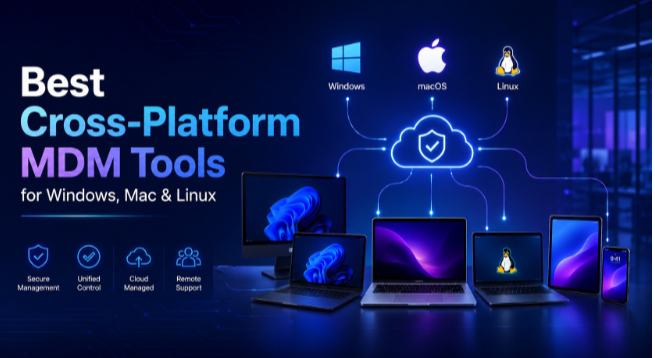
Managing a fragmented technology ecosystem is the new normal. In 2026, modern IT and security teams must seamlessly secure, patch, and monitor mixed-device fleets without sacrificing productivity. Relying on disjointed, platform-specific solutions often leads to tool sprawl, policy gaps, and escalating administrative overhead.
Nevertheless, robust cross-platform mobile device management (MDM) tools allow IT admins to secure and have granular control over Windows, macOS, and Linux endpoints from a single, unified dashboard.
Let’s explore the three best cross-platform MDM solutions to streamline automated device enrollment and provisioning, OS and update management, application and content management, remote support, and device security across your entire organization this year.
1. Scalefusion
Scalefusion is a premier unified endpoint management (UEM) solution with a broad operating system coverage. It’s the best fit for modern enterprises that need seamless cross-platform management of their Android, iOS, macOS, tvOS, Windows, Linux, and ChromeOS devices. In addition to comprehensive device management, it combines Zero Trust Access (ZTA) management with OneIdP and endpoint security & automated compliance with Veltar in a single pane of glass. Scalefusion allows IT admins to configure Windows AI, BitLocker Encryption, and Microsoft Defender Antivirus policies, along with Apple Intelligence, FileVault, and Managed Device Attestation settings.
Key features:
● Zero-touch and bulk enrollment options
● Remote cast, control, and commands
● Enterprise-grade device encryption
● Automated OS and patch updates
● Custom device policy configuration
● AirThink AI for automated scripting
Pricing: $2/device/month for the Essential plan (14-day free trial available with all features unlocked)
Best for: Businesses that need more than a standard MDM platform and operate a diverse, mixed-OS device fleet in a complex IT ecosystem.
2. JumpCloud
JumpCloud is a powerful MDM solution that helps manage and secure a range of devices across multiple platforms, including Windows, macOS, and Linux. It helps protect macOS, Windows, and Linux devices without the headache of fragmented legacy systems. Its security capabilities include conditional access, remote lock/wipe, and passwordless authentication.
Key features:
● Cross-platform automated device management
● Unified identity lifecycle and access management
● Automated patch management and app version control
● Real-time IT monitoring and control with proactive alerts
● Human, machine, and AI identity and access management
Price: $9/user/month for the Device Management product.
Best for: Organizations that need to manage and safeguard multi-OS devices, user identities, and application access from a single cloud console.
3. IBM MaaS360
IBM MaaS360 is a cloud-based, feature-rich UEM platform that helps businesses with centralized control over desktops, laptops, smartphones, tablets, and IoT devices. It’s a good UEM choice for organizations that manage multi-platform, complex environments. With its intelligence-driven approach through Watson AI, it helps curb manual security monitoring, especially for IT teams that manage large, distributed fleets.
Key features:
● Granular policy recommendation engine
● Secure containerization for data separation
● Consistent policy enforcement across OS
● Over-the-air (OTA) device enrollment
● Risk-based automated application patching
Price: $4.24/device/month for the Essentials plan.
Best for: Organizations that are looking for an AI-enhanced UEM platform to manage multi-OS
environments without compromising security and compliance.
4. Microsoft Intune
Microsoft Intune is a cloud-based UEM solution that scales the management and security of diverse endpoint estates. It simplifies endpoint management by automatically enforcing policies, deploying patches, and tracking security compliance for cloud-connected devices from one central dashboard. It delivers deep, advanced control over endpoint security, specialty-device management, app deployment, remote support, certificate handling, analytics, and device updates.
Key features:
● AI-powered configuration baselines
● Conditional access policies to control app access
● Automated onboarding with Autopilot and ABM
● Remote lock, selective wipe, and password reset
● Real-time device health evaluation
Price: $8/user/month for the base plan.
Best for: Enterprises looking for cross-platform device management with advanced capabilities.
5. ManageEngine
ManageEngine Mobile Device Manager Plus simplifies enterprise mobility management by letting IT admins monitor, configure, and secure smartphones, tablets, laptops, and rugged devices from a single central console. The software seamlessly supports Apple, Android, Windows, and ChromeOS platforms. However, Linux management is supported by ManageEngine Endpoint Central. Whether deploying corporate-owned hardware or managing personal devices, its advanced BYOD containerization isolates business data to protect user privacy.
Key features:
● Silent app installation, update, and removal
● Remote wipe of corporate data on lost/stolen devices
● Remote view and control of device screens
● Device location tracking and geofencing
● Complex password policies and device restrictions
Price: $1.28/device/month for the Standard edition.
Best for: SMBs and MSPs needing an affordable, cross-platform solution to manage and secure a mixed fleet of devices from a single console.
Choosing your ultimate MDM solution for 2026
Managing a multi-OS environment requires a unified solution, doing away with fragmented IT tools. In 2026, a truly effective MDM solution must act as a seamless, centralized control center across your entire organization’s fleet. Investing in the right solution today sets the foundation for a secure, scalable, and future-proof digital workplace.
Whether your IT team relies on Windows, macOS, or Linux, the right platform eliminates administrative overhead, enforces stringent security and compliance policies, and ensures smooth operations. By choosing an MDM solution that naturally fits your specific IT infrastructure and device ecosystem, your IT team can spend less time managing endpoints manually and more time driving strategic business growth.