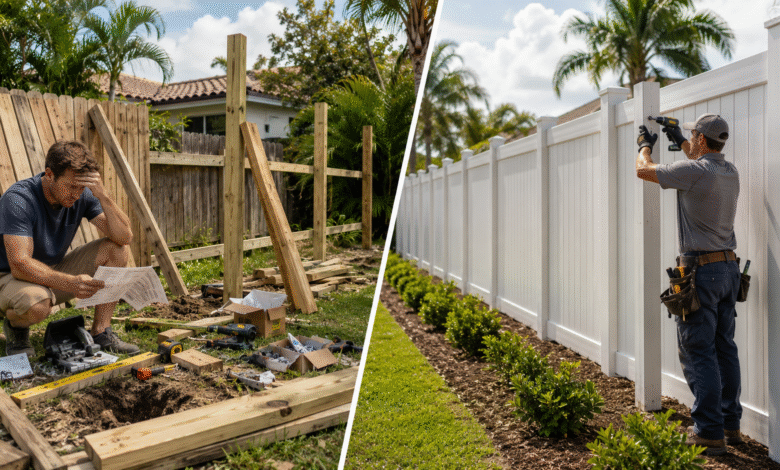
There’s a guy in Ballast Point who spent an entire weekend building a wood privacy fence along his side yard. Rented a post hole digger from Home Depot, bought pressure-treated pine, watched a few YouTube videos the night before. By Sunday evening he had a fence. It looked decent, honestly. Straight enough. Stained. His wife was happy.
By February, two of his posts had shifted about ten degrees and the gate was grinding against the walkway. He called some Fence Companies Tampa to come look at it and the diagnosis was what you’d expect — posts weren’t deep enough, not enough concrete in the footings, and one post was set right on top of a tree root that had started pushing it sideways as the root grew. He ended up paying to have four posts pulled, re-dug, and reset properly. That repair cost him almost as much as having the fence professionally installed would have in the first place.
This isn’t a knock on DIY people. Some of them are genuinely skilled and build things that last. But Tampa has specific conditions that punish mistakes underground, and most of the DIY fence failures we see come down to the same handful of issues.
YouTube Doesn’t Know Your Soil
The tutorials make it look simple. Dig a hole, drop in a post, pour some concrete, move to the next one. And in parts of the country where the soil is dense clay or packed earth, that basic approach actually works well enough. The ground grips the footing. Water drains predictably. Posts stay where you put them.
Tampa soil doesn’t work that way. Most of it is sand, and sand is shifty by nature. It doesn’t compact the same. It doesn’t hold water the same. In neighborhoods like Riverside Heights and Old Seminole Heights, the composition can change within the same yard — sandy in one corner, denser with fill material in another. A post set to the same depth across a property line might be rock solid on one end and floating loose on the other.
Professional crews know to test what they’re digging into. If they hit water at two and a half feet — which happens all the time near the river and in parts of East Tampa — that changes the approach. Deeper hole, more concrete, sometimes a gravel base under the footing to help with drainage. A homeowner following a generic tutorial has no reason to think about any of this. They dig to whatever depth the video said and move on.
The Post Hole Digger Lie
Renting a one-man post hole digger sounds like a great plan until you’ve been fighting it through root-laced sandy ground for three hours and you’ve finished four holes. Those machines kick hard when they hit a root. They bog down in wet sand. And most of the rental units available at hardware stores dig a hole that’s narrower than what a fence post actually needs for a proper footing.
You want the hole wide enough that the concrete bells out around the post, not just fills a tight cylinder. A wider footing at the base gives lateral resistance — that’s what keeps the post from rocking when wind hits the panels. A narrow hole with concrete poured tight around the post is basically a concrete stick sitting in sand. It’ll hold for a while. It won’t hold forever.
The two-man auger units are better but they’re genuinely dangerous if you haven’t used one before. We’ve had customers tell us they gave up on the DIY approach after the auger grabbed a root and nearly threw them off their feet. That’s a trip to the emergency room waiting to happen.
Permits and Property Lines: Where DIY Gets Expensive
Most people who build their own fence skip the permit. Understandable — the permit process in Hillsborough County takes time and costs money, and it feels like overkill for a backyard fence. But the permit exists because the county has rules about fence height, setback distances from property lines, and construction standards in flood zones. A lot of Tampa sits in FEMA flood zones, and the requirements there aren’t suggestions.
The property line issue is the one that burns people most often. A homeowner measures their lot based on what they think the boundary is — the edge of their lawn, the old fence line, wherever the landscaping ends. But property lines don’t always match what the yard looks like. We’ve seen fences built a foot onto a neighbor’s property. That’s a problem that stays quiet until somebody sells the house or the neighbor decides to make it an issue. Then you’re tearing out a fence you spent a weekend building and paying for a survey you should have gotten before you started.
Professional fence companies handle the permit, know the setback requirements, and in most cases will recommend or arrange a property survey if there’s any question about the boundary. It’s boring administrative work but it eliminates a category of risk that no amount of YouTube research will prepare you for.
Materials Aren’t All the Same Grade
Here’s another spot where DIY projects go sideways. A homeowner walks into a big box store and buys whatever pressure-treated fence boards are on the shelf. They look fine. They’re labeled for ground contact. Good to go, right?
Not always. Pressure-treated lumber comes in different retention levels, and the stuff rated for ground contact in a mild climate isn’t the same as what you need when wood is sitting in Tampa’s soggy, termite-friendly soil year-round. The posts especially matter — they’re buried in the ground and exposed to constant moisture. Using a post that’s not rated for severe ground contact in this environment is a slow-motion rot situation.
Vinyl is the same story. The residential-grade vinyl panels at the hardware store are thinner, have less internal reinforcement, and lack the UV inhibitors that commercial-grade vinyl includes. They’ll look fine on installation day. Give them two Florida summers of direct sun and a couple of storms and the difference becomes obvious — warping, cracking, color fading.
We source our materials from suppliers who stock product rated for this climate specifically. It’s not the cheapest option on the shelf, but it’s the option that still looks right in year eight.
The Gate, Again
Every article about fencing in Tampa has to mention the gate because it keeps being the thing that fails. And on a DIY install, the gate is almost guaranteed to be the first problem.
Building a gate that swings freely, latches cleanly, and stays aligned over thousands of open-close cycles is harder than it looks. The hinge post needs to be set deeper and in more concrete than a standard line post. The hinges need to be rated for the weight of the gate. The latch needs to resist Tampa’s humidity without corroding shut.
Most DIY gate installations use the same post depth as the rest of the line and hardware from a blister pack at the store. Within six months the gate is dragging, the latch doesn’t line up, and the homeowner is lifting the gate with one hand while trying to shove the latch into place with the other. We repair gates like this constantly. A deeper post and better hardware at the start would have prevented the entire problem.
Build It Yourself or Hire It Out — Just Don’t Split the Difference
The worst outcome isn’t a full DIY job or a full professional install. The worst outcome is the in-between — where someone does half the work themselves, runs into trouble, and then calls a crew to finish it. Now the installer is working with posts that are already set at the wrong depth, holes that are in the wrong position, and materials that may not be what they’d have chosen. The cost to correct and complete that kind of project often exceeds what a full professional install would have been from day one.
If you’re confident in your skills and you understand what Tampa’s soil and climate require, do it yourself. Plenty of people have. But if there’s any doubt, the smarter investment is getting it done right the first time and not touching it again for a decade.
3014 E Hanna Ave, Tampa, FL 33610
(813) 547-3973