Most dairy farmers don’t have a cow problem — they have a feed problem they haven’t fully diagnosed yet.
Your herd’s genetic potential is fixed. What you put in the feed bunk every single day is not. And that’s exactly where milk production is made or lost. The difference between a cow producing 22,000 pounds of milk per year and one producing 26,000 often comes down to what she’s eating, when she’s eating it, and whether the nutrient mix actually matches what her rumen needs at each stage of lactation.
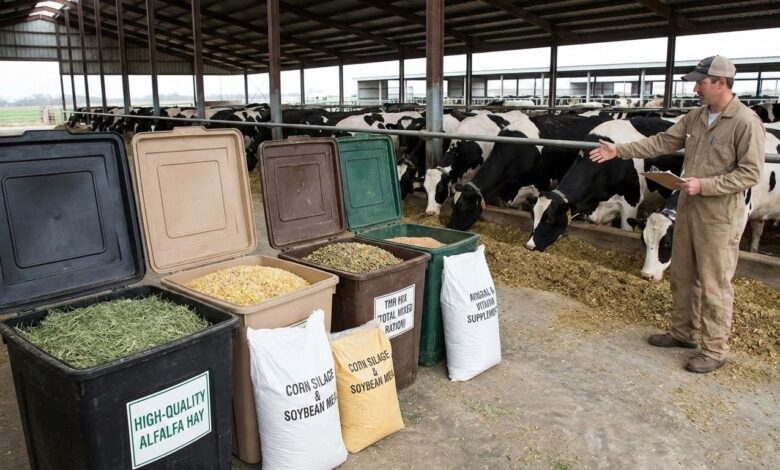
Here’s the short answer: the best feed for dairy cows to maximize milk production combines high-quality forage — especially corn silage and alfalfa — with a properly balanced Total Mixed Ration (TMR) that accounts for the cow’s stage of lactation, dry matter intake targets, and protein-to-energy ratios. No single feed does it alone. It’s the system that wins, especially when supported by well-formulated animal feed and cattle livestock feed programs designed for performance and consistency.
Let’s break that down into what it actually looks like in practice.
Why Does Feed Have Such a Direct Impact on Milk Yield?
Milk production is almost entirely a nutritional output. The lactating dairy cow is one of the most metabolically demanding animals in agriculture. She needs carbohydrates, amino acids, fatty acids, minerals, vitamins, and large volumes of water — all delivered in the right ratios to support her mammary gland’s demand for milk synthesis.
According to the Merck Veterinary Manual, the cornerstone of dairy nutrition is managing feed intake relative to absolute nutrient requirements, with Dry Matter Intake (DMI) being the key monitoring metric. When DMI drops, milk production drops — almost immediately. Research from Oregon State University shows that each additional kilogram of dry matter consumed supports roughly 2 to 2.4 kg more milk.
The numbers are stark: U.S. milk production per cow has climbed from 17,760 pounds per year in 1999 to approximately 24,100 pounds in 2023, with projections near 24,400 pounds in 2024 — largely due to improvements in feed management and nutrition programs, according to USDA data via Statista.
That progress doesn’t happen by accident. It happens feed bunk by feed bunk.
What Is the Best Forage for Dairy Cows?
Forage is the foundation of every effective dairy diet. If your forage quality is poor, no supplement or additive fully fixes it.
High-quality corn silage is widely regarded as one of the most effective forages for milk production. According to research published by Kings AgriSeeds, replacing poor-quality forage with highly digestible cereal silage can potentially yield up to five additional pounds of milk per cow per day. The key variables to test for are NDF (Neutral Detergent Fiber), uNDF240 (undigested NDF after 240 hours), and starch content. More floury starch hybrids generally produce the best results.
Alfalfa hay and haylage are equally important. They provide high protein content and digestible fiber — both critical for early and peak lactation. The American Dairy Association NE confirms that common forage options including alfalfa, corn silage, barley, and pasture grasses form the nutritional backbone of most U.S. dairy herds.
Winter small grains (rye, triticale, wheat) are an underutilized option. They offer very high NDF values, low uNDF240, and may also carry a lower risk of butyric acid formation compared to alfalfa silages — making them a smart rotational option for farms looking to boost digestible fiber with minimal downside.
What NDF Level Should You Target in Dairy Forage?
According to the University of Minnesota Extension, low NDF forages are more digestible and drive higher DMI. A high-fiber forage limits how much a cow can eat — a cow can consume 3% of her body weight in dry matter from excellent hay, but only 1.5% from poor-quality hay. That’s a 50% reduction in intake from a single forage quality decision.
Test your forage. Regularly. It is the single most actionable thing most producers can do immediately.
What Is a Total Mixed Ration (TMR) and Why Do High-Producing Herds Use It?
A TMR blends all feed ingredients — forages, grains, protein sources, minerals, and vitamins — into one uniform mix fed throughout the day. The goal is simple: every bite a cow takes delivers a balanced nutrient profile.
Penn State Extension describes TMR as the most widely adopted feeding method for high-producing dairy cows globally. It was introduced in the 1950s and now dominates large-scale operations. A USDA National Animal Health Monitoring System survey found that roughly 90% of herds with more than 500 cows feed a TMR.
The production case is clear: a correctly balanced TMR can increase milk output by 1 to 2.5 kilograms per cow per day, according to the University of Minnesota Extension. That’s a meaningful gain at any herd size.
Dr. Scott E. Poock, DVM, DABVP, Associate Extension Professor at the University of Missouri, puts the dry matter numbers in plain terms: “Holsteins might need about 28 to 30 pounds of dry matter [as dry cows], whereas once they freshen a mature cow might need 45 to 50 pounds. When she reaches peak lactation she’ll need 55 to 60 pounds of dry matter.” The ration composition — and the sheer volume of it — has to scale with where she is in lactation.
What Grains and Protein Sources Boost Milk Production?
Grains supply the concentrated energy that forage alone can’t deliver at peak production. Protein feeds support amino acid availability for milk synthesis.
Best grain options for dairy cattle include:
- Corn (ground or steam-flaked) — primary starch source, highly fermentable
- Barley — good starch content with slightly slower rumen degradation
- Wheat — high energy, but limit to avoid rumen acidosis risk
Protein supplements that drive milk yield:
- Soybean meal — the most widely used rumen-degradable protein source; supports microbial protein synthesis
- Canola meal — competitive with soybean meal in amino acid profile, particularly methionine
- Cottonseed (whole) — adds both protein and fat; a dual-purpose supplement well-suited to high-producing cows
- Distillers dried grains (DDGs) — a cost-effective byproduct high in bypass protein and digestible fiber
According to research published by the National Institutes of Health (PMC), oilseeds like soybeans, cottonseed, canola, and flax typically contain around 20% fat, making them valuable energy supplements. The recommendation is to keep total dietary fat below 7–8% of ration dry matter to avoid depressing fiber digestibility.
One practical rule from University of Minnesota Extension: One pound of crude protein is needed to produce 10 pounds of milk. If your protein supply is off — or if heat-damaged forage is limiting protein availability — your milk components will show it first.
Does Water Count as Part of Dairy Cow Feed Management?
Absolutely — and it’s one of the most overlooked variables.
Dairy cows drink roughly 5 liters of water for every kilogram of milk produced, according to the American Dairy Association NE. A cow producing 40 liters of milk per day consumes approximately 200 liters of water. Cut water access by 40%, and DMI drops 16–24%, triggering a steep decline in milk yield (Ontario Ministry of Agriculture, via Engormix).
Clean, fresh, cool water should be available within 15 meters of the feed bunk at all times — and in hot weather, at least 60% of the daily ration should be offered at night when heat stress is lower.
What Feed Additives Actually Work for Dairy Cows?
Not all additives deliver a return on investment, but a few have strong research backing:
- Rumen buffers (sodium bicarbonate): Stabilize rumen pH when high-grain rations are fed, protecting against sub-acute ruminal acidosis (SARA)
- Bypass fat supplements (calcium salts of fatty acids): Increase energy density without disrupting rumen fermentation — particularly useful in early lactation
- Yeast cultures and direct-fed microbials: Support rumen microbial populations, improve fiber digestion, and can aid DMI
- Niacin: Shown to help transition cows manage ketosis risk in early lactation
- Rumen-protected amino acids (methionine, lysine): Improve milk protein percentage and overall milk components when metabolizable protein is limiting
Selecting the right additives often depends on herd performance goals and forage quality. Today, comparing different additive brands and formulations has become easier, as many options are available through pet products online marketplaces, allowing farmers to make more informed and cost-effective decisions.
How Do You Know If Your Feed Program Is Actually Working?
Numbers don’t lie — but you have to track the right ones.
Key performance indicators to monitor on a continuous basis:
- Milk production per cow per day — the primary output metric
- Milk fat and protein percentages — early signals of ration imbalances
- Body condition score (BCS) — cows losing condition too fast in early lactation signal a negative energy gap
- Feed refusal rate — orts should be 2–5% of total feed offered daily; less signals underfeeding, more signals palatability or sorting issues
- Milk Urea Nitrogen (MUN) — a high MUN signals excess rumen-degradable protein; a low MUN signals a deficiency
Hubbard Feeds’ research puts it directly: there is the ration on paper from the nutritionist, the ration that is mixed, and the ration the cow actually consumes. These three can differ significantly. Consistent mixing, accurate ingredient loading order, and regular forage testing are what close that gap.
Frequently Asked Questions About Dairy Cow Feed
Q: How much should I feed a dairy cow per day?
A high-producing Holstein at peak lactation needs 55–60 pounds of dry matter daily. Mid-to-late lactation cows eat at 3.4–3.7% of body weight in dry matter. Dry cows drop to 1.5–2.0% of body weight (Oregon State University, Engormix).
Q: What is the single most important feed for milk production?
High-quality forage — particularly corn silage and alfalfa. Forage provides the rumen stability and digestible fiber that makes all other nutrition work. Without good forage, even the best grain and protein program underperforms.
Q: Can I increase milk production just by adding more grain?
Not without risk. Total fat should stay below 7% of ration dry matter. Grain should not exceed 2.3% of body weight. Excess grain without adequate effective fiber causes SARA, which suppresses DMI and milk fat — often dropping total milk output, not raising it.
Q: How often should I test my forage?
At minimum, once per cutting for hay crops and once per quarter for silage. More frequently if you notice changes in dry matter content, manure consistency, or production — all early signs that forage quality has shifted.
The Bottom Line
There is no single magic feed that unlocks a dairy cow’s milk potential. What works is a disciplined, stage-specific feeding system — one that starts with high-quality forage, builds a balanced TMR matched to each production group, delivers adequate dry matter and water consistently, and gets tested and adjusted when numbers move.
Dr. Poock’s point from Missouri is one worth carrying: the producer needs to work with a good nutritionist who can formulate those rations. Not once, but continuously — because the cow’s needs change, the forage changes, and the economics change. The herds that win are the ones that treat feeding like the precision operation it actually is.
Ready to build a feed program that performs? Midsouth Feeds carries the cattle and livestock feed options to support dairy herds at every stage of production — with the expertise to match.