
In October 2022, a British buyer who had been buying the same brand of pasta for more than 11 years suddenly switched brands. The price of the product was virtually unchanged, there were no promos from competitors and the difference between SKUs remained minimal. However, the decision to switch still came. This point explains the nature of today’s brand switching recession UK well – buyers are changing brands not just because of money, but because they feel like they have lost control over the future.
For many FMCG teams, this remains a serious problem of data interpretation. Growth in switching is often perceived as a direct consequence of price sensitivity, though much of the change actually stems from falling consumer confidence. This was particularly evident during the UK’s brand switching cost of living crisis, when even stable categories began to exhibit unconventional buyer behavior.
The main mistake of brands is that they are trying to cure emotional anxiety with price instruments.
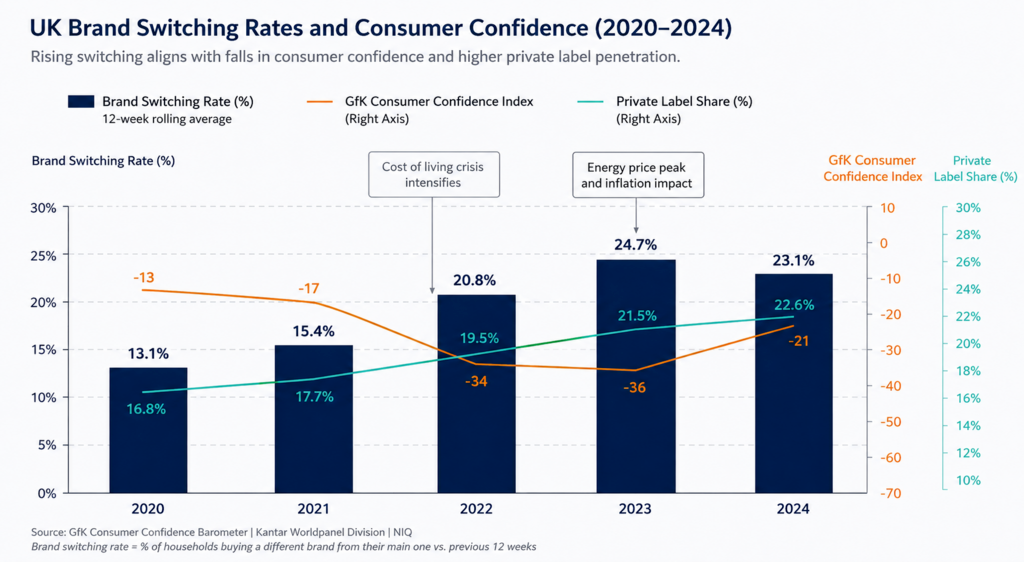
UK grocery brand switching rates during cost of living crisis 2022 to 2024
Not All Brand Switching Recession UK Works the Same Way
Not all switching is the same. For FMCG teams, it’s crucial to distinguish at least three types of consumer behavior. They should therefore be considered separately and in greater detail.
Price-Led Switching
This is a classic situation: the buyer sees a cheaper counterpart and switches to it for savings. Such switching is more common in commoditised categories with low emotional attachment.
Recovery is relatively predictable here, because a return is possible after income stabilization, loyalty is restored through value perception, and the premium gap plays a key role.
Promotional Switching
This is where the trigger becomes a temporary promotion or discount. The buyer may not change their attitude towards the brand, but simply react to tactical pricing.
Such switching is short-term, less dangerous for brand equity, and more often associated with retailer dynamics than with consumer loyalty downturn. That is why many UK grocery brands have historically learned to live with high promo sensitivity.
Confidence-Led Switching
This is the most underrated type of behavior in FMCG consumer behaviour UK. The buyer changes a brand not because they can’t afford the old product, but because they want to feel in control. Even if savings are minimal, the fact of switching reduces internal anxiety.
In this case, several key factors should be highlighted:
- price elasticity becomes secondary;
- shopper psychology is more important than discounts;
- aggressive price tactics can only reinforce erosion of brand trust.
That is why some categories showed switching growth even without significant price changes.
Which UK Shoppers Switch And Which Don’t
One of the key problems with FMCG analytics is that aggregate numbers hide fundamentally different consumer groups. For example, households 25-40 with mortgage, children, and unstable utility costs exhibit a completely different shopping behavior than an audience of 55+ with paid real estate.
At the level of panel data, both segments may look similar but their decision-making radically differs. The most vulnerable groups during a downturn are:
- young families with variable expenses;
- consumers with high debt exposure;
- households sensitive to energy bills;
- shoppers without savings;
- audiences actively following economic headlines
For these segments, UK grocery spending habits are a way to control financial uncertainty.
At the same time, older consumers are less likely to change their brands, more loyal, and slower to respond to economic sentiment shifts. This is especially important for category managers, who often overestimate the scale of switching without considering composition of the shopper base.
The Recovery Question Most Brands Ask Too Early
Most FMCG brands ask the wrong question: “How do we win back switchers?” In fact, the main question is another: “Has consumer confidence recovered enough for return behavior to begin?” This is where many commercial teams start to lose money.
During the brand switching recession UK, companies often launch aggressive promotions too early. However, if anxiety remains elevated, the buyer does not return even with a strong value proposition. The reason is simple: switching was triggered not by price, but by an emotional state.
In a low-confidence environment, recovery usually takes place in several stages:
- Decrease in overall anxiety.
- Stabilizing household budgeting behaviour.
- The return of habitual shopping routines.
- Gradual restoration of brand trust.
- Only after this is actual switching back.
The problem is that many monthly panels record consequences, not causes of behavior. That is why advanced FMCG teams are increasingly looking at important points like weekly sentiment indicators, consumer confidence tracking, search behavior, and anxiety-linked spending signals. Platforms such as Konfidant help brands to analyze not only transactional data, but also broader consumer mood, which is increasingly influencing switching dynamics.
What Brand Teams Still Get Wrong
The main fault of FMCG teams during the downturn is excessive focus on discount messaging. When a brand starts talking only about price, it accelerates commoditization, reduces perceived differentiation, and destroys the long-term loyalty architecture. This is particularly dangerous for mid-tier and premium FMCG brands.
In many cases, aggressive price responses actually confirm consumer anxiety rather than reduce it. Healthy brand equity in a low-confidence environment looks different. Here’s what will really work in such situations:
- stable brand visibility;
- consistent communication;
- emotional reassurance;
- maintaining familiar consumption rituals;
- working with anchor shoppers who haven’t yet switched.
Anchor shoppers are especially important because they maintain category stability during volatility. Brands that maintain a calm tone of voice and do not withdraw entirely into tactical discounting tend to recover positions faster after downturns.
This runs counter to the classical logic of short-term sales optimisation, but the history of consumer loyalty downturn in UK FMCG shows that long-term confidence is recovering much more slowly than sales volume.
The growth of brand switching in the UK in 2020-2024 was more strongly correlated with falling consumer confidence than with prices. As financial anxiety grew, so did the share of private labels, confirming that emotional uncertainty became a key driver of FMCG behavior.