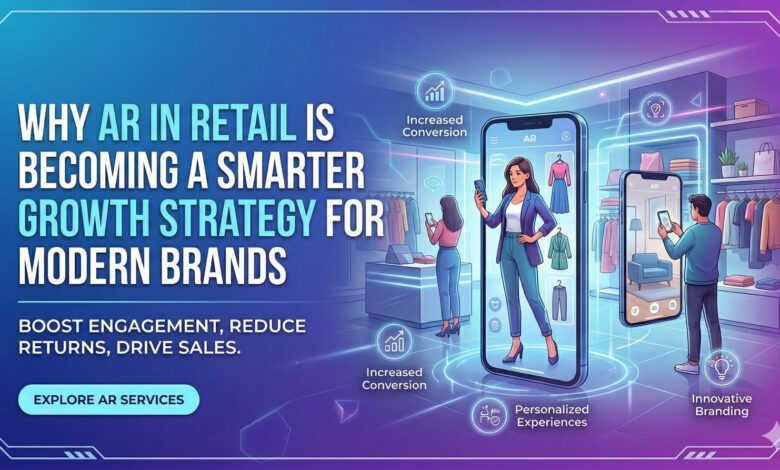
Retail growth today depends on more than visibility. It depends on how clearly a brand helps customers understand a product before they buy. That shift is one reason AR in Retail is getting stronger business attention. As digital commerce becomes more experience-led, brands are looking for practical ways to reduce hesitation, improve engagement, and support better buying decisions across channels.
Augmented reality has moved well beyond experimentation. Retail businesses are increasingly using it to solve familiar challenges such as product uncertainty, low engagement, and the gap between online browsing and purchase confidence. In categories where fit, appearance, scale, or placement influence buying decisions, AR in Retail is becoming a more practical business tool.
Why AR in Retail Is Getting More Attention From Modern Retail Decision-Makers
Retail customers have more choice than ever, but they also expect more clarity before committing to a purchase. Static product images and short descriptions often fail to answer practical questions. Buyers want to know how something will look, fit, or work in their own environment. When that clarity is missing, decision-making slows down.
This is where AR in Retail creates value. It helps brands move beyond showing products and start helping customers evaluate them more confidently.
Some of the reasons businesses are paying closer attention to AR in Retail include:
- More confidence during evaluation.
- Lower friction in digital discovery.
- Better support for omnichannel shopping.
- Better product visualization before purchase.
- Clearer differentiation in crowded retail segments.
- Stronger engagement than standard product pages.
In practical terms, augmented reality helps reduce the gap between browsing and understanding. That makes it commercially relevant rather than purely experimental.
How AR in Retail Improves Product Understanding Before the Buying Decision
Much of the friction in retail starts with hesitation. A customer may like a product but still hold back because it is difficult to tell whether it truly fits their needs. That hesitation can influence both ecommerce experiences and in-store buying decisions.
AR in Retail makes product engagement clearer and more relevant to the moment of purchase. Rather than leaving customers to fill in the gaps through imagination, it gives them a better sense of how the product may look, fit, or appear in a more realistic setting.
This is especially useful in cases such as:
- Virtual try-on for eyewear, beauty, fashion, or accessories.
- Product placement for furniture, decor, or lifestyle items.
- 3D visualization for products where size or design matters.
- Interactive demonstrations for products that need explanation.
- Comparison of styles, colors, or variants in a clearer format.
When customers can understand a product with more confidence, decisions become easier to make. That is one of the main reasons AR in Retail continues to gain relevance across modern retail categories.
The Areas Where AR in Retail Is Delivering the Most Practical Business Value
The impact of AR is not the same in every retail setting. It works best when it solves an actual shopping challenge rather than simply adding a visual layer. At its strongest, AR in Retail helps customers evaluate products more confidently and make better-informed decisions.
Brands are often seeing practical value in areas such as:
Virtual try-on experiences for higher-confidence purchasing
One of the most familiar uses of augmented reality is helping shoppers judge how a product may look before they buy it. This is especially useful in categories where visual appeal has a strong influence on buying intent.
Product placement and spatial viewing for home-focused categories
For furniture, interiors, and similar products, seeing an item inside a real environment can improve understanding and reduce guesswork. AR in Retail makes the evaluation process more grounded.
In-store digital interaction that adds depth to physical shopping
Retailers can also use augmented reality to support product storytelling, assisted discovery, and deeper engagement inside stores without interrupting the physical shopping experience.
The value does not come from using the technology everywhere. It comes from applying it where it can remove a genuine point of customer hesitation.
Why AR in Retail Is Becoming More Important for Omnichannel Commerce Strategy
Modern retail journeys are rarely linear. A customer might discover a product on mobile, compare it later on another device, visit a store, and return online before making a final purchase. That movement across touchpoints has made continuity more important than ever.
This is also why AR in Retail is being viewed more often as a growth strategy. It can make product interaction feel more connected across channels, so customers do not have to reassess everything each time they move from one buying context to another.
A stronger omnichannel journey may include:
- Discovering a product through mobile commerce
- Using augmented reality to assess it in context
- Revisiting the product later with greater purchase intent
- Entering a store with better product understanding
- Completing the purchase with more confidence
This matters because retail growth is not only about attracting attention. It is about helping attention move forward with less friction. AR in Retail supports that shift by improving continuity across the decision journey.
Why AR in Retail Is Becoming a More Practical Long-Term Growth Lever for Modern Brands
As competition in retail continues to grow, visibility alone is rarely enough to shape buying decisions. Brands also need better ways to help customers understand what they are considering, feel more certain about their choices, and move through the purchase process with less hesitation. That is where AR in Retail is proving useful. It helps make product interaction clearer, more relevant, and better suited to the way people now assess purchases across both digital and physical channels.
For modern brands, augmented reality is no longer used only as a presentation layer. Its value lies in improving product discovery, supporting customer confidence, and making commerce experiences feel more connected. When used with purpose, AR in Retail can support stronger engagement and a more effective omnichannel strategy. Pattem Digital helps businesses create digital solutions that are practical, customer-focused, and built for long-term growth. Where more immersive user experiences are needed, this can also extend to capabilities such as game development services.