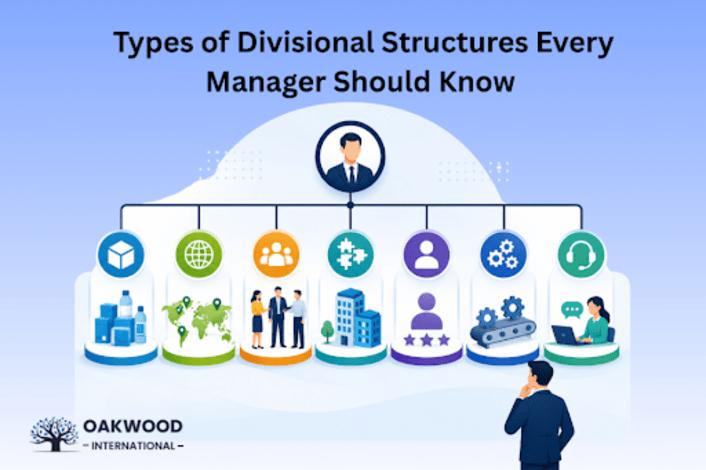
Why do some organisations seem to run smoothly even as they grow, while others struggle with coordination and decision making? As businesses expand, different teams often develop different priorities and ways of working. Keeping everything under one management approach can become challenging. This is one reason many professionals pursue a CIPD Qualification to better understand organisational structures and effective management practices. A Divisional Structure helps businesses organise teams around specific areas of responsibility, making operations easier to manage and more focused. Understanding the different types can help managers create clearer roles and support business growth.
Let us take a closer look at the different types of Divisional Structure.
Why Businesses Use a Divisional Structure
Different departments frequently encounter distinct challenges and priorities as businesses grow. A team serving clients in one area may function significantly differently from a team selling goods in another. Understanding how organisations adapt to these differences is one reason why many professionals pursue a CIPD Qualification to strengthen their management and organisational knowledge.
Organisations can establish distinct divisions that concentrate on particular aspects of the business by using a Divisional Structure. Managers are able to react to opportunities and challenges more quickly since each division has more control over its operations.
Types of Divisional Structures Every Manager Should Understand
Let us examine the primary Divisional Structure types and see how each helps managers in team organisation and business expansion:
Product Focused Divisional Structure
The organisation is split up based on product lines or products in this kind of Divisional Structure. Every division oversees all aspects of its product, including operations and sales.
Teams can specialise and gain experience in a certain product area with this method. Additionally, it facilitates performance evaluation and the identification of growth prospects for certain items. Concepts such as these are often explored during a CIPD Qualification, where organisational structures and management practices are examined in greater detail.
This structure is frequently used by large manufacturing and technology businesses to manage several product categories.
Region Specific Divisional Structure
When you operate in multiple locations, you may face varied client preferences, rules and market conditions.
Divisional Structure a region-specific structure that groups operations into geographical areas. Each regional division can decide what is appropriate for local needs.
This technique enables businesses to be responsive to local markets whilst ensuring that general business objectives are met. And it enhances local team-to-customer communication.
Market Driven Divisional Structure
Different strategies are typically needed for different markets. Businesses that serve corporate clients may function differently from those that serve consumers.
Divisions are arranged based on market segments in a market-driven Divisional Structure. Every division concentrates on comprehending and satisfying the demands of a particular market.
Businesses can develop tailored goods and marketing campaigns with the use of this system. Within each market category, managers can create tactics that closely match client expectations.
Mixed Approach Divisional Structure
A single structure is insufficient for certain organisations due to their complexity. They might provide a variety of goods and services while operating in multiple areas.
A mixed method incorporates components from various Divisional Structure types. For instance, a business may arrange divisions according to product while taking regional obligations into account.
Businesses may handle several priorities at once thanks to this flexibility. To prevent misunderstandings regarding responsibilites, managers should make sure that there is clear communication.
Customer Centric Divisional Structure
Depending on their needs and purchasing habits, customers frequently have different expectations.
Divisions are grouped based on customer categories in a customer-centric Divisional Structure. These could be big corporate clients or individual consumers.
Organisations are able to offer more individualised services thanks to this arrangement. Teams can concentrate on comprehending client needs and gradually forging closer bonds. Learning how customer focused structures support organisational success is another area often covered within a CIPD Qualification.
This technique is frequently advantageous to companies that prioritise the client experience.
Process Oriented Divisional Structure
Some organisations place a lot of emphasis on the procedures that underpin company operations.
Activities are grouped based on important operational processes in a process-oriented Divisional Structure. Manufacturing and quality control are a few examples.
This strategy increases efficiency and uniformity in all business operations. It is easier for managers to spot bottlenecks and make necessary adjustments. Understanding how process based structures improve organisational performance is another reason professionals often choose a CIPD Qualification.
It is especially helpful in businesses whose success is mostly dependent on operational excellence.
Service Centred Divisional Structure
Service-based businesses frequently offer a variety of solutions to various customers.
Teams are arranged in a service-centered Divisional Structure based on the services they provide. Every division gains proficiency in a specific service domain.
Teams are able to concentrate on service quality and ongoing improvement because of this framework. Additionally, it facilitates the development of specific expertise and the allocation of resources.
This paradigm is often used by consulting businesses and professional services firms.
Conclusion
Choosing the right Divisional Structure can have a significant impact on how effectively an organisation operates. Whether the focus is on products or services, each structure offers unique advantages. Understanding these options helps managers create teams that support business goals and improve performance.
For professionals looking to strengthen their organisational and people management knowledge, Oakwood International offers valuable learning opportunities that can support long term career growth and leadership development.