Marketing teams working across retail, events, construction, and corporate environments are under consistent pressure to produce visual materials that hold up in the real world. A banner that fades after two weeks outdoors, a trade show graphic that arrives with color shifts from the approved proof, or a wall mural that doesn’t align properly at the seam — these aren’t minor inconveniences. They are operational failures that reflect on the brand and cost money to correct.
Large format printing has become a core production discipline for US marketers, not a specialty service reserved for occasional use. As physical environments compete harder for attention, and as brand consistency across locations becomes more critical, the decisions made around printing vendors, materials, and specifications carry real weight. Understanding how this category of printing actually works — what drives quality, what causes problems, and what separates a reliable vendor from an unreliable one — is the kind of knowledge that prevents costly mistakes before they happen.
This guide is written for marketing and operations professionals who are responsible for making those decisions and need grounded, practical information to do so with confidence.
What Large Format Printing Actually Covers
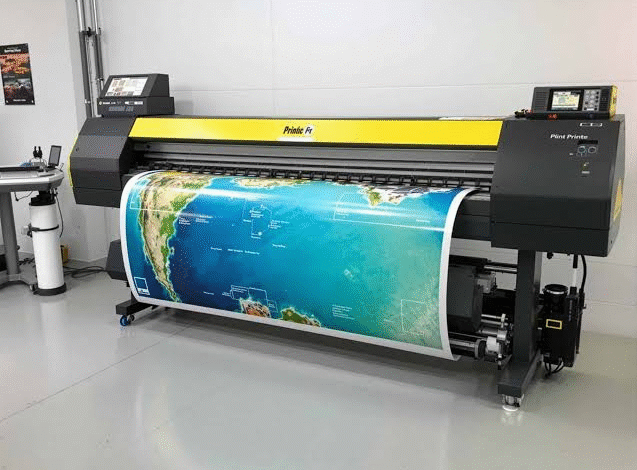
Large format printing refers to the production of printed materials that exceed the output capacity of standard commercial printing equipment. This includes banners, posters, trade show displays, vehicle wraps, window graphics, floor graphics, wall murals, signage for retail environments, and construction site hoardings. The defining characteristic is not just physical size — it is the combination of scale, substrate variety, and the environments in which these materials are used. For a reliable point of reference on what this category encompasses in practice, the Printing Services Large Format guide outlines the core service types and production considerations that most marketing teams encounter when sourcing these materials.
What separates large format printing from standard commercial printing is not just equipment size. It is the range of decisions that must be made before a file even reaches a printer. Substrate selection, ink type, lamination, finishing, installation requirements, and environmental exposure all interact to determine whether the final product performs as intended.
The Substrate Factor
Substrate refers to the material being printed on, and in large format printing, this decision has significant downstream consequences. Vinyl, mesh, fabric, rigid foam board, aluminum composite, acrylic, and canvas each respond differently to inks, behave differently in varying temperatures and humidity levels, and require different finishing approaches. A material that performs well in a climate-controlled interior showroom may degrade quickly when used outdoors in a region with significant UV exposure or temperature swings.
Marketing teams that don’t engage with substrate selection early often find themselves with materials that look acceptable at delivery but fail within weeks of installation. The substrate is not a vendor detail to be left entirely to the print shop — it is a specification that should be tied directly to the intended use case, installation environment, and expected display duration.
Ink Type and Color Integrity
Large format printing equipment uses different ink formulations depending on the application. Solvent-based inks offer strong outdoor durability. UV-curable inks bond directly to rigid substrates and resist fading under direct light exposure. Latex inks are water-based and better suited to interior applications where off-gassing is a concern. Each ink type affects how colors render on different substrates, and this is where color consistency challenges most often arise.
Brands with established color standards face real risk when printing across multiple vendors or across different runs. Color profiles, calibration practices, and proofing workflows all influence whether the green in a brand’s logo looks consistent across a trade show backdrop, a retail banner, and a vehicle wrap produced at different times. This is not a problem that resolves itself — it requires deliberate attention and clear communication between the marketing team and the vendor.
Where Large Format Printing Fits Into Marketing Operations
Large format printing is not a single-use service. It intersects with multiple operational timelines across a marketing calendar. Event marketing, retail rollouts, seasonal campaigns, construction project branding, and corporate environment design all generate demand for large format output at different points in the year, often with compressed timelines and high visibility consequences for errors.
Understanding where these intersections occur helps marketing managers and procurement teams plan more effectively, rather than treating each print order as an isolated transaction.
Trade Show and Event Applications
Trade shows represent one of the highest-pressure environments for large format printing. Deadlines are fixed, logistics are complex, and the materials are on public display in direct comparison with competitors. A banner stand graphic with visible banding artifacts, a tension fabric display with uneven color, or a backdrop that doesn’t fit the frame properly will affect how a brand is perceived by exactly the audience the company is trying to influence.
Vendors who specialize in trade show printing understand the file requirements, the finishing specifications for different display hardware, and the packaging standards that prevent damage in transit. Working with a vendor who treats a trade show order the same way they treat a standard print run is a risk that experienced marketing managers learn to avoid.
Retail and Point-of-Sale Environments
Retail environments add a layer of complexity because materials must often be produced in volume, installed consistently across multiple locations, and replaced on a predictable schedule. A seasonal window graphic campaign for a national retail chain cannot afford inconsistency between locations. The colors, finish, and sizing must be reproducible across the production run.
This is where the vendor’s production infrastructure matters. Print shops with color-managed workflows, consistent equipment calibration, and documented quality control processes are better positioned to deliver repeatable results at volume. The American Institute of Graphic Arts has documented how color management standards in print production directly affect brand consistency across physical touchpoints, reinforcing why these technical practices matter beyond the printing facility itself.
Evaluating Vendors for Large Format Work
Choosing a large format printing vendor is not the same as choosing a general commercial printer. The equipment, expertise, and operational practices required are specific, and the consequences of a poor vendor relationship show up in missed deadlines, inconsistent quality, and materials that fail in the field. Vendor evaluation should be a structured process, not a decision made on price alone.
Production Capacity and Turnaround Reliability
Production capacity affects not just how fast a vendor can complete an order, but how consistently they can meet deadlines across different order volumes and project types. A vendor who can handle a single rush order may not have the infrastructure to process ten simultaneous jobs from the same client during a peak period. Understanding a vendor’s realistic throughput — not their advertised turnaround time — is important for marketers managing complex campaign schedules.
Reliability in this context also means consistent communication. A vendor who proactively flags a substrate availability issue, a file resolution problem, or a scheduling conflict before it becomes a missed deadline is operationally more valuable than one who delivers silence until the problem is unavoidable.
File Preparation and Prepress Support
Large format files have specific requirements that differ from standard print files. Resolution demands at output size, bleed allowances, color mode settings, and embedded font handling all need to be correct before production begins. Vendors with strong prepress support catch these issues during file review rather than after production has started, which protects both the timeline and the budget.
Marketing teams that produce files in-house benefit significantly from working with vendors who provide clear file specifications and are willing to communicate directly with designers when something needs to be corrected. This collaborative approach reduces rework and prevents the kind of production errors that only become visible after the material is installed.
Finishing and Installation Capabilities
Finishing — the processes applied after printing, including lamination, grommeting, hemming, cutting, and mounting — has a direct effect on how a printed piece functions and how long it lasts. A banner without reinforced edges and proper grommets will tear under tension. A wall graphic without the right adhesive backing for the wall surface type will fail to adhere cleanly. These finishing decisions are not optional details — they are part of the product specification.
Some vendors also offer installation services or can coordinate with installation teams, which matters for complex projects like large-scale wall murals, vehicle wraps, or multi-location retail campaigns. When installation is separated from production without clear coordination, alignment errors and installation failures are more likely.
Common Operational Mistakes in Large Format Printing
Many of the problems that marketing teams experience with large format printing are predictable and avoidable. They tend to cluster around a few consistent failure points: insufficient lead time, incomplete file preparation, vague specifications, and inadequate vendor vetting. Recognizing these patterns helps operations and marketing teams build better processes before a project begins, rather than responding to problems after materials have already been produced and shipped.
Ordering too close to a deadline removes any margin for correction. Large format printing at scale takes time, and rush fees aside, compressed timelines increase the likelihood of errors going unchecked. Building a production calendar that accounts for proofing, revision, production, finishing, and shipping — with buffer time at each stage — is a basic operational discipline that prevents a significant proportion of print project failures.
Leaving substrate and finishing decisions entirely to the vendor without providing use-case context is another common failure. Vendors make reasonable assumptions when specifications aren’t provided, but those assumptions may not match the actual installation environment or display requirements. Clear briefs that include where the material will be used, how long it needs to last, and what conditions it will be exposed to give vendors the information they need to make the right recommendations.
Conclusion
Large format printing is a mature, well-established production category, but it is one where decisions made early in a project have lasting consequences. The quality of the substrate, the accuracy of color management, the reliability of the vendor’s production process, and the completeness of the file specification all interact to determine whether the final output serves its intended purpose effectively or creates problems that require time and money to resolve.
For US marketers managing campaigns, retail environments, events, or branded physical spaces in 2025, treating large format printing as a strategic production discipline rather than a commodity service makes a measurable difference. The vendors, workflows, and specifications chosen today will shape what appears on walls, windows, and trade show floors for months to come. Building a deliberate, informed approach to that process is worth the investment of attention.