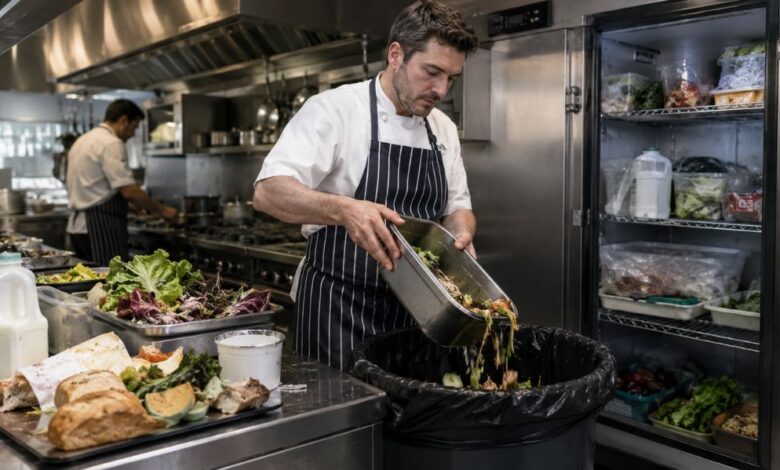
UK hospitality throws away around 920,000 tonnes of food a year. WRAP put the bill at roughly £3.2 billion when you add up the wasted ingredients, the staff time spent prepping food nobody ate, the disposal costs, and the energy used to keep it all cold before it hit the bin.
That number gets quoted a lot in sustainability press releases. What it leaves out is where the waste actually comes from inside a working kitchen. It isn’t customers leaving chips on the plate. That’s a tiny fraction. The real waste happens behind the pass, in the walk-in, and on Sunday night when a chef looks at a half-full chiller and tries to remember when the salmon came in.
Where the waste actually lives
WRAP’s own data breaks restaurant and pub waste into roughly three buckets. Customer plate waste runs at about 21 percent. Preparation waste, the trimmings and offcuts, accounts for around 45 percent. Spoilage, meaning food that went off before anyone could cook it, makes up the remaining 34 percent.
Spoilage is the one operators can do most about and usually do least about. Plate waste is hard to control once a portion size is set. Prep waste is partly unavoidable. Spoilage is almost always a temperature, ordering, or rotation problem, and all three are fixable.
The real cost of one fridge problem
A single walk-in chiller at 3°C above its set point loses you nothing visible on day one. By day three the salad leaves are wilting earlier than they should. By day five the dairy is on the edge. By the end of week two, you’ve quietly thrown away an extra £400 to £600 of stock without ever realising the unit was the problem.
Now scale that. A breakdown that knocks a walk-in offline overnight in summer can write off £2,000 to £6,000 of stock in one go. Insurance often won’t pay unless the unit is on a maintenance schedule. The repair cost is rarely the headline. The lost stock and the missed service trade are.
This is why anyone who has run a kitchen for long enough builds a relationship with a commercial fridge repair firm before they need one. Operators across London and the South East use specialists like Be Cool Refrigeration on quarterly service contracts, partly for emergency response and partly because a properly serviced unit catches the slow temperature drift that quietly kills stock margin over months.
Ordering against memory instead of data
The other big spoilage source is ordering. Independent operators often order on instinct because that’s what they’ve always done. The problem is instinct gets shaped by the last busy week, not the average week.
Modern EPOS systems track sell-through to the menu item. The owners who actually use that data tend to over-order by 5 to 8 percent. The owners who don’t tend to over-order by 20 to 30 percent. Across a year of food spend that’s the difference between a good profit and no profit.
Rotation is boring and saves a fortune
FIFO. First in, first out. Every kitchen knows it. A surprising number don’t actually run it.
The fix is dull. Date-label everything that comes in. Stock new deliveries behind older stock. Walk the chiller at the start of every shift and pull anything within two days of expiry to the front. None of it is glamorous and all of it pays.
Where the easy wins are
If you run a hospitality site and the food waste line on the P&L is creeping, in order, the highest leverage things to look at are usually:
- Walk-in temperature stability. Get the unit serviced. Check the seals. Make sure the condenser isn’t choked with dust. A single degree of drift compounds across a week.
- Daily prep sheets based on the last 14 days of EPOS data, not the last busy weekend.
- Front-of-fridge rotation rules that the kitchen porter actually enforces at shift change.
- A weekly waste log so you know what you’re actually throwing and why. Most kitchens are surprised what shows up at the top of that list.
None of this is interesting. None of it makes the menu. It just quietly turns a 4 percent net into a 9 percent net, which over a year is the difference between a tough business and a good one.
That’s the real cost of food waste. Not the headline £3.2 billion industry number, but the few thousand pounds a month that walks out of the back door of every site that hasn’t got round to fixing the dull stuff.