Custom labels take on an important role from the early stages of manufacturing to the point when a product reaches a customer. These labels organize and track information. Custom labels are far from plain labels. They are tools that contain important information, facilitate automation, and aid brand communication. In today’s production and manufacturing environments, industrial custom labels bridge the connection between machines, systems, and people. Labels can contain information such as real-time batch information, safety information, barcodes, and tracking information. As custom labels help create an efficient production flow, they also support the presentation of the product packaging.
The Role of Industrial Custom Labels in Today’s Manufacturing
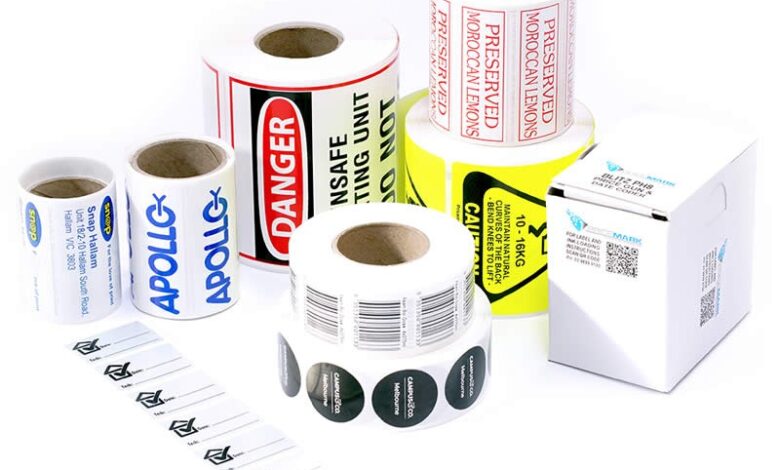
Industrial custom labels are used in manufacturing, warehousing, and logistics systems as specialized identification systems. They incorporate packaging technology to include critical product information and branding in the form of barcodes, QR codes, and serial numbers along with compliance information.
Custom labels are far from typical stickers. They must be able to withstand the stress and conditions of manufacturing and shipping.
Custom labels can be easily integrated into manufacturing systems and can be used to help track and manage product information on a high level during all stages of production.
The Importance of Labels While Producing Goods
Industrial labels become the first marking of an object’s identity once they reach the production stage. Labels are printed with unique codes, one for every object.
Custom labels help manufacturers keep track of:
- Lot and batch numbers
- The date and time production took place
- The identification number of the machine or production line
- The results of the quality assessment
Companies gain a complete digital record for every product. This helps improve the efficiency of the company and eliminates the need for time-consuming manual documentation.
It helps meet manufacturing standards and requirements for enforceable traceability.
How Automation Is Changing Production
Automation is changing how systems of labeling are seen in the majority of today’s factories. Labels no longer need to be applied by hand. Rather, they are printed and applied by machines within the production line.
This brings multiple advantages to production.
- Production can be done at a greater speed
- Labels can be accurately placed more consistently
- The cost of labor is decreased
- Errors as a result of human action are minimized
Automation systems become part of centralized data storage systems. When a product is completed, all relevant data is transmitted to labeling where it is printed in real-time.
Quality Control and Custom Labels
The ability to trace a product using its unique label is one of the greatest advantages of an industrial custom label. Every label is essentially a digital fingerprint of a product.
Labels provide manufacturers invaluable information traceable to potential defects after a product is released to the market. Useful information includes:
- Batch numbers
- Sources of raw materials
- Settings of production machines
- Operators/ shifts
Not only does traceability control quality and mitigate the scale of defects, it improves consumer, partner, and regulator confidence.
Every product is traceable from origin to destination.
Transition from Production to Packaging
Tracking labels serve a different purpose during product packaging. Labels that serve an internal purpose during production, switch from an internal purpose to an external purpose once the product is packaged.
Production and shipping information are supplemented with a product description. Labels also provide safety information and instructions for the product’s intended use. Decals and packaging contain a product’s barcode.
Labels facilitate an internal purpose for data integrity and external purpose for consumer understanding.
The Branding of Industrial Custom Labels
Customers perceive products first by their packaging. Labels provide a way for products to show quality even before a purchase is made.
Labels are also used to present product features and establish a brand identity.
Once a product comes to market, its label is no longer a packaging element. It is part of a business’s marketing strategy.
The Role of Labels in the Supply Chain
Modern supply chains need custom labels. Custom labels help keep track of goods between the different stops in the supply chain.
Goods that are labeled help the supply chain keep track of the inventory in real time.
Some benefits of custom labels in the supply chain are:
- Inventory accuracy
- Better visibility of tracking shipments
- Improved organization of warehouses
- Reduced supply loss
In international trade, custom labels are the one system that work in all countries and with all modes of trade.
Without custom labels, supply networks would be inefficient and chaotic.
Labeling Systems in Harsh Environments
When dealing with industrial work places, systems of labeling need to be durable enough to withstand the environments that they are in. Custom industrial systems of labeling need to be designed to last in such environments.
They are built to last in:
- High temperatures
- Chemicals
- Moisture
- Abrasion of surroundings
- Outdoor elements
Materials such as vinyl and polyester are commonly used to encapsulate and provide protection for a more durable label.
In certain industries, such as automotive and electronics, strong adhesives are used and tough outer coatings are used to protect the integrity of the labels.
Advanced Integration Systems with Labeling
With modern customization of industrial labeling systems, the technologies available are becoming more advanced.
Systems of labeling that incorporate:
- QR for instant connection to digital systems
- RFID for automated connection to transport and logistics systems
- NFC for mobile systems
These advanced integration systems ensure that goods maintain a connection to a digital system.
Smart labels also help to track goods throughout the supply chain and provide instant updates through the exchange of information.
Sustainability in Label Production
Sustainability is a growing focus in every sector of the economy, including labeling systems.
To mitigate the impact of labeling systems on the environment, companies have developed:
- Label materials that are easier to recycle
- Adhesives that are eco-friendly
- Ink use reductions
- Energy-efficient printing
Sustainable labeling systems provide a way to meet evolving global environmental regulations, as well as corporate responsibility and sustainability goals.
The Future of Industrial Custom Labels
The future of industrial custom labels will be intertwined with automation, artificial intelligence, and IoT.
In the next few years, we will see:
- Labeling systems that are completely automated and intelligent
- AI systems that perform quality control
- Real-time tracking of all products
- Smart connected supply chains
Labels will shift from passive systems to active systems that communicate throughout a product’s life cycle.
They will make more operational systems, and industrial processes, automated and will help optimize operations.
Conclusion
Today, industrial custom labels are more advanced and sophisticated than simple identifier stickers.
Industrial custom labels are now vital to every modern production, packaging, and logistics system.
They enhance automation and improve customer-facing systems and supply chains.
As labeling systems and custom labels gain more advanced systems and technologies, custom labels will become a critical, small component of every system used in global manufacturing and will help ensure industrial success.