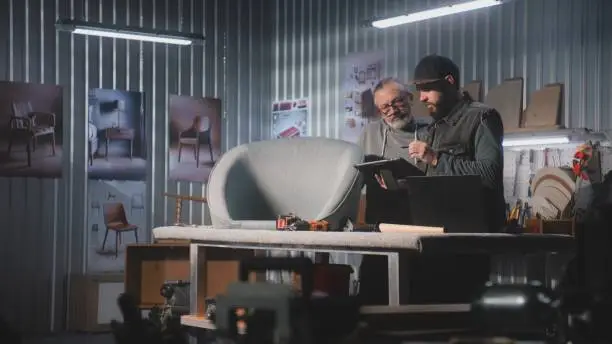
Furniture production sits at the intersection of manufacturing precision, supply chain coordination, and client expectation management. Whether a company is producing custom commercial seating for a corporate office fit-out or managing a residential collection across multiple retail channels, the gap between what was planned and what actually ships often comes down to how well the project was managed between those two points.
The furniture industry carries a specific set of operational pressures that are not always obvious from the outside. Lead times are long, materials come from fragmented global supply chains, production sequences are interdependent, and the final product must meet both aesthetic and functional standards before it ever reaches an end user. When any of these elements falls out of sync, the downstream consequences — delayed installations, missed retail windows, cost overruns — are rarely small.
This guide walks through the core disciplines involved in managing furniture projects from initial specification through final delivery. It is written for procurement managers, operations leads, interior designers managing procurement, and anyone responsible for coordinating furniture production across multiple stakeholders.
What Furniture Project Management Actually Involves
At its core, furniture project management is the structured coordination of all activities required to move a furniture brief from concept to completed delivery. This includes managing supplier relationships, production timelines, quality control checkpoints, logistics sequencing, and final installation. The work is not simply administrative — it requires active decision-making at each stage, with an understanding of how delays or specification changes in one area affect everything downstream.
For teams working across large-scale commercial interiors or multi-location retail rollouts, effective furniture project management is the difference between a controlled delivery and a reactive one. Platforms and services that specialize in this area — such as those offering structured furniture project management support — exist precisely because the coordination load is too complex for ad hoc approaches once a project reaches a certain scale.
The discipline spans several distinct phases, each with its own risk profile and decision requirements. Understanding these phases as connected rather than sequential is what separates a well-managed project from one that spends most of its time in crisis mode.
The Relationship Between Scope and Risk
One of the most consistent failure points in furniture projects is scope ambiguity at the front end. When specifications are not finalized before production begins, changes accumulate mid-stream. Each change — a fabric substitution, a dimensional adjustment, a finish revision — triggers a cascade of rework, re-ordering, or timeline extension that compounds across the project.
The risk is not simply financial. Scope drift affects supplier relationships, erodes trust with clients, and creates internal coordination problems that are difficult to recover from once momentum is lost. Clear scope documentation, agreed upon by all stakeholders before any production order is placed, is the most reliable way to reduce mid-project disruption.
Supplier Coordination and Production Sequencing
Furniture manufacturing rarely happens in a single facility. A typical commercial furniture project might involve upholstery from one supplier, frames from another, foam from a third, and hardware from a fourth — all of which must converge at the right time for assembly or installation. Managing this convergence requires more than a shared spreadsheet. It requires a clear understanding of each supplier’s production capacity, lead time variability, and dependency on upstream inputs.
Production sequencing is the practice of mapping out when each component must be ordered, produced, and delivered to ensure that downstream steps are not held up. When a project manager understands that a fabric order must be placed four weeks before frame production is scheduled, they can work backward from the delivery date to set a realistic procurement calendar. Without that map, procurement decisions are made reactively, and the project runs on assumption rather than information.
Managing Supplier Lead Times Across Geographies
International sourcing adds a layer of complexity that domestic supply chains do not carry in the same way. Transit times, customs clearance, port congestion, and currency fluctuations all introduce variability that must be accounted for in any realistic project schedule. A supplier in one country may have excellent production capabilities but operate on a public holiday calendar that differs from the project’s home market, which means that a two-week production window can become three weeks without anyone at fault.
Experienced furniture project managers build buffer into their schedules not as a sign of poor planning, but as a recognition that variability is structural in global supply chains. The buffer is not wasted time — it is the mechanism that absorbs the predictable unpredictability of international production.
Communication Protocols With Manufacturers
The quality of communication between a project manager and a manufacturing partner directly affects the accuracy of what gets produced. Vague briefs produce vague results. Detailed, structured communication — including technical drawings, material references, finish samples, and written confirmations — reduces the likelihood of costly production errors.
Regular milestone check-ins with manufacturers during production, rather than only at the point of shipment, give project teams the visibility to identify problems early. A quality issue caught during production is significantly easier and cheaper to address than one discovered upon delivery to site.
Quality Control as an Operational Function
Quality control in furniture production is not a final inspection step — it is an ongoing function that runs parallel to production. By the time furniture reaches a warehouse or installation site, a quality issue is already late to be discovered. Meaningful quality control requires defined checkpoints during production, agreed standards documented before manufacturing begins, and a clear process for how non-conformances are reported and resolved.
The International Organization for Standardization has published frameworks around quality management systems that apply broadly to manufacturing environments, including furniture. While furniture-specific quality standards vary by market, the underlying principle — that quality is built in, not inspected in — holds consistently across the industry.
Pre-Shipment Inspection and Factory Sign-Off
Pre-shipment inspection is one of the most practical quality assurance tools available in furniture project management. A qualified inspector visits the factory before goods are packed and shipped, checking a representative sample against the original specification. This step catches dimensional errors, finish defects, assembly issues, and material substitutions before they become a logistics and installation problem.
The cost of a pre-shipment inspection is almost always lower than the cost of receiving non-conforming goods at destination and managing the returns, replacements, or on-site remediation that follows. For large commercial projects where installation is sequenced and time-sensitive, a faulty delivery can delay an entire fit-out program.
Logistics, Installation, and Site Coordination
The physical movement of furniture from factory to final location involves decisions that have a direct impact on product condition and project cost. Packaging specifications, container loading plans, transport mode selection, and delivery scheduling all require active management. Furniture is vulnerable to damage in transit — particularly upholstered pieces, glass components, and items with applied finishes — and damage rates increase when logistics are treated as a handoff rather than a managed phase.
Installation coordination requires alignment between the logistics team, the site team, and the client. Furniture that arrives ahead of schedule to an unready site may be damaged in temporary storage. Furniture that arrives late holds up the completion of a space and triggers contractual issues. Sequenced delivery — where items arrive in the order they are needed on site — reduces handling, storage risk, and installation time.
Last-Mile Delivery in Commercial Projects
Last-mile delivery in furniture projects refers to the movement of goods from a consolidation point or warehouse to the final installation location. In commercial settings, this often involves building access restrictions, lift size limitations, delivery time windows set by building management, and coordination with other trades working on site simultaneously.
Failing to account for these constraints during the planning phase means that delivery vehicles arrive at sites they cannot access, furniture cannot be moved through spaces it was never measured against, and installation teams spend billable time waiting for problems to be resolved. Thorough site surveys and early communication with building management prevent most of these issues from arising in the first place.
Documentation and Handover Processes
A furniture project is not complete at the point of delivery. The handover process — which includes final snagging, documentation of any outstanding items, warranty information, care and maintenance guidance, and sign-off by the client — is what formally closes the project and protects both the supplier and the client going forward.
Documentation throughout the project serves a dual purpose. It provides a real-time record of decisions, approvals, and changes that protects all parties in the event of a dispute, and it creates a reference library for future projects with the same supplier or client. Projects that rely on verbal agreements and informal email chains are consistently harder to close cleanly than those with structured documentation from the start.
Managing Snagging and Post-Delivery Issues
Even well-managed projects encounter issues after delivery. A drawer that does not close correctly, a fabric that has arrived with an inconsistent dye lot, a component that was damaged during installation — these are realities of physical goods projects. The question is not whether issues will arise, but how quickly and efficiently they can be resolved.
A clear snagging process, agreed before installation begins, defines how issues are reported, who is responsible for assessing them, what the resolution timeline is, and how replacements or repairs are coordinated. Without this structure, post-delivery issues drag on, damage client relationships, and consume project management resource well beyond the point at which a project should have concluded.
Conclusion
Furniture project management is a discipline built on the premise that complexity, managed proactively, produces better outcomes than complexity managed reactively. The factories, suppliers, logistics partners, and installation crews involved in any significant furniture project are operating within their own constraints and timelines. The project manager’s role is to create a structure that aligns these moving parts without requiring everything to be perfect.
That structure — clear scope, sequenced production, enforced quality checkpoints, coordinated logistics, and thorough documentation — is not complicated in principle. What makes it difficult in practice is the consistency required to maintain it across months of production, multiple supplier relationships, and the inevitable changes that occur in any real-world project.
Teams that invest in that consistency, whether through internal processes or through specialist support, deliver furniture projects that arrive on time, meet specification, and require minimal remediation after installation. That outcome is not a function of luck. It is a function of how well the project was managed from the moment the brief was written to the moment the client signed off on completion.