Industrial facilities consume energy at a scale that makes even minor inefficiencies financially significant. A manufacturing plant running three shifts, a cold storage warehouse maintaining constant temperatures, a data center supporting round-the-clock operations — each of these environments depends on energy not just as a utility but as an operational input that directly affects output, cost structure, and equipment longevity.
For years, the standard approach to energy management in industrial settings relied on monthly utility bills, periodic audits, and manual meter readings. These methods provided a historical view of consumption, but they offered no visibility into the conditions that drove those numbers. By the time an anomaly was identified, it had already caused measurable financial damage or contributed to equipment wear that shortened asset life.
The shift toward connected sensing and real-time data collection has changed what is operationally possible. Facility managers and operations teams can now track energy behavior as it happens, correlate consumption patterns with production schedules, and identify problems before they compound. This guide addresses how that infrastructure is built, how it functions across different facility types, and what decisions it supports at the operations level.
What an IoT-Based Energy Monitoring System Actually Does
An energy monitoring system using IoT is a network of physical sensors, communication devices, and data processing tools that continuously measures electrical parameters across a facility’s systems and makes that data available for analysis and response. Unlike conventional metering, which captures consumption totals at fixed intervals, an IoT-based approach captures behavior in real time — including load fluctuations, demand spikes, power quality variations, and equipment-specific consumption patterns.
This distinction matters in practice. When an industrial chiller draws excess current during startup, a standard meter records the electricity used. An energy monitoring system using IoT records the event, timestamps it, links it to the specific asset, and makes that information available within seconds. Over time, this creates a detailed operational record that supports both reactive decisions and longer-term planning.
The system does not simply collect numbers. It creates context. A reading of high energy consumption means very little without knowing which circuit it came from, what was running at the time, and how it compares to the same period on previous operating days. IoT architecture makes that contextual layering possible by associating data with specific assets, locations, and time conditions automatically.
The Role of Sensors and Edge Devices
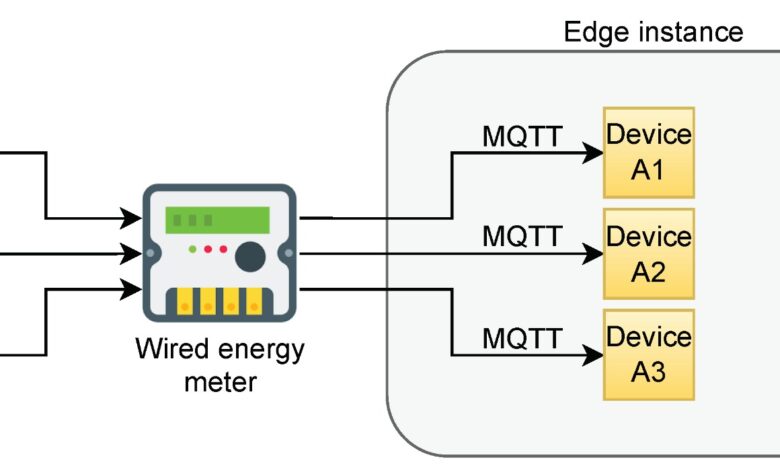
The measurement layer of any IoT energy system begins with sensors installed at key points in a facility’s electrical infrastructure — distribution panels, motor control centers, individual machine circuits, HVAC systems, and utility entry points. These sensors measure parameters such as voltage, current, power factor, and frequency, transmitting readings at intervals short enough to capture transient events that traditional metering misses entirely.
Edge devices process some of this data locally before it is transmitted upstream. This matters in industrial environments where network bandwidth may be limited or where response times need to be fast enough to trigger immediate action. Edge processing also reduces the volume of raw data sent to central systems, which makes large-scale deployments more manageable without sacrificing the granularity needed for meaningful analysis.
Communication Protocols and Network Architecture
Industrial IoT systems use a range of communication protocols depending on the facility environment and the distance between sensors and data collection points. Wired protocols such as Modbus and Profibus are common in older facilities with existing automation infrastructure. Wireless options including Zigbee, LoRaWAN, and cellular-based protocols are more practical in large-footprint facilities or where running new cabling is not feasible.
The choice of communication protocol affects system reliability in ways that matter operationally. A protocol that performs well in a controlled environment may struggle in an industrial space with significant electromagnetic interference, thick concrete walls, or high ambient temperatures. Network architecture decisions made during system design directly determine whether sensor data arrives consistently and whether the monitoring system can be trusted during the operating conditions that matter most.
How Data Moves from Sensors to Decisions
Collecting energy data is only useful if that data can be interpreted quickly and acted upon. The path from raw sensor readings to actionable information involves several layers: data aggregation, normalization, storage, and presentation through dashboards or automated alerts. Each layer introduces decisions that affect how useful the system is to the people responsible for facility operations.
Aggregation platforms receive data streams from multiple sensors and combine them into a coherent picture of facility-wide consumption. Normalization corrects for inconsistencies in measurement timing, sensor calibration differences, and data gaps caused by communication interruptions. Without these steps, the raw data is technically rich but practically unreliable — inconsistent enough that operations staff cannot trust the numbers they see.
Dashboards and Operational Visibility
A well-designed monitoring interface gives operators a clear view of energy consumption at multiple levels simultaneously — the full facility, individual buildings or zones, specific equipment lines, and individual assets. This hierarchical visibility allows a user to quickly move from a high-level anomaly to the specific source causing it without having to navigate through unrelated data.
The most useful dashboards in industrial environments are those built around operational workflows rather than data completeness. Showing every available metric on a single screen creates cognitive load without improving decision-making. Effective interfaces surface the conditions that require attention and allow users to dig deeper only when needed. This requires collaboration between system designers and the people who will actually use the platform day-to-day.
Automated Alerts and Threshold-Based Response
One of the practical advantages of continuous monitoring is the ability to configure alerts that trigger when consumption crosses defined thresholds or when equipment behavior deviates from established baselines. A motor drawing significantly more current than its normal operating range may indicate mechanical stress, lubrication failure, or an impending fault. An alert at that point allows maintenance to inspect and address the issue before the motor fails during production.
Threshold-based alerting works best when baselines are established from real operational data rather than manufacturer specifications. Equipment behavior varies based on facility conditions, load profiles, and age, and alerts calibrated to actual observed behavior generate fewer false positives than those based on generic parameters. Over time, the monitoring system builds a historical record that makes baseline setting increasingly accurate.
Integration with Existing Facility Systems
Most industrial facilities already have some form of automation or building management infrastructure in place. Integrating an IoT energy monitoring layer with these existing systems is one of the more technically demanding aspects of deployment, but it is also where much of the operational value is realized. When energy data is available alongside production output, environmental conditions, and equipment status, the correlations that emerge are far more useful than any single data stream alone.
Industrial control systems, SCADA platforms, and building management systems each use their own data formats and communication standards. The International Electrotechnical Commission maintains widely adopted standards — including IEC 61968 and IEC 61970 — that address data exchange in energy management contexts, providing a foundation for integration work that needs to be both reliable and maintainable over time.
Connecting Energy Data to Production Metrics
In manufacturing environments, energy consumption has a direct relationship with production volume, but that relationship is rarely linear or simple. Startup and shutdown sequences, idle periods, shift changeovers, and product changeovers all create energy signatures that are distinct from steady-state production. When energy monitoring data is connected to production records, it becomes possible to calculate energy intensity per unit produced, identify which production conditions are most efficient, and detect when a process is consuming more energy than it should for a given output level.
This kind of analysis changes the conversation from “how much energy did we use” to “how efficiently did we use energy relative to what we produced.” That shift in framing is significant for operations teams trying to reduce energy costs without reducing output, and it supports capital investment decisions about equipment upgrades with evidence drawn from actual facility performance.
Deployment Considerations for Industrial Environments
Installing monitoring infrastructure in an active industrial facility requires coordination that goes beyond standard IT or electrical work. Sensors must be installed on live circuits without disrupting operations, network infrastructure must be routed through environments that may have high vibration, temperature extremes, or chemical exposure, and the system must be tested under actual operating conditions before it can be trusted for operational decisions.
Phased deployment is often the practical approach in large facilities. Beginning with the highest-consumption assets or the most critical systems allows the team to validate sensor accuracy, test communication reliability, and build familiarity with the platform before expanding to the full facility. This also allows for adjustments to network architecture or sensor placement based on what is learned during the initial phase, reducing the risk of larger-scale installation problems.
Maintenance and Long-Term Reliability
An energy monitoring system is only as reliable as its hardware. Sensors drift over time, connections loosen in high-vibration environments, and communication hardware ages in ways that affect data transmission. Without a maintenance schedule that includes periodic sensor calibration, firmware updates, and physical inspection of installed hardware, system reliability degrades gradually — and often silently, because degraded data looks like valid data until it is compared against a reliable reference.
Establishing ownership and accountability for the monitoring system within the facility’s maintenance structure is a non-negotiable part of long-term deployment success. Systems that are installed but not maintained often become sources of distrust rather than operational insight, which undermines the business case for the investment.
Conclusion
Building an energy monitoring infrastructure using IoT in an industrial facility is not a single decision — it is a sequence of interdependent choices about hardware, communication, integration, and organizational process. The technology itself has matured to a point where reliable, continuous monitoring is achievable in nearly any industrial environment. What determines whether that investment pays off is the degree to which the system is designed around real operational needs, installed with appropriate rigor, and supported with ongoing maintenance and structured use.
Facilities that treat energy monitoring as an operational discipline rather than a technology project tend to realize sustained value from their systems. The data becomes part of how decisions are made, how equipment performance is assessed, and how energy costs are managed in relation to production output. Over time, that embedded visibility becomes one of the more durable advantages available to industrial operations teams working within tightening cost and efficiency constraints.