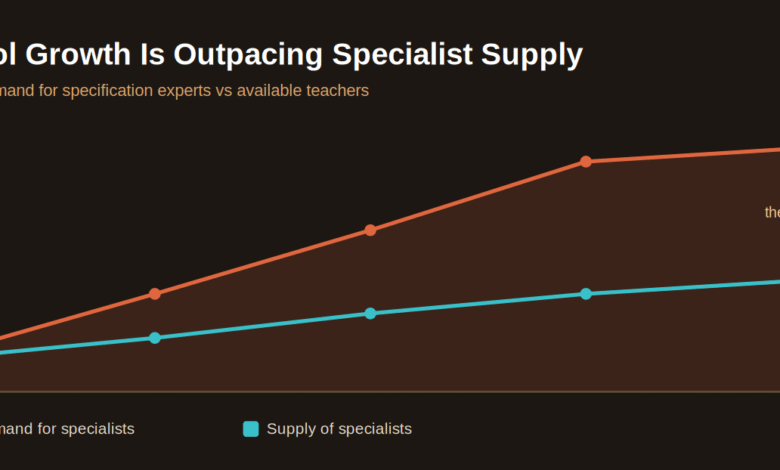
Saudi Arabia’s private education sector is growing quickly. The constraint is no longer buildings or demand. It is finding enough teachers qualified in specific examination specifications.
Walk through the newer districts of Riyadh and the expansion is visible. Schools that did not exist five years ago are enrolling their first full cohorts, and several established institutions have added campuses.
The demand behind this is straightforward. A growing professional population, both Saudi and expatriate, wants internationally recognised qualifications, and increasingly wants them without sending children abroad.
What is less visible is the bottleneck forming behind the growth.
The Policy Context
Education sits close to the centre of Saudi Arabia’s broader economic reform agenda, with human capital development identified as a core pillar of the national programme published at Vision 2030.
That has translated into substantial private-sector expansion. New international schools have opened, existing ones have grown, and the range of curricula available in the Kingdom has widened considerably.
Buildings and enrolment have scaled quickly. Specialist teaching capacity has scaled more slowly, and that mismatch is where the practical problem sits.
Why Specialism Is the Constraint
A school can recruit a qualified physics teacher relatively readily. Recruiting one with several years of experience delivering a specific A-Level specification, who understands that board’s mark schemes and examiner expectations, is considerably harder.
The distinction is not academic. Assessment at this level rewards precision, whether command words, mark scheme structure, or paper-specific technique, and that knowledge is built through repeated delivery of one specification, not through subject qualification alone.
The effect concentrates in the subjects where the shortage is sharpest. Physics, further mathematics and chemistry are consistently the hardest positions for international schools in the region to fill, and the gap widens at A-Level.
Families have responded by sourcing that specialism independently. Demand for online physics tutoring in Riyadh and comparable subject-specific support has grown alongside the school expansion rather than in spite of it, a pattern that suggests the two are related.
A Structural, Not Temporary, Mismatch
It would be reasonable to assume this resolves as the market matures. There are grounds for caution about that.
The pool of teachers with deep experience in any single specification is globally limited, and every expanding international education market is recruiting from it simultaneously. The Gulf competes with Southeast Asia, and both compete with the UK domestic sector.
Meanwhile the specialism requirement is intensifying rather than easing. As grading standards return to pre-pandemic baselines following the disruption of recent years, the margin for imprecise preparation has narrowed across every board.
A school can teach the content adequately and still see students underperform on technique. That gap is exactly what specification experience closes.
How Schools Are Responding
Three approaches are visible across the sector.
The first is aggressive recruitment, competing on package to attract experienced specification teachers. Effective for individual schools, but it redistributes a fixed pool rather than expanding it.
The second is internal development, training existing staff in a new specification. Sustainable, but it takes two to three examination cycles before a teacher is genuinely fluent.
The third is partnership, with schools accepting that external subject specialists will supplement provision for exam-year students, particularly in the shortage subjects.
The third approach is the least discussed publicly and, judging by demand patterns, the most common in practice.
What It Means for Teachers
The shortage has produced a labour market that favours specialists in a way it did not a decade ago.
A teacher with several years of documented delivery in a single high-demand specification now commands materially better terms than a generalist with equivalent overall experience, and the gap has widened.
That has two second-order effects worth noting.
The first is retention pressure. Schools that develop a teacher into a specification expert become vulnerable to losing them to a competitor willing to pay for capability the competitor did not build.
The second is a shift in how teachers manage their own careers. Depth in one specification has become a more valuable asset than breadth across several, which reverses conventional advice and is changing how experienced teachers choose roles.
For the region, this is a mixed development. It raises standards where specialists concentrate and widens the gap where they do not.
How Saudi Compares With the Wider Region
Placed against neighbouring markets, the Saudi position has a distinct profile.
The UAE has a longer-established international school sector, a deeper resident pool of experienced international teachers, and correspondingly more competitive search rankings for anyone marketing into it.
Saudi Arabia has the faster growth rate and the thinner supply of established specialists. Qatar sits between the two, with a smaller absolute market but a mature sector relative to its size.
For providers, the implication is that Saudi represents the least contested opportunity in the group and the one where the underlying need is most acute.
For families, it means the variation between schools is currently wider in the Kingdom than in more established markets, which raises the value of diligence and lowers the reliability of general reputation as a guide.
What It Means for Families
For parents choosing a school in Riyadh or Jeddah, the useful diligence question has shifted.
Reputation and facilities are easy to assess and increasingly similar across the better schools. Department-level teaching stability is harder to assess and considerably more predictive.
Worth asking directly: how long has the head of department been in post, how many teachers in that department have delivered this specification for more than three years, and has the school changed board recently?
A board change is a significant disruption that rarely appears in a prospectus, and it typically costs a cohort or two before the department is fluent again.
The Wider Read
None of this suggests the expansion is unsound. A market adding capacity faster than it can add specialist expertise is a market with genuine demand, which is the better problem to have.
But it does mean the current period is transitional, and families navigating it should expect variation between schools that headline indicators will not reveal.
The schools that come through this well will be the ones that solve the department-level staffing question rather than the enrolment question, and that is a slower, less visible kind of investment than opening a new campus.