Deploying a no-code AI agent builder is rapidly becoming the baseline expectation for any business that wants to operate with efficiency and scale.
Automation is no longer reserved exclusively for enterprises. Relying on manual workflows in modern operations isn’t just inefficient; it causes businesses to miss critical opportunities.
That shift is reshaping how companies think about automation, customer experience, and growth.
By eliminating the technical friction of software development, a no-code AI agent allows front-line teams to design, train, and deploy autonomous digital workers directly into their existing workflows.
The operational value of these agents speaks for itself: they qualify incoming leads, resolve support tickets instantly, and trigger automated follow-ups within a CRM.
For modern companies, the focus must shift entirely; the question is no longer whether a business should adopt AI, but how fast businesses can deploy it.
Defining the No-Code AI Agent Builder
To understand why the no-code AI agent builder has generated so much momentum, it helps to first understand what it actually is.
What is a no-code AI agent?
A no-code AI agent is fundamentally different from rigid, traditional automation tools like scripted chatbots or basic autoresponders.
Traditional automation executes fixed instructions, while an AI agent operates with a cognitive layer driven by large language models.
This allows the system to execute complex workflows through distinct operational capabilities:
- Contextual reasoning: an AI agent analyzes context, weighs changing conditions, and makes independent decisions.
- Intent recognition: an agent functions like a trained sales associate who interprets nuanced requests and adjusts its approach based on customer signals.
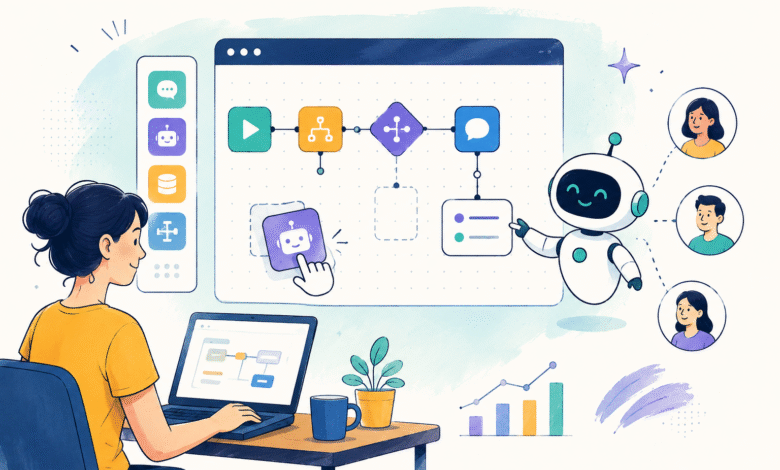
The “no-code” layer is what removes the technical barrier. Instead of writing Python scripts or configuring APIs, users interact with a visual interface, like dragging blocks, setting conditions, and defining triggers.
The underlying intelligence does the rest. Even the operational leaders who understand the business problems deeply can directly build and implement these solutions.
Multimodal capabilities and native integration
Modern no-code AI agents are not limited to text. Multimodal capabilities allow businesses to unify disparate communication channels and existing business digital ecosystems into a single workflow
More importantly, these agents integrate natively with existing web systems, eliminating the technical friction traditionally required to connect complex software ecosystems.
In practice, this deployment versatility manifests in three ways:
- Omnichannel multimodal engagement that allows businesses to engage customers seamlessly across both audio and text formats through a single, unified system.
- Frictionless native integration that deploys directly into existing web infrastructure, including CRMs, e-commerce backends, helpdesk tools, and communication platforms, bypassing the need for a custom, costly software development pipeline.
- Real-time workflow execution that independently pulls relevant data, updates client records, and triggers critical downstream actions instantaneously.
The Shift: No-Code AI vs. Traditional Development
The gap between what traditional development delivers and what modern business operations actually demand has created the conditions for no-code AI to move from an emerging trend to an operational standard.
Eliminating the bottleneck of manual work
Traditional AI development is expensive, slow, and dependent on scarce technical talent.
Even modest automation projects can take weeks of engineering time, involve multiple stakeholders, and still require ongoing maintenance once deployed.
This creates a perpetual backlog where business needs wait on development capacity. However, no code platforms cut through this entirely.
By shifting the build process to a visual, logic-based interface, they allow non-technical teams to take ownership of their own automation.
The IT department stops being a bottleneck and starts being a strategic partner for genuinely complex systems, while the day-to-day operational workflows are handled directly by the teams that understand them best.
Transitioning from basic systems to independent allies
The conceptual leap between a rule-based chatbot and a no-code AI agent builder is significant.
Basic systems require constant updating. Every new scenario must be manually anticipated and programmed. An AI agent, by contrast, brings pre-trained reasoning to every interaction.
It can handle edge cases, interpret ambiguous requests, and escalate intelligently when it genuinely cannot resolve an issue on its own.
Navigating the complexities of AI agents is therefore less about managing a tool and more about deploying an operational ally that grows more capable the more it is used.
Strategic Business Benefits and Economic Impact
The case for adopting a no-code AI agent builder is not built on convenience alone. The measurable impact on cost, speed, and scalability makes it one of the most commercially defensible technology investments available to businesses today.
Faster time-to-market and deployment
Speed is perhaps the most immediately tangible benefit. Where traditional development pipelines measure deployment in weeks or months, a well-designed no-code AI agent can be live within hours.
This is particularly consequential for businesses in fast-moving industries where a delayed response to customer demand carries real commercial cost.
The ability to iterate quickly, such as adjusting workflows, testing new triggers, and updating knowledge bases, means that no-code agents can evolve alongside business strategy.
Cost efficiency and resource optimization
The financial case for no-code AI is compelling. Research suggests that AI-driven automation can reduce operational costs by up to 30% across various industries.
This reduction comes from multiple directions: fewer errors requiring human correction, reduced dependency on large support teams, and faster resolution times that lower the cost per customer interaction.
For small and medium-sized businesses in particular, the ability to manage the software directly through marketing or operations staff represents a structural shift in how overhead is calculated.
Scalability without increasing headcount
Growth traditionally required hiring more. More customers meant more support staff; more leads meant more sales representatives. No-code AI agents separate this connection.
A single well-configured agent can handle thousands of simultaneous conversations, qualify leads, route inquiries, and update CRM records, with no additional payroll.
For growing companies operating with lean teams, this scalability is not a nice-to-have. It is the mechanism that makes sustainable growth financially viable.
Understanding the Internal Mechanics
Now, let’s understand the architecture that makes it work, which allows teams to configure it with intention rather than guesswork.
The structure of drag-and-drop workflows
The visual builder at the heart of every no-code AI platform typically revolves around three component types.
- Triggers define the entry point and instantly initiate the workflow whenever there are inbound inquiries, new form submissions, or automated calendar schedules.
- Action nodes handle specific tasks, such as generating a response, dispatching a notification, updating a CRM record, or pulling data from an external system.
- Logic nodes are where the intelligence lives and become the cognitive center, which evaluates customer profiles, checks specific operational conditions, and routes the workflow based on data insights.
The power of this structure is that it makes complex logic transparent and editable without requiring a developer to interpret it.
A sales operations manager can read a workflow diagram, identify a gap, and fix it in minutes.
Pre-trained reasoning and memory
One of the most practically important features of modern AI agents is memory.
Unlike stateless systems that treat every interaction as isolated, AI agents maintain context by remembering a customer’s previous purchases, past complaints, stated preferences, and prior conversations. This continuity transforms the quality of automated interactions.
A returning customer doesn’t need to re-explain their situation. The agent already knows it and can engage from that foundation rather than starting from zero.
Industry Trends and Future Projections
The growth trajectory of no-code AI agent adoption is backed up by concrete market data and enterprise behavioral shifts that indicate this technology is moving firmly into the mainstream.
Market growth and enterprise adoption
The numbers behind no-code AI adoption reflect how seriously the market is taking this shift.
According to Fortune Business Insights, the global market for no-code AI agent platforms is projected to grow from $8.6 billion in 2026 to $75.14 billion by 2034.
Gartner research estimates that by the end of 2026, 40% of enterprise applications will incorporate task-specific AI agents.
This is a projection that signals how deeply these tools are being embedded into standard business infrastructure, not positioned as peripheral experiments.
The rise of autonomous decision-making
Autonomous decision-making is perhaps the most strategically significant trend within this space.
By 2026, an estimated 15% of daily operational decisions in organizations are expected to be handled by autonomous agents. It is not suggested, not flagged for human review, but executed independently based on pre-defined parameters and real-time data.
For businesses willing to define those parameters thoughtfully, this represents an enormous opportunity to redirect human attention toward decisions that genuinely require judgment, creativity, and accountability.
Practical Use Cases Across Departments
Evaluating the true value of no-code AI agents means focusing on real-world application rather than theory.
The impact is found across the specific workflows where manual processes have historically created the most friction.
Customer support and real-time databases
Customer support is where no-code AI agents have demonstrated the most immediate and measurable value.
Moving far beyond simple FAQ responses, these agents can process returns, update order databases, escalate complex cases, and follow up on unresolved tickets in real time.
Tools like HubSpot’s Breeze have brought this functionality to non-technical teams with minimal configuration required.
Sales, lead qualification, and market research
In sales contexts, AI agents function as persistent research and qualification engines.
They evaluate inbound leads against defined criteria, enrich profiles with publicly available data, and surface high-priority prospects for human follow-up.
Platforms like Gumloop have made this type of complex sales workflow accessible through a visual drag-and-drop interface that requires no coding knowledge to configure or maintain.
Marketing automation and content creation
Marketing teams are using no-code AI to analyze audience trends, generate brand-aligned content variations, and automate campaign distribution.
Tools like Metaflow AI allow marketers to define content parameters using plain language and let the agent handle execution, dramatically compressing the time between insight and activation.
Impact on Engineering and Technical Teams
One of the less obvious consequences of no-code AI adoption is how it reshapes the role of technical teams by redefining where their expertise is most needed.
Productivity gains and the shift to planning
The effect of no-code AI on engineering teams is counterintuitive but important. As AI handles more of the execution layer, the demand for high-quality strategic thinking from technical teams actually increases.
Research indicates that 27% of production code is already AI-generated, and productivity gains are projected to continue.
The real bottleneck is defining the right problems to solve, designing the architecture that AI will execute, and maintaining the governance that keeps autonomous systems trustworthy.
Selecting the Best AI Agent Platform for Your Goals
With dozens of platforms competing for attention, the decision comes down to alignment, not which tool has the most features, but which one fits how your team actually works and how quickly you need results.
Top industry recommendations
Choosing the right AI agent platform requires matching platform strengths to specific business needs.
- Lindy is a strong option for teams prioritizing ease of use across sales, support, and operations; its low configuration overhead ensures a gentle learning curve, making it accessible.
- Relevance AI is better suited for organizations that need to orchestrate multiple agents working in parallel across complex, interconnected workflows.
- Zapier remains the dominant choice for straightforward event-driven automation, particularly for teams already embedded in the tools it connects.
The right choice depends less on which platform has the longest feature list and more on which one aligns with how your team actually works and how quickly you need to be operational.
Conclusion: Embracing Business Optimization
The no-code AI agent builder has moved from a niche productivity tool to a foundational business capability.
It removes the cost and complexity of traditional development, puts automation in the hands of the people who understand the business best, and scales with growth in ways that fixed headcount cannot.
For businesses willing to invest the time in thoughtful configuration, the return is measurable: lower operational costs, faster response times, and a team freed to focus on the work that requires genuine human intelligence.
Key Takeaways
- A no-code AI agent builder allows non-technical teams to deploy, configure, and iterate on AI-powered workflows without writing code, putting automation ownership where business understanding actually lives.
- Unlike rule-based chatbots, no-code AI agents reason, remember context, and make decisions independently, making them operational allies rather than simple responders.
- AI-driven automation has been shown to reduce operational costs by up to 30%, while enabling businesses to scale customer-facing capacity without increasing headcount.
- Gartner projects that 40% of enterprise applications will incorporate task-specific AI agents by the end of 2026, signaling that no-code AI is shifting from early adopter territory to standard infrastructure.
- Platform selection matters: Lindy suits teams prioritizing ease of deployment, Relevance AI handles complex multi-agent workflows, and Zapier remains the go-to for straightforward event-driven automation.
- The most durable competitive advantage is not just adopting the technology; it is configuring it thoughtfully around business workflows and iterating as the workflows evolve.
Don’t let operational pressure stall your growth. A no-code AI agent builder empowers your operational teams to automate complex processes and scale efficiently without technical overhead.
The infrastructure is ready; start building your autonomous ally today.