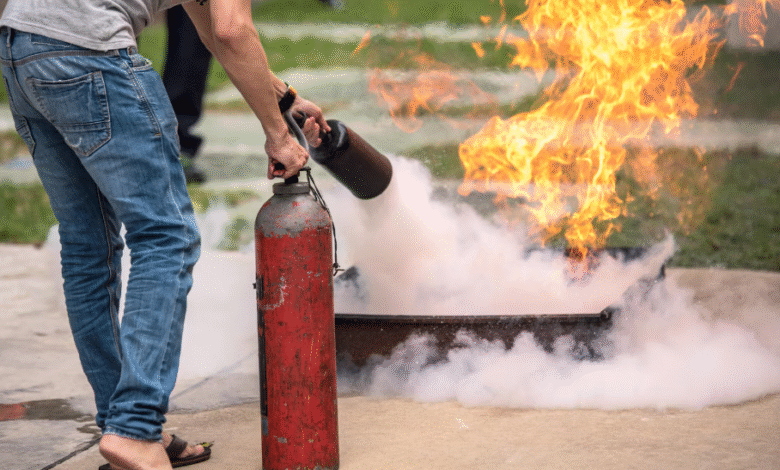
In most US workplaces, fire extinguishers are mounted, inspected on a schedule, and assumed to be ready. What receives far less attention is the label attached to each unit — the printed panel that tells anyone present exactly how to operate it, what type of fire it addresses, and what limitations apply. During an actual emergency, there is no time to search for instructions or interpret unfamiliar symbols. The label is the only reference available, and the ability to read it correctly in advance is what determines whether it gets used effectively or not at all.
This matters across industries. Facility managers, warehouse supervisors, safety officers, contractors, and operations staff are all expected to act appropriately when fire suppression is needed. Most have received some level of training, but that training rarely focuses on the label itself — what it contains, how it is organized, and what each section actually means. Understanding the label as a structured document, rather than a background fixture, is a practical step toward consistent fire safety readiness.
What a Fire Extinguisher Instruction Label Actually Contains
A fire extinguisher instruction label is a standardized document printed directly on the extinguisher body. It is not a general safety reminder. It is a technical reference organized into specific sections, each serving a distinct function during emergency use. Reviewing a properly formatted fire extinguisher instruction label gives any trained or untrained user a clear picture of what the device does, when to use it, and precisely how to operate it under pressure.
The label is regulated in the US and must meet standards set by the National Fire Protection Association (NFPA) and Underwriters Laboratories (UL). This means the information is not arbitrary. Every section exists because it addresses a decision point that arises when someone is facing a fire and must act immediately.
Classification and Rating: The First Thing to Check
The classification section tells the user which types of fires the extinguisher is designed to handle. In the US, fires are grouped into letter-based classes — Class A covers ordinary combustibles like wood and paper, Class B applies to flammable liquids, Class C is for energized electrical equipment, Class D addresses combustible metals, and Class K covers cooking oils and fats typically found in commercial kitchens.
Each classification also carries a numerical rating that indicates relative extinguishing capacity for that class of fire. A higher number indicates a greater capacity, not a more powerful chemical reaction. This distinction matters in facilities where fire risks vary by zone. A unit rated for Class B fires in a storage area may not be appropriate for an electrical panel room or a kitchen. Misreading the classification — or ignoring it entirely — means deploying the wrong agent on the wrong fire, which can make conditions worse rather than better.
Agent Type and How It Affects Deployment
The label identifies the extinguishing agent inside the unit. Common agents in US commercial and industrial settings include dry chemical, carbon dioxide, water, wet chemical, and clean agent compounds. Each behaves differently when discharged and has specific effects on different fire types.
Dry chemical agents are effective across multiple fire classes but leave residue that can damage equipment. Carbon dioxide extinguishes fires by displacing oxygen and is suitable for electrical environments but provides no cooling effect and carries risks in enclosed spaces. Wet chemical agents are formulated specifically for high-temperature cooking fires and should not be used on electrical or flammable liquid fires. Clean agents suppress fires with minimal residue and are often used in server rooms and archival spaces. The agent type listed on the label tells the user not just what the extinguisher contains, but how to anticipate its behavior in the specific environment where it is being used.
The Operating Instructions Section: Reading It Before You Need It
The operating instructions on a fire extinguisher instruction label are presented in a consistent sequence across all compliant units in the US. This sequence is intentional. It reflects the order in which physical actions must occur, and deviation from that order — even under stress — can result in the extinguisher failing to discharge properly or the user being caught off-guard by the release mechanism.
Most compliant US extinguishers follow the PASS sequence, which is detailed on the label itself. PASS stands for Pull, Aim, Squeeze, and Sweep. While this acronym is widely known, the label provides the operational specifics that the acronym alone does not convey — where to aim for different fire types, how far from the base of the fire the discharge should begin, and how to move the stream during suppression.
Pull: The Safety Pin and What It Prevents
The pull step refers to removing the safety pin located in the handle assembly. The pin prevents accidental discharge during transport, storage, and routine inspection. On the label, this step is typically illustrated alongside a written instruction. What the label makes clear — and what verbal training sometimes omits — is that the pin must be fully removed before the handle can be compressed. A partially withdrawn pin is a common cause of failed discharge attempts during drills and emergencies alike.
The label also typically includes a tamper indicator note. If the tamper seal is broken and the unit has not been used, this signals a potential service issue and should be reported before assuming the unit is operational.
Aim: Where the Nozzle Should Point
Aiming instructions on the label specify that the nozzle should be directed at the base of the fire, not at the flames themselves. This is a critical operational distinction. Flames are the visible result of combustion, but the fuel source at the base is what sustains the fire. Directing the agent at the flames without addressing the base typically results in incomplete suppression and rapid re-ignition once discharge stops.
For liquid fires, the label may include an additional caution about indirect application — directing the agent at a surface above the burning liquid and allowing it to fall, rather than blasting directly at the surface, which can scatter the burning material.
Squeeze and Sweep: Controlling the Discharge
Squeezing the handle releases the agent. The label describes how to maintain consistent pressure throughout the discharge cycle. Releasing and re-squeezing mid-discharge interrupts flow and reduces effectiveness. The sweep instruction directs the user to move the nozzle in a controlled side-to-side motion across the base of the fire rather than holding it in a fixed position. This technique ensures even coverage and prevents isolated hotspots from reigniting.
The label also indicates the approximate discharge duration for that specific unit. Most portable extinguishers discharge fully within a relatively short window. Knowing this in advance prevents the user from being caught off guard when the agent is exhausted before the fire is fully suppressed.
Hazard Warnings and Use Limitations Listed on the Label
A well-maintained fire extinguisher instruction label includes a section on hazard warnings and use restrictions. These are not regulatory formalities. They describe real risks that arise when the wrong unit is deployed in the wrong context or when the discharge environment creates secondary hazards.
Common warnings include restrictions on using carbon dioxide extinguishers in confined spaces due to oxygen displacement, cautions against using water-based agents on electrical fires, and notes on the toxicity or pressure hazards of specific agent types. These warnings are particularly important in industrial settings where multiple fire extinguisher types may be mounted in close proximity and where users may reach for the nearest unit without checking the label first.
The Occupational Safety and Health Administration sets requirements for portable fire extinguisher training and availability in US workplaces, and those requirements implicitly depend on workers being able to interpret the label correctly when training is put into practice.
Inspection Indicators and Service Markings on the Label
Beyond operational guidance, the label on a fire extinguisher typically includes space for or reference to inspection and service records. Annual inspections, hydrostatic testing intervals, and recharge documentation are part of the compliance picture for most US facilities. A label that shows overdue service dates, damaged sections, or missing information is itself a safety indicator — it suggests the unit may not be in the condition assumed.
Facility managers responsible for compliance tracking should ensure that label integrity is part of routine inspection. A label that is illegible, partially obscured by paint or adhesive tape, or faded to the point where classification markings are unclear represents the same operational risk as a unit that is physically damaged. The information on the label is only useful if it can be read when it matters.
Conclusion: The Label as a Practical Safety Tool
A fire extinguisher instruction label is not background documentation. It is a condensed operational guide designed to support correct action under time pressure and stress. Each section — classification, agent type, operating sequence, hazard warnings, and service indicators — serves a specific function that connects directly to whether a fire is controlled or allowed to escalate.
For safety coordinators and facility managers, incorporating label review into routine training reinforces practical knowledge beyond the PASS acronym. Workers who understand what the classification means, why the agent type matters, and what the hazard warnings apply to are better positioned to respond appropriately when the situation requires it. The label is already on the unit. Taking time to understand it fully is the low-effort step that closes the gap between equipment availability and equipment effectiveness.