Businesses moving into the UK often focus first on the visible commercial questions: where to base operations, how to hire staff, how to open a bank account, how to register with Companies House, and how to win customers. Those steps matter, but there is another area that can catch overseas founders and finance teams by surprise: UK accounting rules.
For many companies, one of the biggest practical issues will be lease accounting under FRS 102.
This is especially important because the UK’s domestic accounting framework is changing. The Financial Reporting Council issued amendments to FRS 102 as part of its Periodic Review 2024, and most of the changes apply for accounting periods beginning on or after 1 January 2026, with early adoption permitted.
For businesses moving to the UK, this means leases need to be understood early. Office space, warehouses, retail units, production equipment, vehicles, studio equipment, lighting rigs, IT hardware, and specialist machinery can all create accounting consequences. A lease is no longer just a monthly payment to be budgeted. Under the revised UK GAAP model, it may become an asset, a liability, a disclosure issue, and a key part of financial reporting.
What Is FRS 102?
FRS 102 is the main financial reporting standard used by many companies in the UK and Republic of Ireland. It applies to a wide range of businesses that prepare accounts under UK GAAP rather than IFRS. FRS 102 lease accounting is designed to simplify and help business owners as best possible but it can still throw up some problems.
For overseas businesses arriving in the UK, this distinction matters. A parent company may be used to IFRS, US GAAP, local GAAP, or another national accounting framework. But once it establishes a UK subsidiary or operates through a UK reporting structure, it may need to prepare accounts under UK rules.
Companies House guidance also explains that an overseas company only needs to register in the UK when it has some degree of physical presence, such as a place of business or branch where it carries on business. Once a UK establishment is opened, registration documents must be filed within one month.
That means accounting should not be left until after operations begin. If the business is leasing premises or equipment from day one, lease data should be captured from day one.
Why Lease Accounting Is Changing
Historically, many operating leases under FRS 102 were kept off the balance sheet. A business might lease an office, vehicle, or piece of equipment and simply recognise lease payments as an expense over time, with future commitments disclosed in the notes.
The revised FRS 102 model changes that for many lessees. ACCA explains that the 2024 amendments mandatorily replace the previous FRS 102 version for accounting periods beginning on or after 1 January 2026, and that lessees recognise a right-of-use asset and lease liability on the balance sheet.
This brings UK GAAP closer to IFRS 16, although businesses should not assume the rules are identical in every respect. The broad direction is clear: leases become more visible in the accounts.
For companies entering the UK market, that visibility can affect reported assets, liabilities, profit presentation, debt metrics, and financial ratios.
What Is a Right-of-Use Asset?
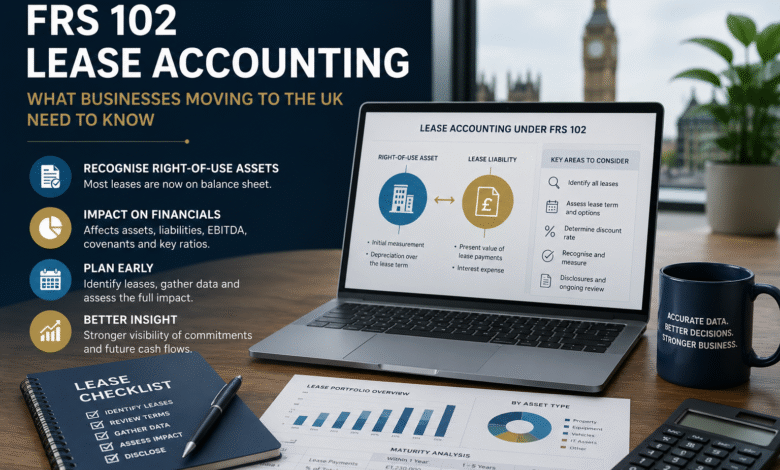
A right-of-use asset represents the business’s right to use an asset during the lease term. For example, if a company leases an office in Manchester for five years, it does not own the office, but it does control the right to use that office during the agreed period.
Under the revised lease accounting model, that right can be recognised as an asset.
A lease liability is recorded at the same time, representing the obligation to make future lease payments. The liability is measured using the present value of those payments, subject to the detailed rules and assumptions that apply.
In simple terms:
- The business records an asset for the right to use the leased item.
- The business records a liability for future lease payments.
- The old operating lease rental expense is replaced by depreciation and interest expense in many cases.
AccountingWEB summarises the impact by noting that most leases for lessees will be recognised on balance sheet, with more assets and liabilities reported. It also notes that the previous operating lease expense is replaced by depreciation on the right-of-use asset and interest on the lease liability.
Why This Matters for Businesses Moving to the UK
A company moving into the UK may lease several assets before fully understanding the accounting implications. These could include:
- Offices
- Warehouses
- Retail premises
- Vehicles
- IT equipment
- Manufacturing machinery
- Medical or lab equipment
- Restaurant equipment
- Studio space
- Advertising displays
- Lighting equipment
- Storage facilities
Each arrangement needs to be reviewed. Some agreements will clearly be leases. Others may be embedded inside broader service contracts.
For example, a company might sign a facilities agreement, logistics contract, or managed equipment arrangement that gives it the right to use a specific asset. Even if the contract is not labelled “lease,” it may still contain lease accounting implications.
This is one of the first lessons for overseas businesses: UK lease accounting is not only about property leases. It can apply wherever the business obtains control over the use of an identified asset for a period of time in exchange for consideration.
The Balance Sheet Impact
The biggest visible change is often on the balance sheet. A company that previously showed relatively low liabilities may now report significant lease liabilities.
This can affect:
- Net asset position
- Gearing
- Debt-to-equity ratios
- EBITDA-related analysis
- Lending agreements
- Investor reporting
- Group consolidation
- Management accounts
This does not necessarily mean the business has become riskier. The lease obligation already existed commercially. The new accounting simply makes it more visible.
However, perception matters. Banks, investors, directors, parent companies, and potential acquirers may all review balance sheet liabilities. Businesses moving to the UK should explain the accounting impact clearly so stakeholders understand what has changed and why.
Profit and Loss Impact
The profit and loss account can also change.
Instead of recognising a simple rental expense, many leases will involve depreciation of the right-of-use asset and interest on the lease liability. This can change how profit appears across the lease term.
In many cases, total expense over the life of the lease may be similar, but the timing and presentation may differ. ACCA notes that the commercial substance of a lease should remain the same and the total expense recognised in profit and loss over the life of the lease will be the same, but the accounting presentation changes. (ACCA Global)
This matters for businesses that report monthly performance, track EBITDA, reward managers based on operating profit, or compare UK performance with overseas entities using different standards.
Why International Finance Teams Need to Prepare Early
Overseas finance teams often underestimate the practical work involved in lease accounting. The calculation itself is only one part of the process. The bigger challenge is collecting the right data.
A UK lease accounting process may require:
- Lease start date
- Lease end date
- Renewal options
- Break clauses
- Fixed payments
- Variable payments
- Rent review terms
- Index-linked payments
- Lease incentives
- Initial direct costs
- Restoration obligations
- Discount rates
- Asset class
- Entity ownership
- Currency
- Contract modifications
If lease contracts are scattered across legal, property, procurement, operations, and local management teams, the finance team may struggle to build a reliable lease register.
For a business moving into the UK, the best time to set up lease tracking is before signing leases, not after the first audit.
Example: An Advertising Business Leasing Lights and Event Equipment
A useful example is an advertising or experiential marketing business moving into the UK and leasing large amounts of lighting equipment for campaigns, events, pop-up brand activations, and digital installations. The company might lease lighting rigs, LED panels, projection equipment, illuminated display units, power systems, and temporary event structures from specialist suppliers. If those arrangements give the business control over specific assets for an agreed period, they may need to be assessed under FRS 102 lease accounting. Instead of simply treating every lighting rental as a short-term campaign cost, the finance team may need to decide whether any contracts create right-of-use assets and lease liabilities. Short-term or low-value exemptions may apply in some cases, but longer-running equipment leases across multiple campaigns could affect the balance sheet. This is why operational teams and finance teams need to communicate before contracts are signed, especially in industries where leased equipment is central to delivery.
Short-Term and Low-Value Leases
Not every lease will necessarily create a major balance sheet entry. The revised model includes practical exemptions, including for certain short-term and low-value leases.
However, businesses should not assume an exemption applies without checking. A short event rental might be treated differently from a multi-year vehicle lease or a long-term office lease. A low-cost item may be simple, while a portfolio of many similar assets could still become significant in aggregate.
For businesses moving to the UK, the safest approach is to create a policy with the help of accountants and apply it consistently.
Embedded Leases Can Be Easy to Miss
One of the most difficult areas is embedded leases. These are leases contained inside contracts that are not obviously lease agreements.
Examples might include:
- A logistics contract using dedicated vehicles
- A data centre arrangement involving identified servers
- A manufacturing service using specific machinery
- A facilities contract involving dedicated equipment
- A signage or advertising contract using specified display units
- A warehousing agreement for a defined storage area
If the business has the right to control the use of an identified asset, the contract may contain a lease component.
This is particularly relevant for companies entering the UK quickly and signing multiple supplier agreements. Procurement teams may focus on commercial terms, while finance teams later discover accounting consequences.
Lease Accounting Software May Become Necessary
A small UK subsidiary with one office lease may be able to manage lease accounting in a spreadsheet. But once a business has multiple leases, modifications, renewal options, assets, locations, or entities, manual tracking becomes risky.
Lease accounting software can help by:
- Maintaining a central lease register
- Calculating right-of-use assets
- Calculating lease liabilities
- Generating journals
- Tracking modifications
- Managing discount rates
- Storing contracts
- Producing reports for auditors
- Supporting group consolidation
For overseas businesses, software can also help align UK finance reporting with parent company requirements. It creates a clearer audit trail and reduces reliance on individual spreadsheets.
Impact on Banks, Investors and Parent Companies
Lease accounting changes can affect how the UK business is viewed by external and internal stakeholders.
Banks may look at higher reported liabilities. Investors may examine EBITDA and leverage differently. Parent companies may need reconciliations between UK GAAP and group reporting standards. Directors may need to explain why the same lease costs now appear differently in the accounts.
This is not a reason to avoid leasing. Leasing remains commercially useful. It provides flexibility, reduces upfront capital expenditure, and allows businesses to enter the UK market without buying property or equipment.
But it does mean companies should understand the reporting impact before making commitments.
Key Questions Before Signing a UK Lease
Before signing a UK lease or long-term equipment agreement, businesses should ask:
- Does this contract contain a lease?
- What asset is being used?
- Do we control the use of the asset?
- How long is the lease term?
- Are there renewal or break options?
- Are payments fixed, variable, or index-linked?
- Is the asset low-value or short-term?
- What discount rate will be used?
- How will this affect the balance sheet?
- Could it affect lending covenants?
- Who will maintain the lease register?
- How will modifications be recorded?
These questions can save time and reduce accounting surprises later.
UK GAAP Is Not Just a Finance Team Issue
Lease accounting often fails when it is treated as a finance-only task. In reality, lease data sits across the business.
Legal teams negotiate contracts. Operations teams use equipment. Property teams manage premises. Procurement teams select suppliers. Finance teams report the numbers.
For a company moving to the UK, these teams may also be split across countries and time zones. That makes communication even more important.
A good internal process should require finance review before significant lease or asset-use contracts are signed. This does not mean finance blocks commercial decisions. It means the business understands the accounting consequences before committing.
Preparing for the 2026 Changes
Businesses moving to the UK should prepare now by reviewing lease exposure and reporting needs. ICAEW notes that the 2024 amendments to FRS 102 bring additional requirements for leases, revenue recognition, share-based payments, and taxation for small companies, with practical implementation resources available for affected entities.
A practical preparation plan includes:
- Identify all existing leases and asset-use contracts.
- Build a complete lease register.
- Review whether contracts contain lease components.
- Assess short-term and low-value lease exemptions.
- Gather payment schedules and key dates.
- Decide how discount rates will be determined.
- Assess the balance sheet and profit impact.
- Review bank covenants and investor reporting.
- Consider lease accounting software.
- Train UK finance and operational teams.
- Speak to accountants before the first reporting period.
Early preparation reduces risk. Waiting until the year-end close can create rushed judgments and unreliable estimates.
Common Mistakes Businesses Make
Businesses entering the UK often make similar lease accounting mistakes.
They may assume all leases are treated as simple expenses. They may overlook equipment leases. They may miss embedded leases. They may fail to document renewal options. They may ignore lease modifications. They may keep lease data in local spreadsheets without central review. They may underestimate the effect on debt ratios. They may also assume IFRS 16 knowledge automatically solves FRS 102 reporting.
Each of these mistakes can lead to accounting errors or audit delays.
Why This Can Be an Opportunity
Although FRS 102 lease accounting can feel like a compliance burden, it can also improve business visibility.
A proper lease register helps management understand:
- Long-term property commitments
- Equipment dependency
- Future cash outflows
- Renewal deadlines
- Break options
- Lease concentration risk
- Cost by location or asset type
- Potential refinancing or renegotiation opportunities
For a business newly entering the UK, this visibility is valuable. It helps leaders understand the real cost of establishing operations and the future obligations created by early growth decisions.
Final Thoughts
FRS 102 lease accounting is becoming a major issue for businesses moving to the UK. The revised rules mean many leases that were once treated as operating expenses will become visible on the balance sheet through right-of-use assets and lease liabilities.
For overseas businesses, the challenge is not just technical accounting. It is operational readiness. Companies need to identify leases, collect contract data, review supplier arrangements, understand exemptions, assess stakeholder impact, and build reliable reporting processes.
The businesses that handle this well will not simply comply with UK GAAP. They will gain a clearer view of their commitments, costs, and growth decisions.
Moving to the UK brings opportunity, but it also brings accounting responsibilities. Getting to grips with FRS 102 lease accounting early is one of the smartest steps an incoming business can take.