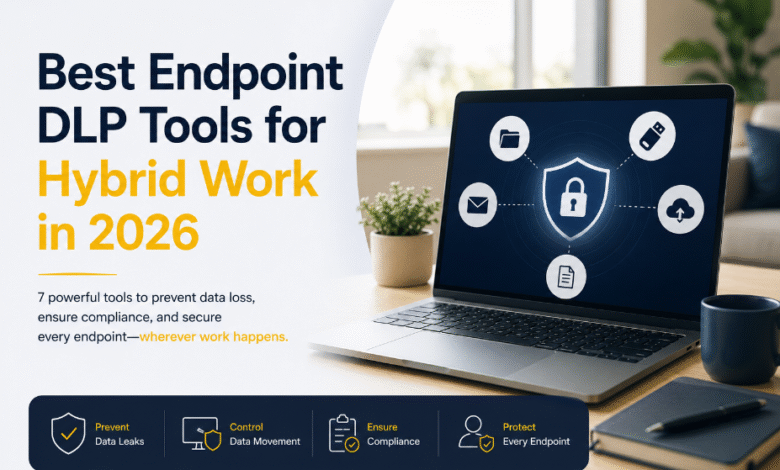
Hybrid work has changed how organizations access, store, and share data. Employees now work across multiple locations, networks, and devices, creating more opportunities for sensitive information to be exposed or transferred outside approved channels. Traditional perimeter-based security controls are no longer enough to protect business-critical data.
This is where an endpoint data loss prevention (DLP) solution plays an important role. By monitoring user activity, controlling data transfers, and enforcing security policies directly on devices, endpoint DLP tools help organizations reduce data leakage risks while maintaining compliance.
In this article, we will explore seven of the best endpoint DLP tools for hybrid work for 2026 and look at their key capabilities.
Significance of DLP tools in a hybrid work environment
Data has become one of the most valuable assets for modern organizations, making its protection a business priority. As companies continue adopting cloud services, remote work models, and AI-powered technologies, sensitive information is moving across more devices, applications, and networks than ever before. This increased flexibility also expands the potential attack surface for data breaches and unauthorized sharing.
DLP solutions help organizations protect personally identifiable information (PII), intellectual property, financial records, and other sensitive business data. Beyond reducing the risk of data loss, they support compliance with regulations such as GDPR, HIPAA, and PCI DSS by enforcing security policies and maintaining audit trails.
For organizations managing a distributed workforce, endpoint DLP has become an essential layer of security. It helps balance productivity, compliance, and data protection.
7 Best endpoint DLP tools for hybrid work
1. Scalefusion Veltar
Scalefusion Veltar is an endpoint-centric security and automated compliance solution designed to help organizations protect sensitive data across distributed work environments. Integrated into Scalefusion UEM, Veltar combines endpoint security, including data protection controls, and compliance enforcement into a single console.
This unified approach reduces tool sprawl, IT overhead, and gives IT teams deep visibility into device activity.
For hybrid workforces, Veltar helps control how data is accessed, transferred, and stored across corporate endpoints. Organizations can enforce policies on data movement through channels such as storage, wireless, media, and portable devices, external network adapters, email, websites, IPs, and applications, minimizing the risk of data leakage and unauthorized access.
Key features
- Granular access controls: Configure permissions (full access, read only, or deny access) for storage devices connected to endpoints to control how users interact with sensitive data.
- Conditional access policies: Restrict data access by defining conditions to use I/O devices or managing peripheral connections. I/O device access control (IODAC) conditions include IP address, day, start time, end time, and timezone or endpoint’s local timezone.
- Encryption enforcement: Ensure only encrypted devices can access endpoints, minimizing unintentional data exposure.
- Device type restrictions: Allow or block device categories, including USB drives, SD cards, optical drives, and external HDD. Implement specific access policies for human interface, media, and wireless devices, printers, USB headphones, Windows portal devices, and external network adapters.
- Comprehensive activity logging: Maintain IODAC, app control, and VPN tunnel event logs, along with a detailed compliance summary for each device to support audits, investigations, and compliance requirements.
Limitation
Since Veltar delivers granular, enterprise-grade control rather than generic defaults, IT teams must invest dedicated time during rollout to fully map its extensive security layers to their exact risk profile.
2. Trellix
Trellix DLP is an enterprise solution designed to safeguard sensitive data across endpoints, networks, cloud environments, and storage systems. It combines real-time monitoring with policy-driven controls to help organizations detect, prevent, and respond to unauthorized data movement.
For hybrid work environments, Trellix provides centralized visibility into data handling activities while helping security teams enforce consistent protection policies across distributed users and devices.
Key features
- Centralized monitoring and event management: Monitor data activities, investigate incidents, and manage DLP policies from a unified console.
- User coaching and policy notifications: Deliver real-time alerts and guidance to users when they attempt actions that violate security policies.
- Predefined policy templates: Deploy out-of-the-box rules across common data loss vectors, including endpoint, network, and cloud channels.
Limitation
Endpoint monitoring can occasionally impact system performance, particularly during resource-intensive operations or large-scale policy enforcement.
3. Fortra
Fortra DLP is an enterprise data protection solution that helps organizations discover, classify, monitor, and secure sensitive information across endpoints, networks, and cloud environments. Supporting Windows, macOS, and Linux devices, it provides visibility into user activities and data movement while enabling granular controls to reduce the risk of data loss.
Key features
- Analytics and reporting: Monitor security events, generate reports, and create alerts for high-priority incidents.
- Streamlined incident management: Simplify investigation workflows with drag-and-drop incident handling capabilities.
- Real-time remediation: Enforce security policies instantly and automate actions such as scanning, blocklisting, and user notifications.
Limitation
Organizations with large-scale deployments may need to allocate additional resources for reporting and analytics optimization.
4. Microsoft Purview
Microsoft Purview DLP is a cloud-native solution that helps organizations protect sensitive information across endpoints, applications, cloud services, and Microsoft 365 environments. It combines data classification, sensitivity labeling, and policy enforcement within a unified framework, making it easier to manage data protection requirements across distributed workforces.
Key features
- Centralized policy management: Create, manage, and enforce DLP policies through the Microsoft Purview portal.
- Integrated data classification: Leverage built-in classification and sensitivity labeling capabilities to identify and protect sensitive information.
- Unified alerting and monitoring: Track policy violations and data-sharing activities through a centralized dashboard.
Limitation
Effective deployment often requires careful policy planning and configuration to align with organizational data protection requirements.
5. Forcepoint
Forcepoint DLP delivers unified, real-time protection to simplify data security across AI, cloud, web, email, and endpoints. By leveraging pre-defined policies and ARIA, organizations can quickly deploy precise controls based on industry, region, and live risk signals. This ensures total visibility and continuous control, enforcing consistent policies everywhere data moves to prevent loss and misuse.
Key features
- Real-time, risk-adaptive protection: Secure data dynamically using automated, risk-aware controls that analyze user behavior and context to block exfiltration before it happens.
- Accelerated response with ARIA: Speed up security operations using ARIA (Adaptive Risk Intelligence Assistant), an integrated AI that uncovers insights, recommends defenses, and deploys policies directly from chat.
- Simplified global compliance: Streamline global compliance by using over 1,800 built-in templates and classifiers to instantly identify and protect PII and sensitive enterprise data.
Limitation
The breadth of policy customization options may require additional familiarization for teams managing complex data protection requirements.
6. Zscaler
Zscaler is an enterprise-grade DLP solution integrated into a powerful inline security cloud. Part of a complete security service edge (SSE), it reduces cost and complexity by replacing legacy point products. It enables centralized policy enforcement, scalable TLS/SSL inspection, consistent protection, and streamlined workflows.
With AI-powered data discovery, Zscaler DLP helps find sensitive data risks in just a few clicks. Furthermore, it provides actionable visibility across all data with zero-configuration data security.
Key features
- Indexed document matching: Protect high-value forms that typically carry sensitive data. Fingerprint critical documents like tax forms or medical paperwork.
- Optical character recognition: Secure data in image files. Scan images to classify information for PNGs and JPEGs as well as images embedded in other files.
- Exact data match: Quickly find and control occurrences of specific data. Fingerprint critical information, enhance detection accuracy, and avoid DLP false positives.
Limitation
Organizations seeking extensive data-at-rest discovery capabilities may require additional tools to complement endpoint and in-transit data protection.
7. Mimecast Incydr
Mimecast Incydr is an insider risk management and DLP solution designed to prevent data leaks and intellectual property theft from employees and contractors. It provides real-time monitoring across endpoints, cloud, and email to protect sensitive data while allowing standard collaboration.
Mimecast Incydr provides one solution to identify and stop data exfiltration from every modern work channel. It offers AI-powered risk prioritization, powerful shadow AI visibility, and agentic AI workflows.
Key features
- Adaptive controls: Equip teams with adaptive controls for organization-specific DLP. Monitor and apply controls for at-risk users. Add risk context and automate responses.
- Threat detection with AI: Use AI to track and prioritize data exfiltration risks to evaluate scores of signals, factoring in destination, user, and data, user context.
- Data insights: Get instant clarity with dashboards for shadow AI, cloud storage, and source code movement. Identify PII, PCI, and custom data risks.
Limitation
Organizations operating highly customized virtual desktop or hybrid environments may need additional planning during deployment and policy configuration.
Final verdict
Finding the best endpoint DLP tool ultimately depends on your organization’s security requirements, compliance obligations, operational needs, and existing technology stack. Solutions such as Trellix, Microsoft Purview, Forcepoint, Zscaler, and Fortra each offer unique strengths, ranging from insider risk management to cloud-native data protection and advanced data classification capabilities.
However, organizations seeking a unified approach to endpoint security may find value in solutions that combine DLP, compliance, and device management capabilities. Scalefusion Veltar, an endpoint-centric security solution integrated into a modern UEM platform, is one such option. It offers advanced endpoint DLP and automated compliance capabilities with centralized visibility and command across managed devices.
Building a truly resilient hybrid architecture means balancing strict data policies with seamless employee productivity. The right DLP tool must fit your specific operational needs, compliance requirements, and budget constraints.