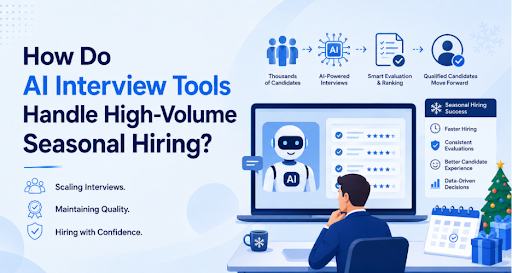
Seasonal hiring exposes the structural limits of traditional recruiting faster than any other event on the talent acquisition calendar. A retailer that runs a lean, ten-person recruiting team for eleven months of the year suddenly needs to evaluate tens of thousands of applicants in a six to eight week window. Amazon alone plans to bring on 250,000 seasonal workers for the 2025 holiday period, matching its hiring volume from the prior two years [Fox Business, 2025]. UPS is adding more than 125,000 seasonal workers for the same period [WWD Sourcing Journal, 2026]. These are not incremental staffing adjustments. They are compressed, time-boxed hiring surges that traditional interview processes were never designed to absorb.
For C-suite leaders, the seasonal hiring window is a direct test of operational readiness. A missed staffing target during peak season does not just show up in an HR dashboard. It shows up in customer service levels, fulfillment speed, and revenue. This is why enterprise organizations are increasingly building AI interview infrastructure as a permanent capability rather than a seasonal workaround. This article breaks down exactly how AI interview tools handle high-volume seasonal hiring, the operational mechanics behind that capability, and what leadership teams should evaluate before the next hiring surge arrives.
Why Traditional Interview Processes Break Down at Volume
Enterprise hiring processes are typically built around a linear, sequential model: resume review, recruiter phone screen, hiring manager interview, panel interview, offer. This model works reasonably well at steady-state hiring volumes. It fails predictably once volume spikes.
Several data points illustrate why:
- Enterprise companies already conduct 65 to 75 interviews per hire under normal conditions, compared to 9 to 11 for small and mid-size businesses [RecruitBPM, 2026]. Seasonal surges multiply this burden across every open requisition simultaneously.
- The average time-to-hire across industries sits at 41 to 44 days [RecruitBPM, 2026], a timeline that is fundamentally incompatible with a hiring window that may only last six to eight weeks.
- Recruiters spend an average of 16 hours per week on scheduling coordination alone [Yello, cited in Hirevire, 2025]. When application volume increases tenfold during peak season, scheduling becomes the primary bottleneck rather than candidate quality.
- Scheduling now consumes 38% of recruiter time industry wide, making it the single largest operational tax on the hiring function [GoodTime, 2026].
- 90% of companies missed their hiring goals in the most recent hiring cycle, and one in three missed by a wide margin [GoodTime, 2026].
The underlying issue is not a shortage of applicants. Seasonal roles routinely see application volume that outpaces the ability of a fixed recruiting team to process it within a fixed timeline. Something has to give: speed, quality, or headcount. AI interview tools exist specifically to remove that trade-off.
How AI Interview Tools Absorb Volume Without Adding Headcount
AI interview platforms address seasonal volume through five core mechanisms. Each one targets a specific point of failure in the traditional process.
1. Asynchronous, Parallel Screening
Traditional phone and video screens are sequential by nature. One recruiter can only speak with one candidate at a time. AI interview tools remove this constraint by allowing candidates to complete structured interviews on their own schedule, which the system then evaluates in parallel.
- Organizations using AI video interviews report handling up to 10 times more interviews compared to traditional methods [Applicantz, 2025].
- AI-powered voice screening is projected to be the entry point for 80% of high-volume recruiting by mid-2026 [Fueler, 2026].
- 73% of recruiters using AI platforms can now shortlist candidates within 24 hours, compared to a process that traditionally takes weeks [Applicantz, 2025].
For a C-suite leader, the operational implication is straightforward: candidate volume no longer scales linearly with recruiter headcount. A fixed team can process a 10x spike in applications without a corresponding increase in staffing cost.
2. Automated Scheduling and Coordination
Interview coordination is one of the most time-intensive and error-prone parts of the seasonal hiring cycle, particularly across multiple locations and shift patterns.
- AI-powered interview scheduling reduces coordination time by an average of 65% [Careertrainer.ai, 2026].
- Automating interview coordination alone produces a 33% average reduction in overall hiring timelines [Fueler, 2026].
- Companies using AI scheduling tools are 1.6 times more likely to hit their hiring goals [Pin, 2026].
3. Structured, Standardized Evaluation
High-volume hiring introduces significant inconsistency risk when dozens of hiring managers across multiple locations are each applying their own informal evaluation criteria. AI interview tools standardize the evaluation rubric across every candidate and every location, which matters both for quality control and for legal defensibility at scale.
- AI-driven interview platforms reduce average recruiter screening time by up to 75% [Careertrainer.ai, 2026].
- AI screening reduces time to shortlist by 60 to 80% across multiple applicant tracking system platforms [PeoplePilot, cited in Tech Magazine, 2026].
- Resume parsing and skill identification through AI systems now achieve 89 to 94% accuracy rates [Incruiter, citing Workday, 2026].
4. Continuous Availability
Seasonal candidates frequently apply outside standard business hours, particularly for retail, logistics, and hospitality roles where the applicant pool includes students, second-job holders, and shift workers. AI interview systems operate on a 24/7 basis, removing the constraint of recruiter working hours entirely. This directly addresses one of the most common causes of seasonal candidate drop-off: a lag between application and first response that gives competing employers time to make an offer first.
5. Integration With Existing ATS and Workforce Systems
Enterprise-grade AI interview tools are built to sit inside the existing hiring stack rather than replace it. This matters for seasonal hiring specifically because integration determines whether a surge in interview volume can flow directly into onboarding without manual handoffs.
- 75% of enterprise talent acquisition teams already use AI-powered applicant tracking systems [Careertrainer.ai, 2026].
- 54% of companies integrate AI recruitment tools directly with their existing HR management systems [Careertrainer.ai, 2026].
- 97.4% of Fortune 500 companies use an ATS as their hiring system of record [Recruiterflow, 2026], making integration a baseline requirement rather than an optional feature for any enterprise deployment.
The Measurable Business Case
Seasonal hiring is ultimately a cost and revenue protection issue for the enterprise. The financial case for AI interview tools during high-volume periods is well documented across independent benchmarks:
| Metric | Reported Impact | Source |
| Time-to-hire reduction | 40% to 60% | [Applicantz, 2025; Careertrainer.ai, 2026] |
| Cost-per-hire reduction | 20% to 40% | [Apollo Technical, 2025] |
| Screening and admin cost reduction | 60% to 75% | [Peterson Technology Partners, 2026] |
| Recruiter workload reduction | 20% (equivalent to one full recruiter’s capacity) | [SHRM, cited in Pin, 2026] |
| Early-stage candidate drop-off reduction | 28% | [Careertrainer.ai, 2026] |
| Candidate experience score improvement | 73% of organizations report improvement | [Careertrainer.ai, 2026] |
The cost of inaction is equally quantifiable. The Society for Human Resource Management estimates the cost of a single bad hire at approximately $17,000 [SHRM, cited in Intervuebox, 2026]. At seasonal hiring volumes in the tens of thousands, even a small error rate in candidate selection translates into a material line item on the P&L, not to mention the downstream cost of understaffed locations during peak revenue periods.
A Documented Enterprise Case: Unilever
Unilever’s Future Leaders programme remains one of the most frequently cited enterprise benchmarks for AI-driven high-volume hiring. The company processes over 250,000 applications annually to fill roughly 800 roles, using AI-powered video interviews and predictive analytics to narrow the pool to 350 shortlisted candidates for human review [Incruiter, citing Eightfold AI and case data, 2026]. The documented results include more than 50,000 recruiter hours saved annually, approximately £1 million in cost savings, a 16% increase in diversity among new hires, and a 96% candidate completion rate. The model that emerges from this case, and one that applies directly to seasonal retail, logistics, and hospitality hiring, is AI handling volume and consistency at the top of the funnel while human judgment is preserved for final-stage decisions.
Governance Considerations for Enterprise Leadership
Speed and cost reduction are necessary but not sufficient criteria for evaluating AI interview tools at the C-suite level. Three governance areas deserve explicit attention before deployment at scale.
Bias and fairness controls. AI in talent acquisition is associated with up to a 50% reduction in measurable hiring bias when properly configured and audited [Recruitment Smart, 2025]. However, only 17% of companies report feeling fully prepared to address the ethical concerns associated with AI in HR, including interview bias [Careertrainer.ai, 2026]. This gap between adoption and governance readiness is a board-level risk, not a technical afterthought.
Regulatory compliance. High-volume hiring frequently spans multiple states and jurisdictions, each with evolving requirements around automated employment decision tools. Enterprise buyers should confirm that any AI interview platform maintains documented audit trails, supports human-in-the-loop review at final decision stages, and can produce evidence of validated, non-discriminatory scoring methodology on request.
Vendor accountability and data handling. Seasonal hiring surges involve processing personal data for candidates who may never become employees. Enterprise procurement should require clear data retention policies, candidate consent mechanisms, and defined data deletion timelines consistent with applicable privacy regulation.
What to Evaluate Before the Next Hiring Surge
For leadership teams preparing to deploy or scale AI interview capability ahead of a seasonal hiring window, the following evaluation criteria matter most:
- Throughput capacity. Confirm the platform’s demonstrated ability to process the projected application volume within the compressed hiring window, not just steady-state volume.
- Integration depth. Verify native integration with the existing ATS, HRIS, and onboarding systems to avoid manual handoffs that reintroduce bottlenecks.
- Scoring transparency. Require documentation of how candidates are scored and what human oversight exists before a rejection or advancement decision is finalized.
- Multi-location and multi-language support. Seasonal hiring frequently spans geographically dispersed sites and diverse candidate populations.
- Time-to-value. Given the short runway before peak season, prioritize platforms that can be configured and validated in weeks rather than quarters.
- Compliance documentation. Confirm the vendor can provide audit-ready records for regulatory review, particularly in jurisdictions with automated employment decision tool requirements.
The Strategic Takeaway
Seasonal hiring will continue to compress into shorter windows as retailers, logistics providers, and hospitality operators respond to shifting consumer demand patterns. Recent data shows overall seasonal hiring volume has actually declined, with retailers projected to add fewer than 500,000 positions in the final quarter of 2025, the smallest seasonal hiring gain in 16 years [CNBC, 2025]. This makes precision more important than raw volume. Enterprises are no longer just trying to hire more people faster. They are trying to identify the right candidates faster, with fewer resources, and with defensible, consistent evaluation standards across every location.
AI interview tools address this directly by decoupling interview throughput from recruiter headcount, standardizing evaluation at scale, and compressing timelines that would otherwise cost enterprises their strongest candidates to faster-moving competitors. For C-suite leaders, the decision is no longer whether to adopt AI interview infrastructure. It is whether that infrastructure is enterprise-ready, governed appropriately, and integrated deeply enough to perform when the next seasonal surge arrives.