Free OpenRouter Models: What ‘Free’ Actually Means, and a Cleaner Way to Get Cheap Models

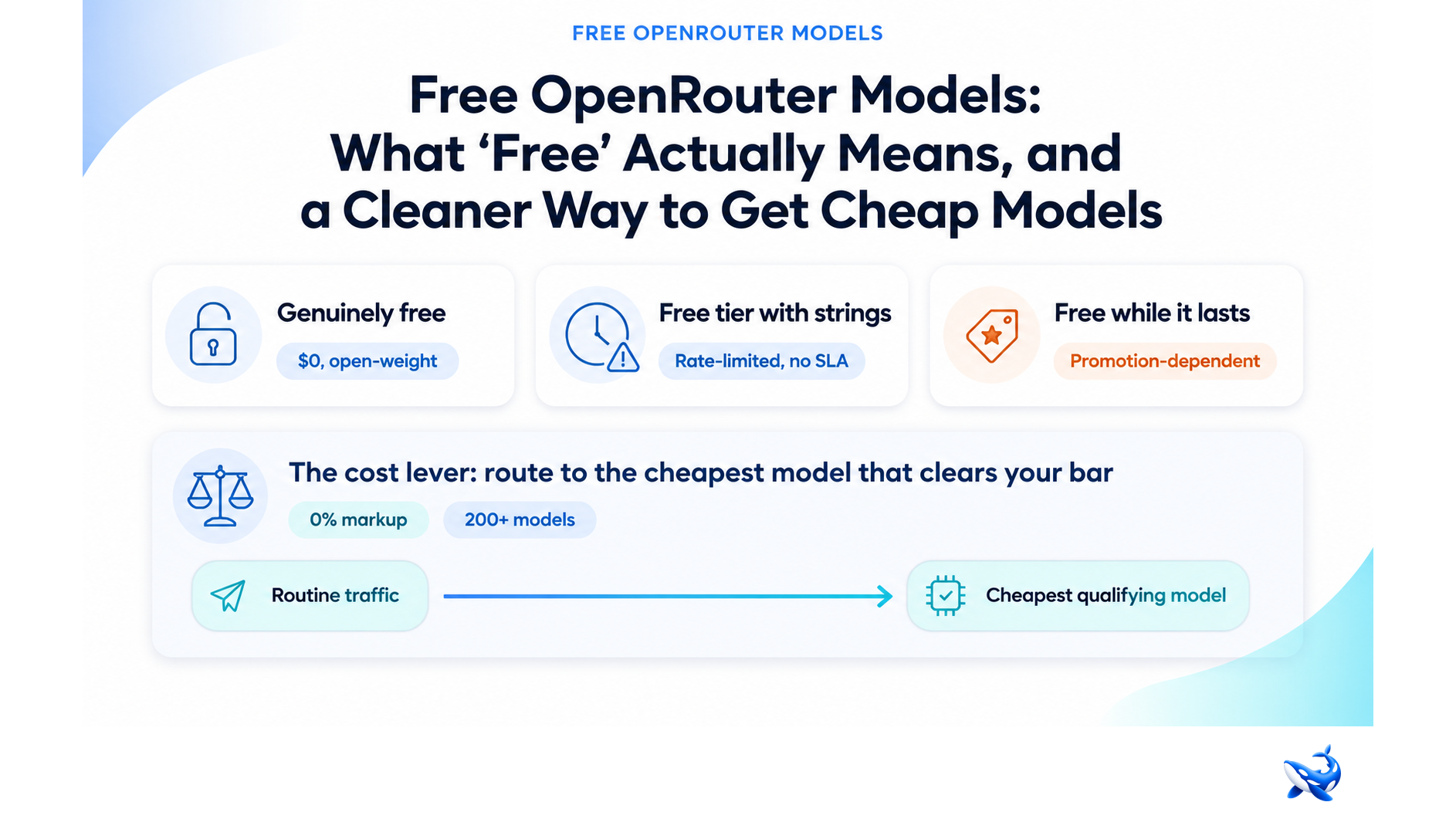
Type “free OpenRouter models” into a search engine and every result says the same three words — but the things behind those words are different products. Some are genuinely free models served at $0.00, some are rate-limited free tiers with strings attached, and some are listings that stop being free the moment a provider changes a quota. The cheap way to build is not chasing that list; it is a router that charges you only what a model actually costs. OrcaRouter is that router — one API key, 200+ models, 0% markup, and a free tier of its own — and this article walks through what “free” on those listings really means, how to tell a real free tier from a free tier with strings, and why free listings are a smaller cost lever than routing routine traffic to the cheapest model that clears your bar — the openrouter alternative write-up argues the same point: treat the free column as an entry point, and make the cheaper-model routing the actual lever.
Model aggregators exist because nobody wants fifteen API keys and fifteen billing portals. The promise — one key, hundreds of models — is genuinely useful, and the free entries are the first thing most people click. But “free” is doing a lot of work in that phrase. This guide is for the person who typed the search hoping to build something without a big bill: it separates the free listings you can lean on from the ones that will surprise you, then shows where the real savings actually live.
What “free” means on a model list
Walk down the free column of any aggregator’s model list and you find at least three different things wearing the same label.
• Genuinely free models. Open-weight, cheap-to-serve models listed at $0.00 by providers who use them as loss leaders or research showcases. The price is the price: you call it, you cache it, you pay nothing.
• Free tier with strings. Any model behind a free tier that is rate-limited, concurrency-capped, and offered without an SLA or production terms. The price is $0 only inside the quota.
• Free while it lasts. Listings tied to promotions, funding, or a provider’s goodwill. They can disappear with a single changelog entry, and your application finds out when the 401s start.
The category difference is the whole point. Genuinely free is a pricing choice; a free tier is a marketing choice; free-while-it-lasts is a favor. All three rank for the same search term, and treating them as interchangeable is how production bills get a surprise.
Genuinely free versus “free tier with strings”
Here is the distinction that matters. A genuinely free model costs nothing and stays that way while the provider lists it — you can call it repeatedly and build it into the base of your routing ladder. A free tier with strings is different: the $0 price holds only within a quota, and the moment your traffic looks like production — steady volume, concurrent requests, a latency requirement — the strings show up as rate-limit 429s, cold starts, or a forced upgrade.
| Genuinely free model | Free tier with strings | |
| Price | $0, no quota games | $0 only inside the quota |
| Reliability | As the provider serves it | Rate-limited, no SLA |
| Best use | Bottom rung of a routing ladder | Testing and prototypes |
| Production-ready? | Only with a paid fallback behind it | No |
A quick checklist tells the two apart. Does the documentation state the quota explicitly? Limits written down are strings you can plan around; limits revealed only after the first 429 are traps. Is there an SLA or a production disclaimer? No SLA means it is a toy tier. Who eats the serving cost, and for how long? Free only works while someone else is paying the bill. And can you route around it? A router can treat a free model as the bottom of a ladder instead of the whole ladder — and that last point is the practical one. Free tiers are best used as the base of a routing stack, never as the entire architecture: when a free model fails a routine request, it should be one step down, with a cheap paid fallback directly behind it.
The free tier you can actually lean on
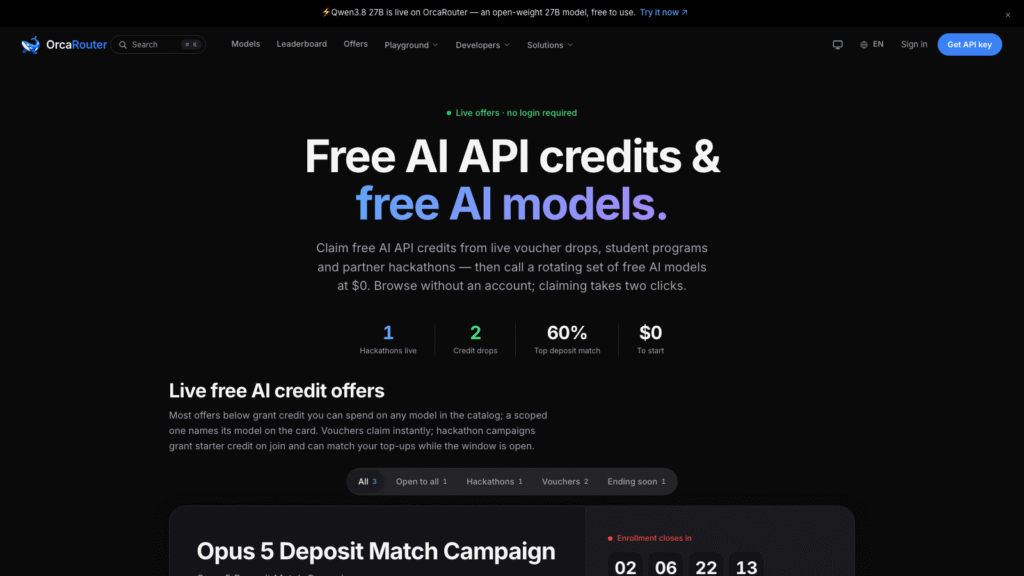
OrcaRouter’s offers page is the honest version of this pattern. There is a free tier to try the platform on — one API key, access to the full catalog of 200+ models across OpenAI, Anthropic, Google, Meta, Mistral, xAI, DeepSeek, Qwen, GLM, and MiniMax, at 0% markup, with the provider’s list price passed through and no $0.00 added on top (OrcaRouter’s own /offers page, checked August 22, 2026). The free tier is for trying; production traffic is billed at what the provider actually charges. That framing matters, because the free tier is not where the savings come from — it is the door, not the deal.
The deeper cost lever is routing, not free models
Here is the insight that saves more money than any free entry on a list. The deepest cost lever is not finding $0 models — it is making sure every request is answered by the cheapest model that clears your bar. OrcaRouter does this automatically: each prompt is graded in under 1 millisecond and routed to the model that meets your standards for the lowest price, in its orcarouter/auto routing mode. Routine traffic lands on a cheap, fast model; hard tasks escalate to an expensive one; and nothing pays flagship prices for a trivial request. Pair that with 0% markup and you pay the provider’s list price and nothing on top, while a single key covers 200+ models with automatic failover and per-request logs — so a free model failing becomes a routing event, not an outage.
This is also why the free tier with strings is not the trap people fear, as long as you architect around it. The honest use of a free model is as the cheapest rung of a ladder that also contains a capable paid fallback. When the free rung is rate-limited, the request fails over to the next-cheapest model that clears your bar — your cost goes from $0 to a few cents, and your latency does not spike into a retry storm. That is the difference between treating “free” as a feature and treating it as a floor.
The takeaway
Free tiers and genuinely free models are for prototypes, personal projects, and the bottom rung of a routing ladder. They are not for production traffic with a reliability requirement, latency-sensitive workloads, or anything where a quota change could break the build. The decision rule is simple: if you are building for real, stop optimizing for $0 and start optimizing for the cheapest model that clears your bar at 0% markup. That is exactly the shape of an OrcaRouter setup — a free tier on /offers to test with, one key across 200+ models, provider list prices passed through untouched, and adaptive routing that keeps routine traffic cheap while the hard requests reach the model they deserve. Free models are a nice entry ticket; routing is the actual savings.
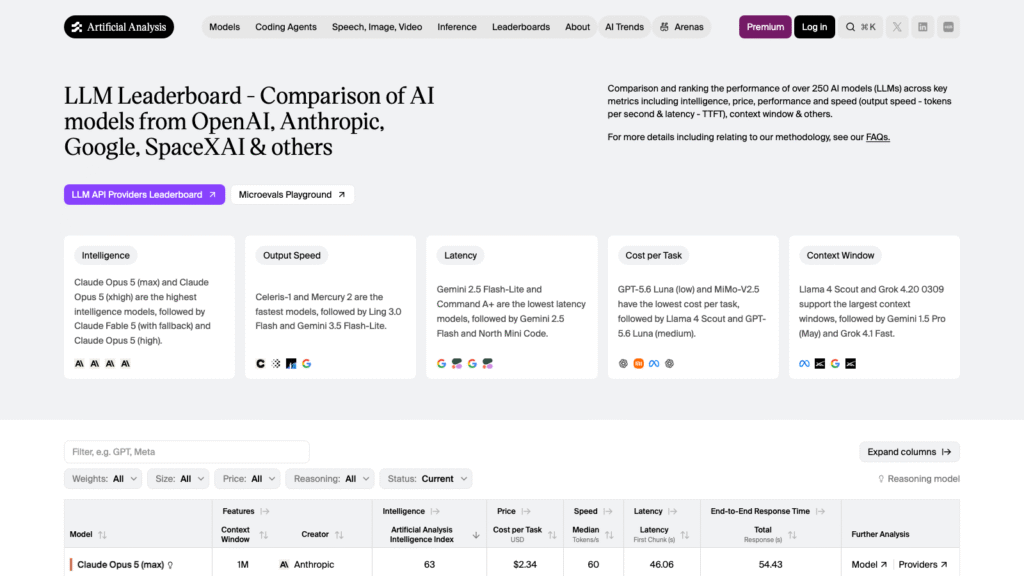
Sourcing note: product claims — one key across 200+ models, 0% markup pass-through, a free tier on /offers, sub-1ms prompt grading before routing, automatic failover, and per-request logs — are OrcaRouter’s own, from https://www.orcarouter.ai and its /offers and /pricing pages, checked August 22, 2026. No competitor (including OpenRouter) is linked, cited as a source of any statistic, or endorsed; no specific third-party free-model lists are quoted. The neutral leaderboard screenshot is from Artificial Analysis, checked August 22, 2026.