Selling a rare book isn’t the same as selling a used paperback. Condition, edition, and demand all play a much bigger part in what it’s worth, and the route you choose can make a real difference to both the final price and how long the process takes.
If you’re researching selling rare books, AbeBooks and WeBuyBooks are probably two names you will come across both services. They’re often mentioned alongside one another, but they’re not actually doing the same job. AbeBooks is a marketplace where sellers list books and wait for a buyer. WeBuyBooks is a buyback service that makes a direct cash offer instead.
Keep reading as we explain how each service works for rare books, what happens if your title doesn’t have an ISBN, and where the two genuinely differ when it comes to speed, effort, and payout.
Two Different Ways to Sell a Rare Book
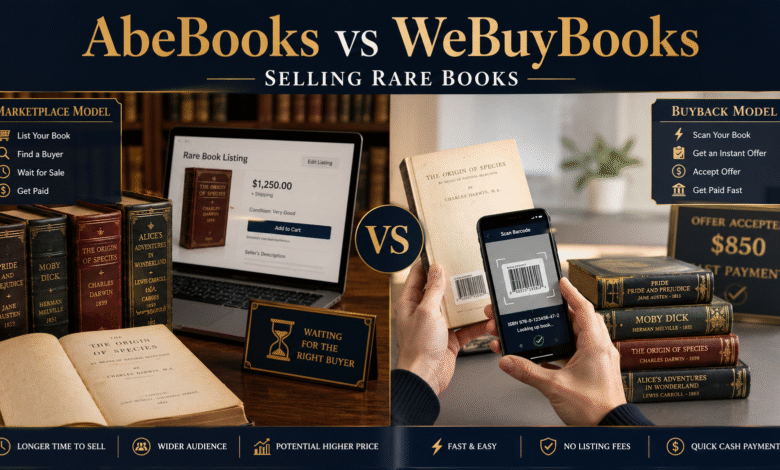
AbeBooks operates as a buyer-side marketplace. Sellers create a listing, set their own price, and wait for a collector to make a purchase. WeBuyBooks works differently. It’s a seller-side buyback service that offers a cash payment rather than a listing. Over the years, WeBuyBooks has paid out more than £38 million to UK sellers and processed over 28 million books, reflecting the scale of its buyback operation.
And that distinction matters because the two services follow completely different models. A marketplace relies on buyer demand matching a seller’s asking price, which can take weeks or even months. A buyback service completes the transaction in one go once a value has been agreed.
If you’re looking for ways to sell rare books in the UK, you’ll usually end up choosing between these two routes. The better option depends on whether you value complete control over pricing or a quicker, more straightforward sale.
Listing a Rare Book on AbeBooks
Every seller on AbeBooks creates their own listing for each book. That means describing the edition, noting any flaws, researching comparable copies, and setting a price based on what similar books have sold for. This is fine if you have one, but time consuming if you have ten books.
After that, it’s largely a waiting game. There’s no guaranteed timeframe because everything depends on a buyer deciding your copy is the one they want. Once it sells, you’ll need to package and ship the book yourself, and payment is released once the transaction has been completed.
For someone who understands the collector market and doesn’t mind managing the process, that level of control can work in their favour. If demand is strong, waiting for the right buyer could result in a better selling price.
Getting a Rare Book Assessed by WeBuyBooks
Books with an ISBN and barcode, including many first editions like Harry Potter, go through the standard app process for an instant valuation. Simply download the app, scan the barcode on the book (or enter the ISBN) and you’ll get an instant offer. Titles without a barcode follow a different route.
WeBuyBooks has a dedicated Antiquarian Team that manually assesses these books because a barcode scanner can’t value a title without an ISBN. Sellers submit details and photographs by email, and the team reviews the information before making an offer.
The company has published appraisal work covering Tolkien titles, Charles Dickens first editions, and Folio Society collections, which demonstrates experience with exactly the kinds of books an automated scanner can’t identify properly.
Understanding the No-ISBN and First Edition Process
It’s easy to assume that only a specialist marketplace can properly deal with books that don’t have a barcode. In reality, that’s not the case.
As a no-ISBN book buyer, WeBuyBooks sends these books to their human assessment team rather than relying on automated pricing. That review covers the same details a rare book dealer would consider, including edition points, publisher information, and print-run details provided with the submission. It’s worth checking the non-ISBN catalogue before sending a book, as your title may already be recognised.
Speed, Postage, and Payment Compared
This is where one of the biggest practical differences between the two services becomes clear. With AbeBooks, payment only happens once a buyer purchases your book. A listing could sell within a few days, or it could remain unsold for many months depending on demand.
WeBuyBooks removes that uncertainty. There’s no buyer to wait for, no listing to manage, and nothing to pay upfront. Postage is also free using prepaid drop off or collection, and payment is typically made by next working day bank transfer once the books have been checked.
Which Rare Books Suit Each Service?
Getting the best outcome usually comes down to matching the book to the right selling route rather than assuming one service is always better.
If you know the collector market well and you’re happy to wait for the right buyer, AbeBooks may achieve a stronger price for books with high specialist demand. For many sellers, though, certainty is worth more than chasing the highest possible figure.
WeBuyBooks is often the better fit for anyone who wants a straightforward transaction, particularly for ISBN-bearing first editions that can be valued instantly and for no-ISBN titles that the Antiquarian Team can assess without the seller having to research prices themselves.
Cookbooks, craft guides, and other specialist non-fiction can also perform well because niche demand often leads to stronger offers than more common fiction titles.
Verdict: AbeBooks or WeBuyBooks for Rare Books
AbeBooks suits sellers who want complete control over pricing and are happy to invest time creating listings, managing enquiries, and shipping books themselves.
WeBuyBooks is better suited to sellers who want one straightforward transaction and a definite outcome, whether the book has a barcode or not.
Neither service is inherently better for rare books. The right choice depends on whether you value control over price or certainty over timing, and how much time you’re willing to spend managing the sale.
Getting a Free Valuation for Rare Books with WeBuyBooks
AbeBooks and WeBuyBooks solve different problems for rare book sellers. One gives you more control over pricing, while the other offers a quicker, more predictable process for both ISBN and no-ISBN titles.
Whether you’re scanning a barcode or emailing details to the Antiquarian Team, getting a valuation only takes a few minutes and gives you a clear answer either way. If you’re unsure what your rare book is actually worth, that’s often the quickest way to find out.